Xia Baolong, the director of both the Hong Kong and Macao Work Office (HKMWO) of the Communist Party of China (CPC) Central Committee and the Hong Kong and Macao Affairs Office (HKMAO) of the State Council, said yesterday that the implementation of executive-led governance in the Hong Kong Special Administrative Region (HKSAR) and the Macau Special Administrative Regions (MSAR) is an essential requirement for safeguarding their constitutional order, ensuring the implementation of the principles of “Hong Kong people governing Hong Kong”, “Macau people governing Macau”, and a high degree of autonomy, and achieving efficient governance in the two SARs.
Xia made the remarks while delivering a speech during a thematic seminar in Beijing yesterday morning hosted by the Chinese Association of Hong Kong and Macao Studies (CAHKMS) about “Upholding and Improving Executive-led Governance to Promote Good Governance in the [Hong Kong and Macau] Special Administrative Regions”.
The HKMWO and HKMAO released Xia’s speech on their website yesterday.
A parallel session was set up in Hong Kong and Macau respectively where attendees listened remotely, by video link, to the speech delivered by Xia in Beijing.
The parallel session in Macau was held at the San Chok Un Guesthouse (“New Bamboo Mansion”) on Penha Hill, attended by dignitaries such as Chief Executive Sam Hou Fai, Central People’s Government Liaison Office in the MSAR Director Zheng Xincong, Deputy Foreign Ministry Commissioner Cheng Lei, Legislative Assembly (AL) President André Cheong Weng Chon, and Court of Final Appeal (TUI) President Song Man Lei.
In his speech, Xia noted that when hearing work reports from the chief executives of the Hong Kong and Macau special administrative regions (SARs) respectively in December last year, President Xi Jinping raised clear requirements for both SARs to uphold and improve their respective executive-led governance.
Xia said that Xi’s remarks have provided clear direction for the two SARs to ensure the implementation of their executive-led system, enhance governance effectiveness, and promote high-quality development.
Xia noted that executive-led governance, as a key principle in the design of the two SARs’ political systems under their respective Basic Laws, originates from the Constitution of the People’s Republic of China (PRC), serving as an institutional guarantee for the comprehensive and accurate implementation of the “One Country, Two Systems” principle.
Xia noted that the two SARs’ Basic Laws were drawn up in accordance with the nation’s Constitution, where a distinctive feature of their political systems designed by their Basic Laws is the implementation of executive-led governance, adding that this design fully reflects Chinese characteristics and the features of Hong Kong and Macau’s capitalist systems, complying with the “One Country, Two Systems” principle and the legal status of the two regions and possessing profound political, legal, and practical foundations.
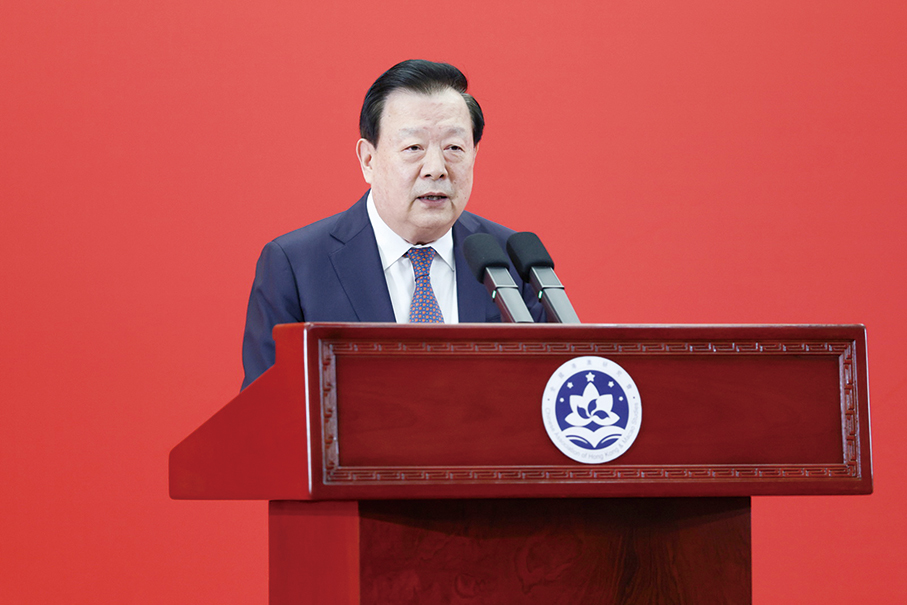
Xia Baolong, director the Hong Kong and Macao Work Office (HKMWO) of the Communist Party of China (CPC) Central Committee and the State Council’s Hong Kong and Macao Affairs Office (HKMAO), delivers a speech during yesterday’s seminar in Beijing hosted by the Chinese Association of Hong Kong and Macao Studies (CAHKMS). – Photo: HKMWO-HKMAO
Xia lays out executive-led governance’s 3 essential requirements
Xia said that the implementation of executive-led governance is an essential requirement for safeguarding the constitutional order of the two SARs. Xia noted that the two regions’ Basic Laws each clearly stipulate that the chief executive is the head of the SAR and its government who is accountable to the SAR and the Central People’s Government. Executive-led governance, Xia said, embodies the fundamental requirement for the chief executive to represent the entire SAR in being accountable to the central authorities, being conducive to properly handling the relationship between the central authorities and the SAR and maintaining its constitutional order.
Xia said that the implementation of executive-led governance is an essential requirement for ensuring the implementation of the principles of “Hong Kong people governing Hong Kong”, “Macau people governing Macau”, and a high degree of autonomy. In the design of the two SARs’ political system under executive-led governance, Xia said, the chief executives and the governments of the two SARs play a leading role, representing the fundamental interests of Hong Kong and Macau and the overall interests of their compatriots. This is the best form of governance for realising the principles of “Hong Kong people governing Hong Kong”, “Macau people governing Macau”, and a high degree of autonomy, Xia said.
Xia also said that the implementation of executive-led governance is an essential requirement for addressing the realities of Hong Kong and Macau and achieving efficient governance in the two SARs. Implementing executive-led governance and fully leveraging the leading role of the chief executives and the governments of the two SARs, Xia said, are conducive to enhancing the functionality and efficiency of the governance organs, uniting forces from all sides, flexibly responding to various risks and challenges, and maintaining the prosperity and stability of Hong Kong and Macau.
Xia underlined that the successful implementation of the executive-led system in the two SARs demonstrates its strong vitality and superiority. Since the return of Hong Kong and Macau to the motherland, Xia said, the two SARs’ chief executives, with the central government’s full support, have led the governments of the two SARs in implementing executive-led governance and uniting various segments of civil society to work hard, thereby maintaining the long-term prosperity and stability of Hong Kong and Macau and enabling the implementation of the “One Country, Two Systems” principle to achieve globally recognised success.
Xia outlines executive-led governance’s 5 advantages
Xia said that the experience since the return of Hong Kong and Macau to the motherland has proven that executive-led governance has the advantages of strengthening governance coordination and ensuring effective policy implementation, thereby effectively safeguarding the nation’s sovereignty, security, and development interests; the advantage of seizing opportunities and flexibly adapting to the real situation, thereby effectively promoting economic prosperity and development; the advantage of concentrating resources to accomplish major tasks while balancing the interests of all sides, thereby effectively improving people’s social welfare and well-being; the advantage of innovating and maintaining policy stability, thereby effectively enhancing international competitiveness and influence; and the advantage of quickly responding to the latest situation and handling it efficiently, thereby effectively addressing and resolving various risks and challenges.
Xia emphasised the need for the two SARs to follow the correct direction of the “One Country, Two Systems” principle, uphold and improve their executive-led systems, and continuously enhance governance effectiveness.
Overall, Xia said, executive-led governance has operated smoothly and effectively in the implementation of the “One Country, Two Systems” principle, particularly playing an important role in promoting Hong Kong’s transition from chaos to stability and from stability to prosperity, demonstrating strong institutional resilience.
However, Xia said, it must also be recognised that the implementation of executive-led governance in the special administrative region(s) has not always been smooth. For instance, Xia said, it once faced significant challenges in Hong Kong, providing profound lessons. Those against China and destabilising Hong Kong and external forces sought to hollow out and change the executive-led governance established by the HKSAR Basic Law, advocating for “separation of powers” to undermine the authority of the chief executive and the government of the HKSAR, thereby harming the authority of the central authorities and even resisting or rejecting the power of the central authorities.
Xia also said that the key to upholding and improving executive-led governance in the two SARs is that their chief executives and the governments must strengthen their sense of responsibility as the leaders of Hong Kong and Macau and effectively shoulder the responsibility as the primary persons accountable for the governance of Hong Kong and Macau.
Xia also said that the chief executive and the governments of two SARs must implement executive-led governance in all aspects of governance, striving to build efficient and effective governments. Under the leadership of the chief executives, all government entities must proactively strengthen top-level design and strategic planning for the development of the two SARs, align with the nation’s 15th Five-Year Plan, and enhance the foresight and initiative in the future development of Hong Kong and Macau.
Sam, the MSAR government’s five policy secretaries, Legislative Assembly (AL) President André Cheong and Court of Final Appeal (TUI) Song Man Lei issued separate statements on Xia’s speech to express their full support for his remarks.
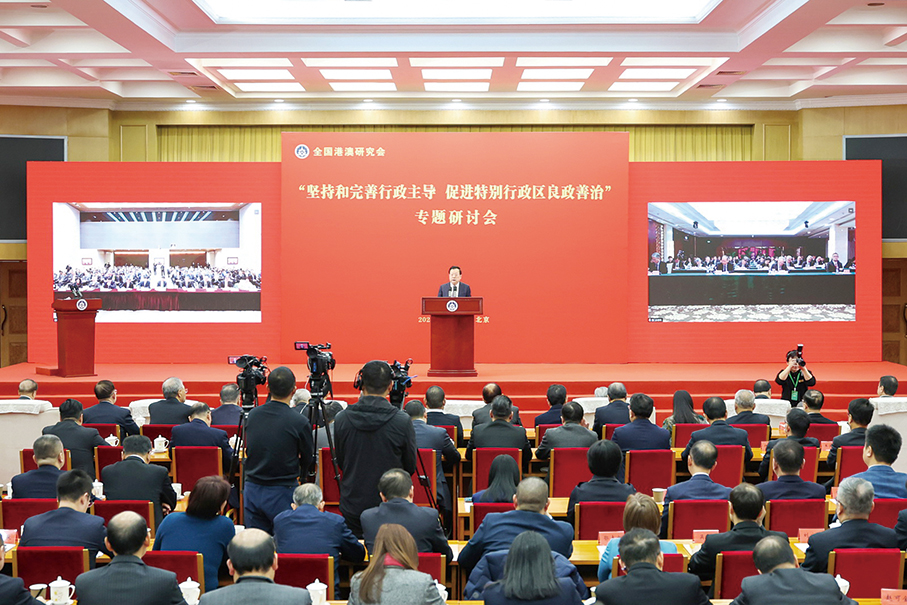
Attendees listen to Xia Baolong’s speech during yesterday’s thematic seminar about “Upholding and Improving Executive-led Governance to Promote GoodGovernance in the [Hong Kong and Macau] Special Administrative Regions”, with the parallel sessions in Hong Kong (left) and Macau being displayed on the stage by video link. – Photo: HKMWO-HKMAO