Xinhua writer Shen Anni
BEIJING – Earlier this year, Xin Minghua, a devoted fan of the “Ne Zha” animated films, journeyed all the way from Shanghai to Sichuan Province, just to visit Nezha Palace, a site dedicated to the legendary mythological figure.
“We heard there was a Nezha Palace here and thought it was interesting, so we came to see it for ourselves,” Xin said.
Visitor numbers at the Cuiping Hill scenic area in Yibin, where the palace was built in 1991, have surged since these movies became major hits, with attendance in 2025 tripling that of 2024 and a daily attendance peaking at 8,000, according to site operators.
The success of Chinese films is flowing beyond the big screen, driving a new wave of consumption across the country. From film-themed travel and spin-off merchandise to cinema equipment, box-office hits are opening up fresh avenues for economic growth.
Data from the China Film Administration (CFA) show that the country’s film industry had generated a total output of 817.26 billion yuan in 2025, placing it among the largest in the world. Each yuan earned at the box office is estimated to create 15.77 yuan of output in related industries, a figure also among the global leaders.
Experts say this impressive performance reflects not only the growing strength of China’s film sector, but also a broader shift from a box-office-driven model to a more diverse consumption economy.
That transition, notably, is being reinforced by policy support. In 2025, the CFA rolled out a series of “film-plus” initiatives nationwide.
“The film industry is taking practical steps to deepen integration with tourism, dining, technology, gaming and merchandise sectors,” said Luo Yang, deputy head of the CFA.
“Nobody,” an animated film inspired by the classic Chinese tale, “Journey to the West,” has emerged as a standout example of this transformation.
This film has seen the launch of more than 800 licensed products, generating nearly 2.5 billion yuan in retail sales. It has also secured IP licensing and co-branding deals with over 30 companies. One collaboration with a coffee chain proved especially successful, with sales of the themed drinks surpassing 5 million cups within just three days of launch.
“The Legend of Hei 2,” another animated blockbuster, has drawn large crowds to pop-up stores, thus boosting offline spending. Industry data reveal that for every yuan spent on a ticket, nearly five yuan is generated in related merchandise.
Beyond merchandise, films are sparking a tourism boom, with one movie after another turning entire cities into must-visit destinations.
In “Creation of the Gods II: Demon Force,” elements of Yin-Shang culture, the ancient culture centered in central China’s Anyang City, have become a magnet for visitors, boosting the city’s cultural tourism.
Xu Hejian, deputy curator of Anyang’s Yinxu Museum, said the museum has seen consistently high visitor numbers since the film premiered, with many visitors eager to track down the artifacts showcased on screen.
An official from the Anyang municipal government said the city plans to host a series of cultural and tourism activities over the Spring Festival holiday, with a total of 235 events scheduled.
China’s flourishing film industry is also driving growth in cinema technology and the expansion of movie theaters.
In 2025, orders for LED cinema screens in China jumped by roughly 50 percent compared with the previous year, cementing the country’s position as home to the world’s largest number of LED-equipped theaters. Nationwide, a total of 1,065 cinemas were newly built last year.
With virtual reality films now getting screening approval under China’s national film regulatory framework, many cinemas in 2025 took the lead in investing in a new generation of screening halls. Beijing’s 798 Hyper Vision, the country’s first virtual reality cinema, has welcomed around 63,000 visitors since opening in May last year.
Despite its rapid growth, China’s film economy still has significant room for expansion. According to a film industry report released in December last year, revenue from movie merchandise remained relatively low in China.
The Chinese market also faces a lack of stable, high-quality intellectual property and advanced industrial design and production capabilities, the report observed.
Even so, experts say China’s film industry, underpinned by a vast domestic market, a complete industrial chain and strong policy support, has moved beyond the phase of simply catching up in scale and is entering a new stage of quality-driven growth. The potential of film to promote China’s economic and social development is being realized at pace, with the film economy emerging as a powerful engine for upgrading the country’s service consumption sector.
“The film industry is building new forms of cultural business and a more diverse consumption ecosystem, reflecting the vast growth potential of China’s cultural economy and creating new drivers of economic growth,” said Zhu Di, a researcher at the Chinese Academy of Social Sciences.
– Xinhua
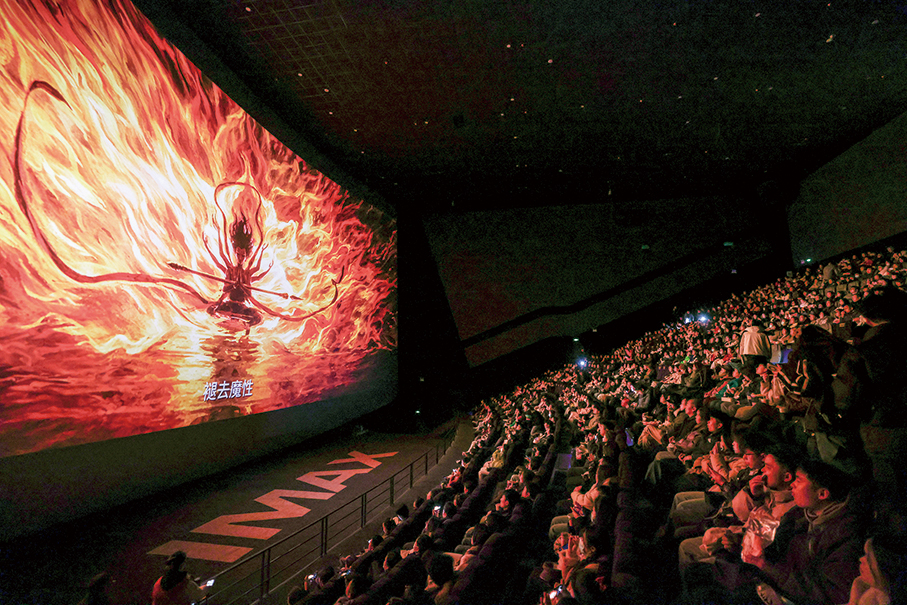
Spectators watch the Chinese animated film “Ne Zha 2” at a cinema in Guiyang, capital of Guizhou Province, on Feb. 25, 2025. Hitting cinemas during the Spring Festival holiday in 2025, “Ne Zha 2” shattered numerous records to become the world’s highest-grossing animated film. – Xinhua