10 pct of buses must be pure e-vehicles from 2032
The government has signed six-year service agreements with the city’s two public bus operators – Transmac and TCM – which will start on January 1, 2027, and are scheduled to end on December 31, 2032, according to which at least 10 percent of their respective fleets must be pure e-buses from January 1, 2032.
The two companies’ current six-year service agreements, which started on January 1, 2021, are scheduled to expire on December 31 this year.
The two new agreements were published in the Official Gazette (BO) yesterday.
Currently, most of the city’s public buses are extended-range e-vehicles.
According to specialist websites, extended-range electric vehicles have a plug-in battery pack and an electric motor, as well as an internal combustion engine. The electric motor is used for driving the wheels, while the internal combustion engine is only used as a generator to recharge the battery when it is depleted.
While pure e-vehicles are exclusively powered by an on-board battery pack, thereby generating zero emissions, extended-range e-vehicles still generate minimal emissions as they are equipped with a small internal combustion engine used as a generator to recharge the battery.
According to the latest available data on the website of the Transport Bureau (DSAT), at the end of the second quarter of this year, the two public bus operators had 964 vehicles in service, comprising 24 diesel buses, 25 natural gas buses, 911 extended-range e-buses, and four pure e-buses.
Natural gas buses, extended-range e-buses, and pure e-buses are all officially classified as new energy vehicles (NEVs); 97.5 percent of the city’s public buses were NEVs at the end of the second quarter.
According to the two agreements gazetted yesterday, the two public bus operators must ensure that at least five percent of their respective buses will be pure e-vehicles from January 1, 2030, and at least 10 percent of their respective buses will be pure e-vehicles from January 1, 2032.
Interchange discounts with LRT
Moreover, the new agreements require the two public bus companies to establish a fare system connected to the Light Rapid Transit (LRT), enabling passengers to enjoy interchange fare discounts between public bus and LRT rides.
The modus operandi of the interchange fare discounts will be drawn up by the government.
Community representatives have been calling for the implementation of fare discounts for rides between the two means of public transport with the aim of encouraging more residents to choose to use the LRT when out and about.
In 2025, according to official statistics, TCM and Transmac carried a record total of 231 million passengers – a daily average of 636,000 passengers, an increase of 1.81 percent from 2024.
The daily average number of public bus passengers during the first six months of this year stood at 665,100, a year-on-year increase of 6.12 percent.

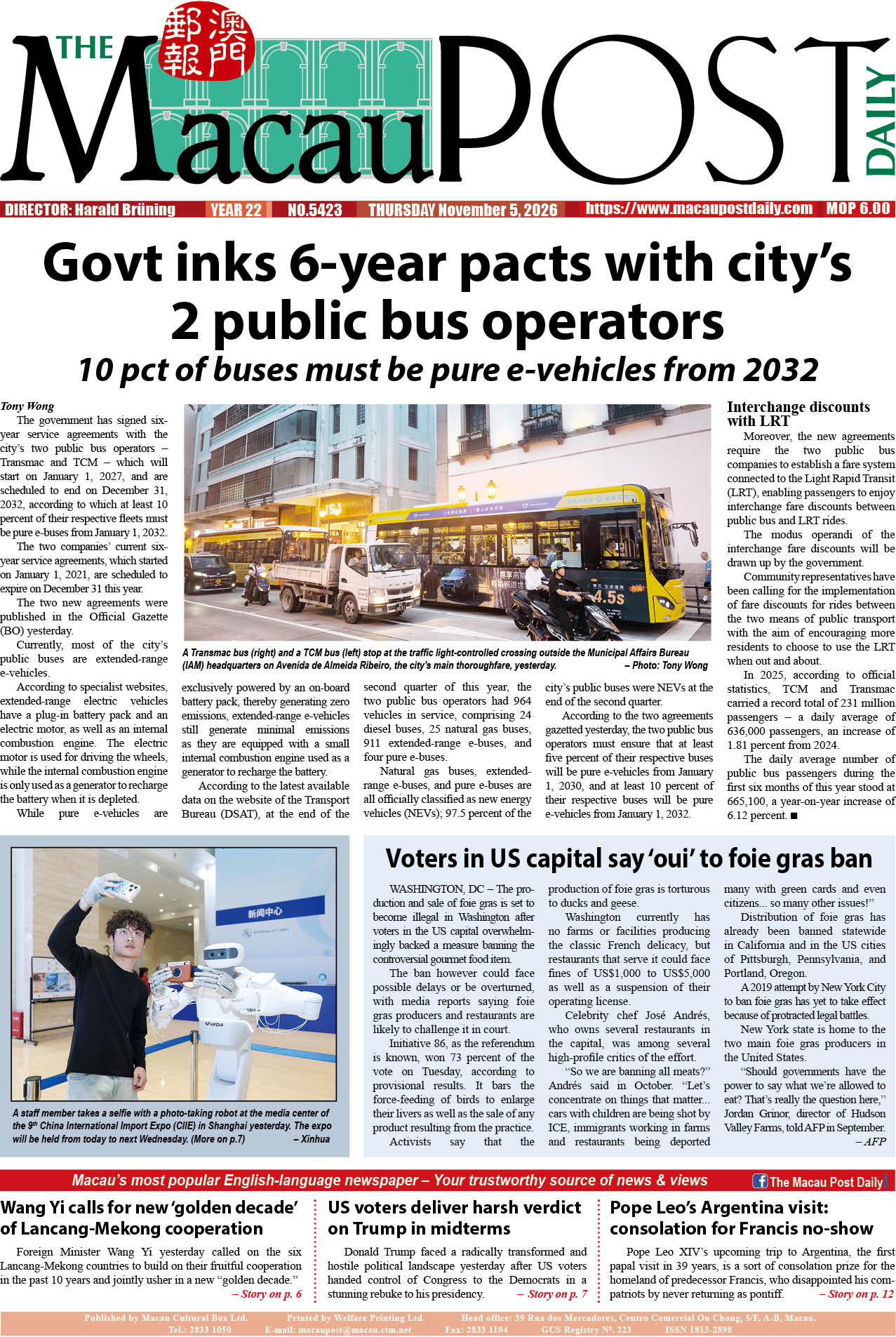
A Transmac bus (right) and a TCM bus (left) stop at the traffic light-controlled crossing outside the Municipal Affairs Bureau (IAM) headquarters on Avenida de Almeida Ribeiro, the city’s main thoroughfare, yesterday. – Photo: Tony Wong