The local government announced yesterday that it has finished drafting a bill regulating the operation of the Macau Special Administrative Region’s (MSAR) Committee for Safeguarding National Security, the organisational structure and operation of which are currently governed by an administrative regulation.
Government-drafted bills must be passed by the legislature to become law, while government-drafted administrative regulations, aka by-laws, do not require the legislature’s approval.
The government said yesterday that the bill proposes to list various new statutory functions and powers of the committee, which an administrative regulation cannot govern and must be regulated by a law.
Secretary for Administration and Justice Wong Sio Chak, who is also the spokesman for the government’s top advisory Executive Council, made the announcement during a press conference at Government Headquarters yesterday.
The bill will be submitted to the Legislative Assembly (AL) in due course for debate, review and vote. The government proposes that the bill, if passed by lawmakers in its final reading, will take legal effect on the day after its promulgation in the Official Gazette (BO).
The MSAR government set up its Committee for Safeguarding National Security in 2018 through an administrative regulation, which is tasked with various duties and functions such as coordinating the government’s various tasks concerning the safeguarding of the nation’s sovereignty, security and development interests; studying and evaluating the situation in Macau concerning national security and the city’s social stability; formulating local policies on the safeguarding of national security; and promoting work on improving the local legal system on safeguarding national security.
The Committee for Safeguarding National Security is chaired by the MSAR’s chief executive, with the secretary for security as its vice-chairman.
The committee has an office tasked with providing administrative support to the committee. The office is headed by the secretary for security.
Since its establishment in 2018, the committee’s administrative regulation was amended in 2021 adding the posts of a national security affairs adviser and three national security technical advisers appointed by the central government to the committee.
The national security affairs adviser, according to the administrative regulation’s current version, is tasked with supervising, guiding, coordinating, and supporting the MSAR in safeguarding national security, while the three national security technical advisers are tasked with assisting the national security affairs adviser and advising on matters pertaining to the duties and functions of the office of the committee.
The post of the National Security Affairs Adviser is held by the director of the Liaison Office of the Central People’s Government in the MSAR, while the three National Security Technical Adviser positions are filled by other officials from the Liaison Office
During yesterday’s press conference, Wong noted that under the guidance of the central authorities’ holistic approach to national security, the MSAR government set up its Committee for Safeguarding National Security in 2018 tasked with assisting the chief executive in policymaking for matters concerning the safeguarding of national security.
The central authorities’ holistic approach to national security lists various non-traditional threats to national security that the country is facing, in addition to the traditional ones.
Wong underlined that with the aim of further improving Macau’s legal system for safeguarding national security and strengthening the local government’s top-level structure concerning the city’s institutional system for safeguarding national security, it is necessary to more comprehensively define and regulate the functions and powers, organisational structure, and operation of the MSAR’s Committee for Safeguarding National Security through a law, as part of the local government’s commitment to firmly safeguarding the nation’s sovereignty, security and development interests and building a more solid barrier for national security.
Wong noted that the bill proposes to establish a law to comprehensively define and regulate the nature, duties, and powers of the Committee for Safeguarding National Security, as well as the composition including the committee’s chairman, national security affairs adviser, and national security technical advisers, as well as the administrative unit under the committee to be tasked with performing the committee’s daily functioning and execution of tasks.
Wong underlined that the future law will list various new statutory functions and powers of the committee, which an administrative regulation cannot govern and must be regulated by a law.
Since the Chief Executive Election Law and the Legislative Assembly Election Law were amended in 2024, the MSAR’s Committee for Safeguarding National Security has also been tasked with assessing whether chief executive election candidates uphold the MSAR Basic Law and bear allegiance to the People’s Republic of China (PRC) and the MSAR, as well as assessing whether legislative election candidates uphold the MSAR Basic Law and bear allegiance to the MSAR. However, these new duties are currently not formally listed in the current administrative regulation governing the committee’s operation.
Wong said yesterday that the bill proposes to formally list the committee’s new duties concerning its assessments of the qualifications of chief executive election candidates and legislative election candidates.
Wong noted that the future law will replace the current administrative regulation governing the committee.
Currently, it is the Judiciary Police (PJ) who provide administrative, financial and technical support to the operation of the committee and the office under the committee.
Wong said yesterday that the bill proposes that the composition of the Committee for Safeguarding National Security will include a standing secretariat to be tasked with the committee’s daily operations and functioning. He said that the standing secretariat will replace the current office operated under the committee. He said that the operation of the standing secretariat will be equipped with financial resources and government staff, in which case the committee’s operation will no longer need to be supported by the Judiciary Police.
Wong said that the proposed establishment of a standing secretariat under the committee will be of the same practice as its counterparts in the Chinese mainland and Hong Kong.
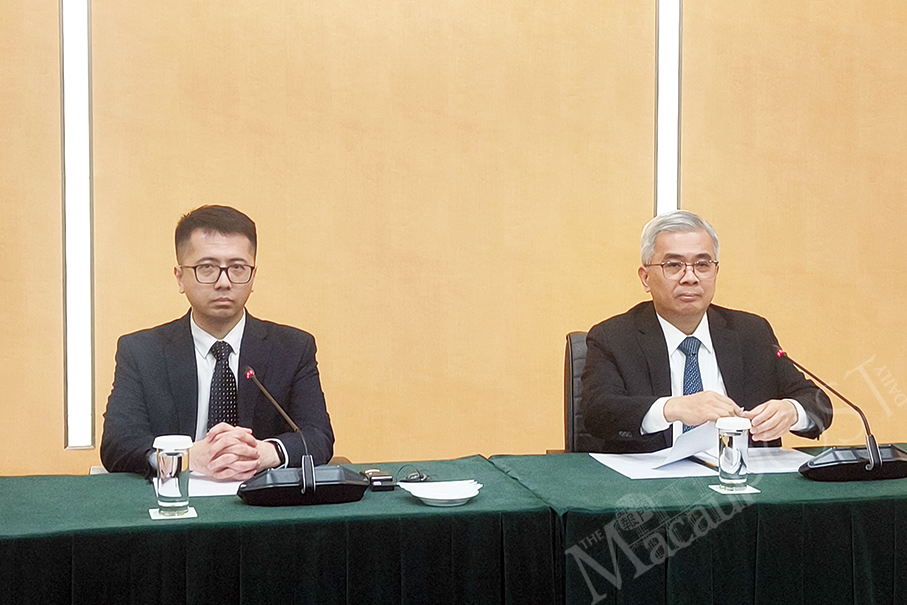
Secretary for Administration and Justice Wong Sio Chak (right) and his chief-of-cabinet Chang Cheong address yesterday’s Executive Council press conference at Government Headquarters. – Photo: Tony Wong