The Macau government has announced its decision to launch the Light Rapid Transit (LRT) East Line Extension project as soon as possible, while accelerating the planning and design of the LRT South Line.
The government has also decided to continue gathering public opinion more extensively on its proposed Seac Pai Van Extension before launching the project – a shift from its original proposal to designate the line as a short-term project.
The decisions follow the government’s assessment of public feedback collected earlier this year regarding its LRT expansion plan.
Circular network
On Friday, the Public Works Bureau (DSOP) held a press conference to announce the findings of its assessment of public feedback gathered earlier this year. The consultation concerned plans to expand the city’s LRT network across the short, medium, and long term. The expansion comprises six new lines which, together with existing lines, will form a circular LRT network.
The government’s LRT expansion plan is officially known as the “Strategic Study for the Development of the Macau Light Rapid Transit”. The public consultation period ran from January 23 to February 28.
6 new lines
The LRT expansion plan released earlier this year proposes six new lines:
Short term: East Line Extension and Seac Pai Van Extension.
Medium term: South Line, and the section of the West Line between the Qingmao pedestrian border checkpoint and the Fai Chi Kei waterfront.
Long term: The remaining section of the West Line (between the Fai Chi Kei waterfront and Barra), the Taipa North Line, and the Taipa Central Line.
The full version of the plan, available in Chinese and Portuguese, can be downloaded from its dedicated website (https://www.dsop.gov.mo/public/event/lrt2026/).
Existing network
Macau’s LRT system currently comprises three operational lines: the Taipa Line, the Seac Pai Van Line, and the Hengqin Line. The Taipa Line serves Taipa and Cotai, with an extended section connecting to the peninsula’s Barra Station through the lower enclosed deck of the Macau-Taipa Sai Van Bridge.
The Seac Pai Van Line connects the Taipa Line’s Cotai section with Coloane’s sprawling Seac Pai Van public housing neighbourhood, while the Hengqin Line connects the Cotai section with the Macau-side zone of the Hengqin joint checkpoint.
Currently, the only ongoing LRT construction is the East Line project, which connects the Barrier Gate checkpoint at the peninsula’s northern tip to the Taipa Ferry Terminal via the Zone A and Zone E1 land reclamation areas. The East Line will cross the sea between Zone A and Zone E1 through an undersea tunnel. It is scheduled to come into service in 2029.
Proposed route details
According to the LRT expansion plan, the proposed East Line Extension would run from the Barrier Gate checkpoint to the Qingmao checkpoint, where the proposed West Line would begin. This means the East Line Extension and the West Line would connect at Qingmao Station.
The East Line Extension would also feature a spur line running to a future sports park, located on the plot of land currently occupied by the now-defunct greyhound racetrack (Yat Yuen Canidrome). The entire 1.5-kilometre East Line Extension will be built underground.
The 2.1-kilometre-long Seac Pai Van Extension would run between Coloane’s Seac Pai Van public housing neighbourhood and Coloane Village. Two intermediate stations would be set up: one near the Giant Panda Pavilion in Seac Pai Van Park, and another near the Lai Chi Vun shipyards area. This entire extension would be an elevated line.
The proposed South Line would run from the Hong Kong-Zhuhai-Macao Bridge (HZMB) Macau checkpoint to the future ES5 station in the southern area of Zone A (a station on the ongoing LRT East Line project). From there, it would run to Nape, featuring two stations (one near the waterfront Kun Iam statue and another near Avenida 24 de Junho), before continuing to the Nam Van Lake district with a station near Plot A9. It would then head to the Sai Van district with a station near Macau Tower, before finally arriving at Barra.
Plot A9 is an undeveloped waterfront site situated between AIA Tower and the Nam Van Peninsula residential building. Most of the 7.7-kilometre-long South Line would be built underground and underwater, though the section on the HZMB man-made island will be elevated.
The proposed West Line would run from the Qingmao checkpoint to the Fai Chi Kei waterfront, and then along the Inner Harbour to Barra. The 3.7-kilometre line would be built underground and underwater along the Inner Harbour, with stations in the Patane district, near Avenida de Almeida Ribeiro (the city’s main thoroughfare, commonly known as San Ma Lou in Cantonese), and near the Praia do Manduco neighbourhood (known as Ha Van in Cantonese).
The proposed Taipa North Line would run from the future ES6 station in Zone E1 (a station on the ongoing LRT East Line project, to be known as Pac On Station) to the future Zone D land reclamation area, onwards to the current Zone C land reclamation area (reclaimed but not yet developed), and finally to the existing Ocean Station near the Ocean Gardens residential neighbourhood. The 3.9-kilometre line would be built underground and underwater.
The proposed Taipa Central Line would run from the future Zone D land reclamation area to near Estrada Almirante Marques Esparteiro in Taipa, through to Taipa Central Park, and connect to the existing Jockey Club Station on the Taipa Line. The 2.2-kilometre line would also be built underground and underwater.
Seac Pai Van Extension draws most attention
According to Friday’s press conference, the government received 805 opinions during the public consultation period, 772 of which were classified as relevant to the LRT expansion plan and deemed valid for assessment.
Data from the press conference revealed public interest was distributed as follows:
Seac Pai Van Extension: 30 per cent of relevant opinions
South Line: 16 per cent
East Line Extension: 15 per cent
West Line: 15 per cent
Taipa Central Line: 13 per cent
Taipa North Line: 12 per cent
Some 92 per cent of all relevant opinions were classified as positive, with the remainder classified as negative. Compared to the other proposals, the Seac Pai Van Extension received the lowest proportion of positive feedback, accounting for 84 per cent of the total opinions raised for that specific line. By contrast, positive feedback accounted for 95 per cent to 96 per cent of the opinions raised for each of the other five lines.
The negative feedback regarding the Seac Pai Van Extension primarily focused on:
The potentially adverse impact of the proposed elevated structures on the landscape and visual environment.
Construction and operational noise affecting residential households.
Potential ecological impacts.
Privacy and fire safety concerns due to the elevated tracks being located too close to residential buildings.
Addressing the media, DSOP Director Lam Wai Hou stated that after assessing public feedback alongside the city’s current infrastructure capabilities, the government is committed to launching the LRT East Line Extension project as soon as possible, while fast-tracking the planning and design of the LRT South Line.
Lam noted that the main LRT East Line is scheduled to open in 2029. He pointed out that because jurisdiction over the V-shaped area southeast of Zhuhai’s Gongbei checkpoint was transferred from Zhuhai to Macau in 2024, the East Line Extension project can commence as soon as its final design is completed.
Lam added that the proposed South Line received widespread support, and current infrastructure conditions on the HZMB man-made island make it feasible to launch the project in the short term. He stressed that space for an LRT station had already been reserved when the HZMB Macau checkpoint was built, and structural piles for the future station’s platform have already been completed.
When asked by reporters about the decision to delay the Seac Pai Van Extension until after the East Line Extension and South Line projects, Lam noted that the Seac Pai Van Extension drew the highest amount of public scrutiny and the largest share of negative feedback.
Lam clarified that should the Seac Pai Van Extension go ahead in the future, greater care will be needed to address community concerns regarding its design and route. Consequently, the government has decided to prioritise the East Line Extension and the South Line in the short term.
However, Lam emphasised that the government does not plan to shelve the Seac Pai Van Extension. Instead, more work will be carried out to gather public opinion more extensively before any construction begins.

Public Works Bureau (DSOP) Director Lam Wai Hou (second from left) and other officials address Friday’s press conference at the Transport Bureau Building on Estrada de D. Maria II. – Photo: DSOP
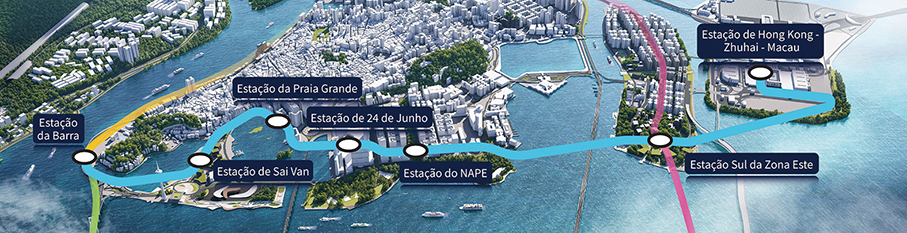
This diagram released by the government in January shows the proposed South Line’s stations.