The Legislative Assembly (AL) yesterday passed a government-initiated bill establishing a legal system to formally govern the use of the Macao Special Administrative Region’s (MSAR) coastal waters.
The new law, which takes effect on December 1 this year, includes a system for granting private entities concessions or permits to use designated maritime areas for specified periods of time.
The legislation is officially titled the Law on the Use of Maritime Areas.
The outline of the bill was passed during a plenary session in April, after which it was reviewed by the legislature’s 3rd Standing Committee. It was resubmitted to yesterday’s plenary session – attended by Secretary for Transport and Public Works Raymond Tam Vai Man – where it was voted on article by article in its second and final reading.
Under the new law, concessions will be granted to private entities to use maritime areas for infrastructure requiring long-term operations. Concessions will last between 2 and 15 years and can be renewed for up to five years each time.
Maritime projects permitted under a concession include:
1. Facilities to serve the nation’s overall interests, particularly safeguarding national security;
2. Facilities to ensure the provision of essential public services, such as telecommunications, electricity, fuel, and tap water;
3. Facilities determined by the chief executive as making major contributions to Macau’s socioeconomic development;
4. Facilities used for vessel docking and their respective navigation channels.
In general, public tenders will be required to grant concessions. However, tenders will be exempt for projects under categories (1) and (2). Furthermore, the government may decide whether to exempt tenders on a case-by-case basis for projects under categories (3) and (4).
In contrast, a “temporary permit” will be granted to private entities using a maritime area for short-term projects. Temporary permits will last up to two years and can also be renewed for up to two years each time.
Under the new law, private entities will be required to pay for the use of maritime areas.
Once a concession is terminated or revoked, facilities set up in the maritime area will generally revert to the MSAR without compensation, free of liability, and free of encumbrances. However, the chief executive may instead require private entities to remove the facilities.
Conversely, after a temporary permit is terminated or revoked, private entities must generally remove their facilities. However, the chief executive can require that facilities remain, in which case they will revert to the MSAR without compensation, free of liability, and free of encumbrances.
During yesterday’s plenary session, Tam noted that the government is still drafting criteria to determine usage fees for maritime areas. Under the law, these fees will be set via an executive order issued by the chief executive.
On December 20, 2015, marking the 16th anniversary of the establishment of the MSAR, the Central People’s Government granted Macau formal jurisdiction over 85 square kilometres of its surrounding coastal waters. Previously, unlike Hong Kong, Macau did not have formal jurisdiction over its coastal waters. Macau’s current land area stands at 33.4 square kilometres.
Subsequently, in July 2018, Macau enacted its framework law on coastal water management, officially known as the Maritime Areas Management Framework Law.
The 2018 framework law stipulates that Macau’s coastal waters are state-owned and that the Central People’s Government authorises the MSAR government to exercise administrative power over them. The framework law required the local government to draft specific laws and regulations for managing these waters, enabling the MSAR government to grant concessions, permits, or other official approvals – a mandate fulfilled by the bill passed yesterday.
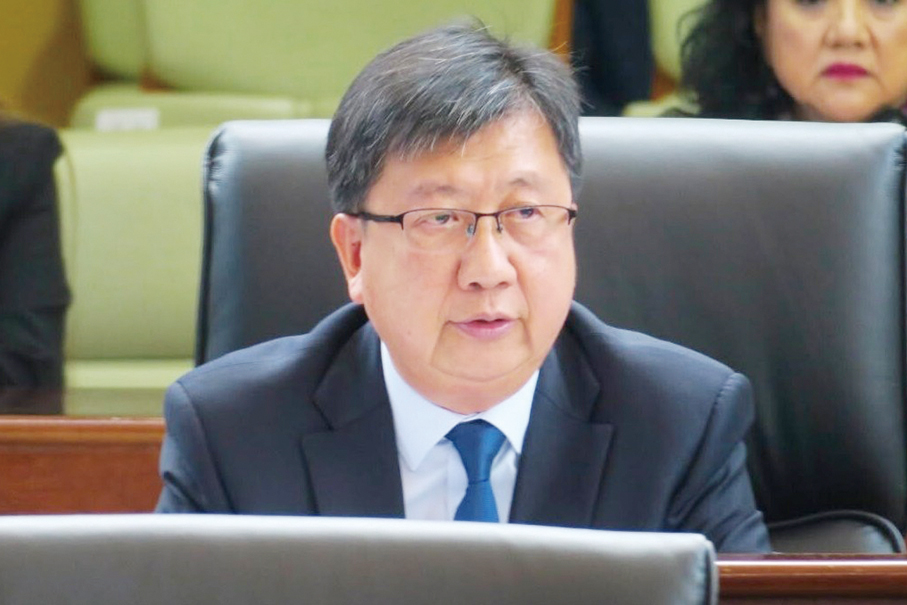
Secretary for Transport and Public Works Raymond Tam Vai Man addresses yesterday’s plenary session in the Legislative Assembly’s (AL) hemicycle. – Photo courtesy of TDM