A research team led by Hu Yuanjia from the public University of Macau (UM) published a study in Nature Biotechnology analysing the global patent landscape of optogenetics, outlining technological developments, industrial challenges and future clinical prospects for the emerging biotechnology field, according to a UM statement on Wednesday.
The research was conducted by scientists from the university’s Institute of Chinese Medical Sciences and the State Key Laboratory of Mechanism and Quality of Chinese Medicine, in collaboration with Zhang Yanfei from the Tianjin Institute of Industrial Biotechnology, the statement said.
According to the study, optogenetics is a biotechnology that uses photosensitive proteins to regulate cellular activity with high precision, enabling biological processes to be controlled at the millisecond and single-cell levels, the statement noted. Originally focused on neuroscience, the technology has expanded into synthetic biology, natural product biosynthesis and clinical medicine, the statement added.
The team analysed 332 patent families and found that global optogenetics patent applications peaked in 2019 before declining significantly afterwards, the statement said, highlighting that blue light-activated optogenetic tools accounted for 41 percent of innovations and have been widely applied in clinical medicine and cell biology.
Researchers identified retinal disease treatment as the most advanced area of clinical translation, with 11 clinical trials registered by the end of 2023, according to the statement.
However, the study noted that no optogenetics-related products have yet received market approval, highlighting ongoing challenges in industrialisation and clinical application, the statement said.
The researchers said major technical limitations include restricted tissue penetration, limitations in photosensitive protein performance and long-term expression stability, as well as insufficient safety data for human applications, the statement said, pointing out the absence of adaptive regulatory frameworks and increasing ethical concerns.
According to the statement, the study suggested that future breakthroughs may depend on multidisciplinary integration, combining optogenetics with technologies such as calcium channel regulation, upconversion luminescence* materials and organoid systems to develop more clinically feasible therapeutic models.
The researchers also noted renewed momentum in the sector, with optogenetics-related patent publications increasing again in 2024 and 2025 after a decline in 2023, the statement said, noting that new oncology-related patents involving light-controlled immune cell infiltration and near-infrared light-regulated immune pathways were highlighted as emerging areas of interest.
The study added that the number of related clinical trials has now increased to 16. Among them, MCO-010, developed by US company Nanoscope Therapeutics, has completed a Phase IIb clinical trial and has begun a rolling Biologics License Application submission to the US Food and Drug Administration.
The research was supported by multiple funding bodies including the Science and Technology Development Fund (FDCT) and UM.
*Upconversion luminescence is an optical process where a material absorbs two or more low-energy photons (such as near-infrared light) and emits a single, higher-energy photon (such as visible or ultraviolet light) - DeepSeek
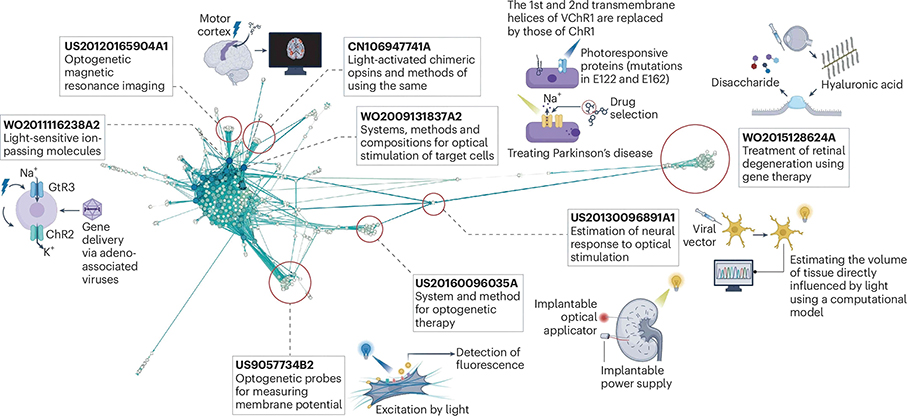
This infographic provided by the public University of Macau (UM) yesterday shows the technology flow and cluster distribution of optogenetics.