Macau’s Environmental Protection Bureau (DSPA) has announced that the government intends to increase the proportion of clean energy sourced from external power purchases to 50 percent.
The government-appointed Central District Community Service Consultative Council held its regular monthly meeting yesterday at the Patane Activity Centre on Avenida de Demétrio Cinatti. The council invited Chan Mei Pou, head of the bureau’s Environmental Planning and Assessment Department, and senior official Un Pui Kei to discuss the implementation of the “Macau Long-term Decarbonisation Strategy”.
In a post-meeting press briefing, council deputy convenor Pui Seng In cited a DSPA statement – released to councillors during a closed-door session – as stating that Macau’s carbon emissions stem primarily from electricity supply and land transport. Together, these sectors account for over 80 percent of total emissions.
Pui noted that to align with the national “Dual-Carbon Goals” (Carbon Peaking and Carbon Neutrality), the authorities aim to achieve carbon peaking before 2030. The electricity and land transport sectors are specifically targeting near-zero emissions before 2050.
According to the DSPA website, the strategy encompasses electricity, land transport, energy conservation in buildings, clean energy replacement, and waste treatment. The initiative aims to encourage all relevant sectors to weigh emission reduction benefits when formulating policy, while guiding the public towards a greener society.
Regarding electricity supply, councillor Chan Meng Kei said that Macau’s local power plant now operates entirely on natural gas, with fuel oil units reserved solely for emergency backup. Chan added that later this year the local government will begin negotiations with China Southern Power Grid (CSG) to renew their cooperation framework. These talks will include plans to increase the share of clean energy in imported electricity to 50 per cent, supporting the goal of carbon neutrality by 2050.
Turning to land transport, Chan noted that the bureau has improved charging infrastructure, introduced subsidy schemes, and reduced e-vehicle charging fees twice.
Chan pointed out that as of February this year, the number of electric motorcycles has risen from 390 (prior to the 2022 launch of the current plan) to 6,700 – a 17-fold increase.
Furthermore, the share of newly purchased light electric vehicles and motorcycles among residents has risen from 2.0 percent before the plan’s introduction to nearly 50 percent.
The bureau will continue to adjust the ratio of fast-to-slow charging points* and install more points for electric motorcycles. Construction is also underway on a supercharging station in Cotai, which is expected to be completed by mid-year, Pui said.
*In a technical context, the term refers to the numerical relationship between high-speed chargers and standard-speed chargers within a specific network. – Gemini
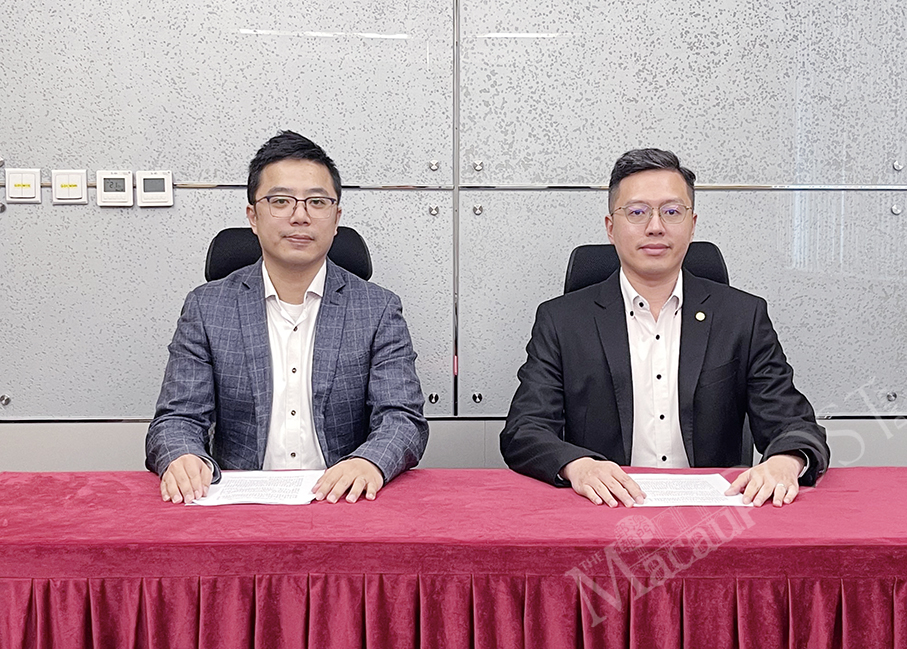
Central District Community Service Consultative Council Deputy Convenor Pui Seng In (left) and fellow councillor Chan Meng Kei look on during yesterday’s press briefing after the government-appointed council’s closed-door meeting at the Patane Activity Centre on Avenida de Demétrio Cinatti. – Photo: Armindo Neves