Analysis
BEIJING – China’s economy grew by 5.0 percent in 2025, in line with official targets, bringing the country’s 14th Five-Year Plan period (2021-2025) to a steady close amid rising global uncertainties.
The world’s second-largest economy saw its gross domestic product (GDP) reach a record of 140.19 trillion yuan last year, the National Bureau of Statistics (NBS) said yesterday.
The economy’s fourth-quarter performance also firmed, expanding 4.5 percent from a year earlier and growing 1.2 percent from the previous quarter.
Facing abrupt changes in the external environment and mounting domestic difficulties and challenges, China adopted more proactive and effective macro policies. This approach has helped offset adverse external shocks and stabilize the foundation for development in the face of headwinds, Kang Yi, head of the NBS, told a press conference.
“For a super-large economy like China, achieving such stable development is by no means easy amid intertwined risks and challenges,” Kang noted.
Looking globally, China has maintained a growth rate that ranks among the highest of major economies, serving as one of the most stable and reliable engines of world economic growth, with its contribution to global growth expected to be around 30 percent, he added.
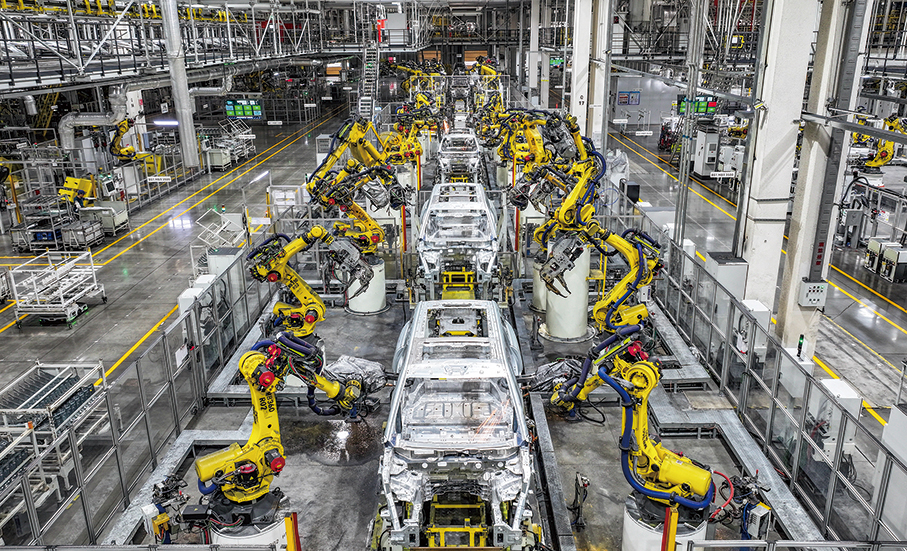
This drone photo shows the robotic production line at the Seres Super Factory in Liangjiang New Area, Chongqing Municipality, on September 19, 2025. Seres is an electric vehicle (EV) manufacturer. The term “Super Factory” typically suggests advanced manufacturing capabilities, often involving automation and innovation. – Xinhua
STABILITY UNDERPINNED BY POLICY
“Stability was a defining feature of China’s economy in 2025,” Kang said.
Consumption played a more pronounced “ballast” role as the country shifted toward making domestic demand the main engine and stabilizing anchor of economic growth.
Total retail sales of consumer goods topped 50 trillion yuan, rising 3.7 percent from a year earlier and consolidating China’s position as one of the world’s largest retail markets. Online retail sales climbed 8.6 percent as e-commerce and new sales channels continued to expand.
Service consumption added support. Service retail sales grew 5.5 percent, and service-related spending accounted for 46.1 percent of per-capita consumption expenditure in 2025.
Final consumption expenditure contributed 52 percent of overall economic growth, up by five percentage points compared to a year earlier, making it “the main driver and a stabilizing anchor of economic growth,” Kang said.
Policymakers reinforced the recovery with a slew of pro-consumption measures throughout the year, including a 500-billion-yuan re-lending facility aimed at boosting service consumption and elderly care, alongside a nationwide initiative funded by ultra-long special treasury bonds to support consumer goods trade-in programs.
Elitza Mileva, the World Bank’s lead economist for China, recently noted that the country’s proactive policies aimed at boosting household consumption, including raising pension benefits and providing childcare subsidies, would strengthen the social safety net, reduce precautionary savings and exert a more sustainable impact on driving domestic consumption.
Yesterday’s data also revealed a clearer shift in the country’s industrial sector toward new growth drivers. Notably, equipment manufacturing and high-tech manufacturing accounted for 36.8 percent and 17.1 percent of value-added industrial output, respectively.
The added-value of the manufacturing sector reached 34.7 trillion yuan in 2025, up 6.1 percent year on year, keeping its share of GDP at around 25 percent. China is expected to remain the world’s largest manufacturing country for the 16th consecutive year.
Such resilience was underpinned by a proactive stance on macro policy. Last year, the country cut the reserve requirement ratio by 0.5 percentage points and lowered a key policy rate by 0.1 percentage points, moves aimed at reducing financing costs and keeping liquidity ample.
On the fiscal side, authorities issued 1.3 trillion yuan in ultra-long special treasury bonds and established new policy tools to energize investment.
Authorities also took targeted steps to stabilize key sectors and support employment. In the property sector, efforts included credit-related policies and assistance for developers and homebuyers, while the government’s emphasis on job creation helped keep the labor market broadly stable.
MOMENTUM SET TO HOLD
Looking ahead, policymakers have signaled a more proactive stance in 2026 to cement the recovery. At December’s Central Economic Work Conference, Chinese leadership put expanding domestic demand at the top of economic priorities in 2026 and reiterated a focus on high-quality development.
Policy support is already on the way, with 62.5 billion yuan in ultra-long special treasury bond funds front-loaded to back this year’s trade-ins for consumer goods.
Monetary policy also remains supportive. Last week, the People’s Bank of China (PBOC) announced a 0.25-percentage-point cut to the interest rates on all structural monetary policy tools. The rate cuts for re-lending and re-discount facilities took effect on Monday.
The central bank has also indicated that there is room to further cut interest rates and the reserve requirement ratio this year.
Meanwhile, the PBOC unveiled additional monetary and financial measures, including a dedicated 1-trillion-yuan re-lending quota for private enterprises and a move to lower the minimum down payment ratio for commercial property mortgages to 30 percent.
“China’s economy has shown notable resilience despite facing multiple shocks in recent years,” said Sonali Jain-Chandra, who led an International Monetary Fund (IMF) team that visited Beijing and Shanghai last month.
Liu Jing, chief economist for Greater China at HSBC, expects China in 2026 to stay on a path of structural transformation and achieve appropriate growth, with domestic demand, including both consumption and investment, providing the primary impetus amid a more balanced import-export mix.
“Over the medium to long term, service consumption will be a more critical growth driver,” Liu was quoted last month by Shanghai Securities News as saying. HSBC forecast a recovery in fixed-asset investment, led by a strong rebound in infrastructure investment from early 2026.
It also sees innovation capacity becoming another key advantage of the country – alongside its massive production base and ultra-large-scale market – which has the potential to further attract foreign investment. – Xinhua