The inaugural Startup Fest Macao 2026 opened at the Macau Tower Convention & Entertainment Centre yesterday, bringing together startups, technology companies and investors for a three-day business-to-business expo, with sustainability and smart hospitality among the topics highlighted by Macau Hotel Association Vice Chairman Rutger Verschuren.
Organised by the Macao Startup Club and co-organised by 369 Co-op Town, the event features 60 startups and established companies from the Chinese mainland, Hong Kong, Macau, China’s Taiwan region, Malaysia, Thailand, the United Kingdom and the United States.
According to a statement by the organisers yesterday, the expo is supported by more than 30 organisations, including the Economic and Technological Development Bureau (DSEDT), the Commerce and Investment Promotion Institute (IPIM) and the Macao Government Tourism Office (MGTO). Organisers expect more than 2,500 visits, with a programme featuring 12 summit forums, seven thematic seminars and around 50 local and non-local speakers, the statement noted.
In his welcome remarks at a business lunch at Artyzen Grand Lapa Macau in Nape yesterday, Macao Startup Club President James Si Tou said that government support had helped businesses and startups of different types emerge, contributing to a more diversified and mature entrepreneurial ecosystem. He said the organisers hoped to continue working with the government and industry to create opportunities for local entrepreneurs.
Macao Startup Club Chairman John Ku (顧銘恆) said that the expo aimed to connect industries, technology and products, helping businesses apply new tools to improve productivity. Its themes include smart manufacturing, the low-altitude economy, cybersecurity, cultural tourism, MICE (Meetings, Incentives, Conferences, and Exhibitions) and entertainment, in line with the local government’s “1+4” development strategy for appropriate economic diversification.
The event also introduced SMART PASS, an intelligent platform combining electronic business cards and business matching, allowing participants to connect by scanning codes at the venue.
In his keynote address, Verschuren highlighted how established businesses could work with startups to introduce sustainable and technology-driven solutions. Drawing on the experience of Artyzen Grand Lapa Macau, which opened – under a different name – in 1984*, he said the hotel had remained in operation for more than four decades because it continued to adapt. “If we had not changed and kept up with the times, this building would just be rubble by now,” Verschuren said.
Verschuren described the hotel as a living laboratory for sustainability and smart hospitality, inviting local startups to develop and test solutions in areas including energy and building management, food waste, guestroom technology and reducing single-use items. He noted that last year, Artyzen became the first hotel in Macau to receive LEED Gold certification for Operations and Maintenance from the US Green Building Council. It also received several environmental recognitions this year, including the Macao Green Hotel Silver Award.
The hotel is also exploring solar energy applications and AI-based room controls, while working towards an international smart-building certification covering connectivity, building systems, guest experience and cybersecurity. Verschuren said that hotels could provide a practical testing environment because solutions could be assessed through real guests, kitchens and building systems. He added that technology could help address staffing challenges in Macau’s hospitality sector, particularly by automating repetitive tasks such as data entry and routine enquiries. However, he stressed that technology should support employees rather than replace them.
“A guest remembers the person who welcomed them, not the system behind it,” Verschuren said.
Verschuren also cautioned startups against greenwashing, saying businesses should be able to provide evidence to substantiate claims about sustainable products and supply chains. He highlighted the importance of traceability, while noting that digital records were only reliable when the information entered into them was accurate. “Honest numbers beat big claims,” he said.
Following the opening ceremony, a summit forum titled “AI Reshaping the Future: New Opportunities and Challenges for Youth Entrepreneurship in Macao” brought together representatives from Alibaba Cloud, Kingdee, Shenzhen Xizhiyue and BrainCo, the statement noted.
*Over the decades, the hotel has operated under several different names:
The Excelsior (1984): It originally opened under the Excelsior brand, which was part of Mandarin International Hotels (the precursor to Mandarin Oriental).
Oriental Hotel / Mandarin Oriental, Macau: Shortly after opening, it was renamed the Oriental Hotel, and following the group’s corporate rebranding, it became the well-known Mandarin Oriental, Macau—a name it held for over two decades.
Grand Lapa, Macau (2009): In August 2009, ahead of the opening of the new Mandarin Oriental property at One Central (which opened in 2010), the original Avenida da Amizade hotel was rebranded as Grand Lapa, Macau (drawing inspiration from Lisbon’s Lapa district), though it continued to be managed by the Mandarin Oriental Hotel Group until early 2014, when management transitioned to Artyzen Hospitality Group (a subsidiary of Shun Tak Holdings).
Artyzen Grand Lapa Macau (2021): On January 1, 2021, the property underwent a further rebrand to incorporate the Artyzen flagship name. – Gemini
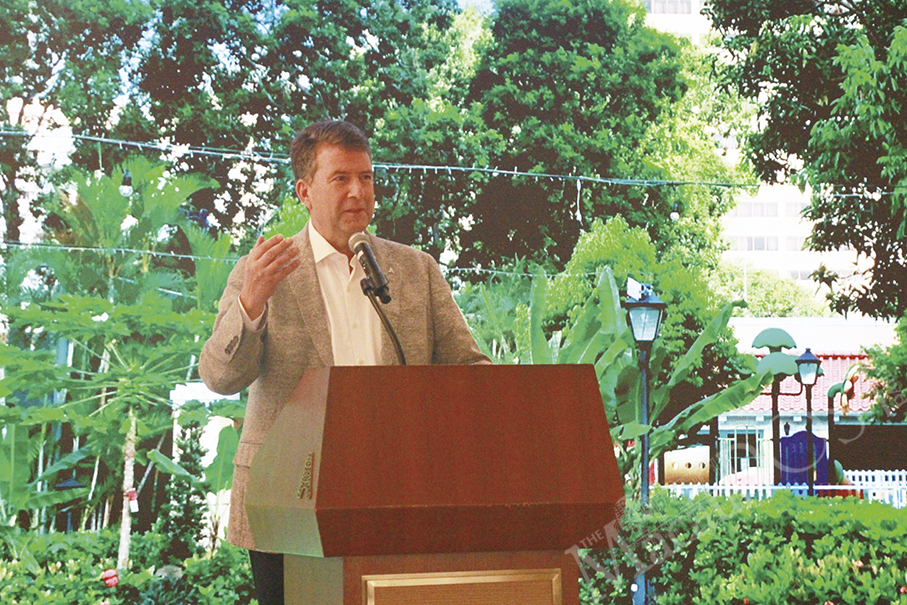
Macau Hotel Association Vice Chairman Rutger Verschuren addresses yesterday’s “Startup Fest Macao 2026” business lunch at Artyzen Grand Lapa Macau’s Chinnery Ballroom in Nape. – Photo: Khalel Vallo