The government yesterday launched a programme encouraging restaurants across the city to offer healthy menus tailor-made for senior citizens, with the aim of making it easier for them to access healthy dishes when dining out.
Restaurants offering at least three healthy dishes suitable for the dietary needs of senior citizens – including ease of chewing, safe swallowing, and deboning – are eligible to join the programme.
The government said yesterday that the programme – officially named Healthy Meals Plan for Elderly Persons – will be an important step to foster the development of the city’s silver economy*.
The programme also aims to set up and constantly improve Macau’s official standards for healthy meals for seniors and establish an evaluation system on the matter.
The new programme is run by the Social Welfare Bureau (IAS) in collaboration with the Health Bureau (SSM) and the public Macao University of Tourism (UTM). The implementation of the programme is supported by the Municipal Affairs Bureau (IAM) – the public entity tasked with licensing restaurants.
The Social Welfare Bureau is the public entity tasked with planning and implementing the government’s policies and initiatives for senior citizens.
Restaurants wishing to join the new programme are required to be members of the Health Bureau’s current “Healthy Restaurant” programme first. Restaurants offering at least five dishes officially regarded as healthy can join the Health Bureau’s programme. Restaurants in this programme, according to the SSM website, can attract diners seeking healthy-cum-delicious meals – also willing to pay a higher price for this.
In the new programme, the Macao University of Tourism is tasked with providing restaurant chefs with free-of-charge special training to enhance their skills to prepare healthy-cum-delicious dishes suitable for the dietary needs of senior citizens.
A ceremony marking the launch of the new programme was held on UTM’s Mong-Ha campus on the peninsula yesterday.
Delivering a speech during yesterday’s ceremony, IAS President Wilson Hon Wai underlined the government’s commitment to achieving the goal of healthy ageing for senior citizens.
Hon said that the new programme aims to encourage the local restaurant sector to provide seniors with more diversified healthy dining choices. This will assist the elderly in improving their dietary habits, enhancing physical strength, preventing and delaying chronic conditions, and raising their quality of life, ultimately creating a win-win-win scenario of “benefiting seniors, developing the restaurant industry, and fostering community inclusion”.
Also delivering a speech, SSM Director Alvis Lo Iek Long noted that eating healthily is crucial to the overall health of senior citizens. For seniors to eat healthily, three aspects of conditions must be met: they need to have the respective knowledge; they need to acquire the required skills to practise healthy dietary habits; and a favourable environment fostering their incentives to choose healthy dishes is required.
In the first aspect, Dr Lo said, the government has launched various activities and competitions – alongside online and offline information dissemination – to equip seniors with correct healthy eating knowledge.
In the second aspect, Dr Lo said, the government has adopted new technology to empower seniors to practise healthy dietary habits. For instance, through the “My Health” component of their Macao One Account app, seniors can take a photo of food allowing them to instantly view calories and determine if the dish is healthy, thereby helping them put healthy behaviours into practice, Lo said.
In the third aspect, Dr Lo said, a favourable environment is also important to help seniors practise healthy eating.
Dr Lo pointed out that his bureau has launched its “Healthy Restaurant” programme, which has so far been joined by 383 restaurants across the city, offering residents more diversified healthy dining choices.
Dr Lo said that the new programme goes a step further by focusing on the specific dietary needs of senior citizens – such as ease of chewing, safe swallowing, and deboning.
* The silver economy refers to the economic opportunities arising from a growing population of older adults. It encompasses goods and services specifically designed to meet the needs of seniors, including healthcare, technology, housing, and leisure. This sector is driven by longer life expectancies and increasing disposable income among the elderly. It also promotes active ageing and aims to improve the quality of life for this demographic. Ultimately, the silver economy represents a significant and expanding market for innovation and business development. It is also known as “silver-haired economy”. – DeepSeek
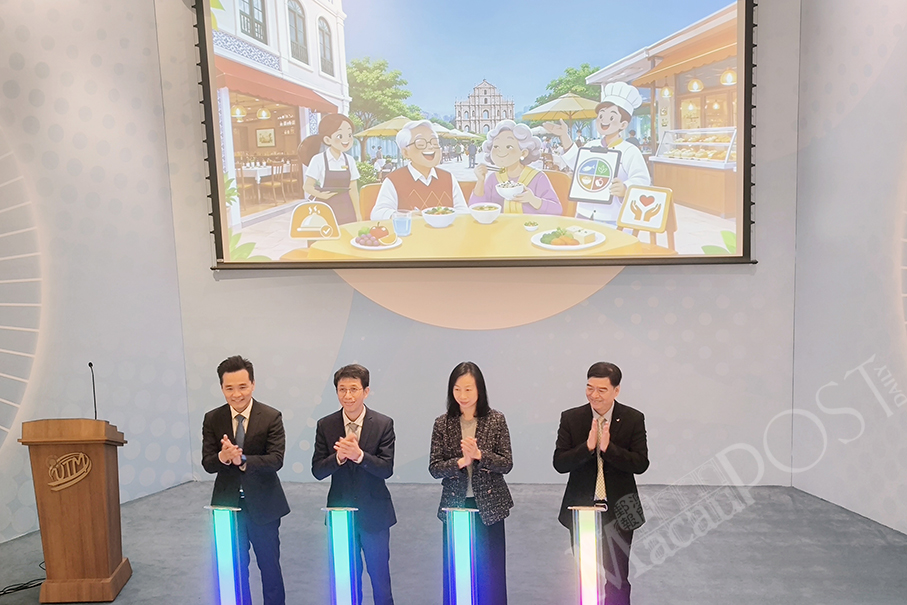
Health Bureau (SSM) Director Alvis Lo Iek Long (from left to right), Social Welfare Bureau (IAS) President Wilson Hon Wai, Macao University of Tourism (UTM) Rector Fanny Vong Chuk Kwan, and Cheong Kuai Tat, who heads the Municipal Affairs Bureau’s (IAM) Food Safety Department, applaud after symbolically launching the programme yesterday, on UTM’s Mong-Ha campus. – Photo: Tony Wong