According to a statement issued by the Health Bureau (SSM) on Saturday, three children at a crèche in Taipa have contracted enterovirus in a cluster infection. All patients have mild symptoms and no severe complications have been reported.
Enteroviruses are a very common group of viruses that can cause mild cold-like symptoms, hand-foot-and-mouth disease, or, in more severe cases, conditions such as viral meningitis. They spread easily through respiratory droplets, unwashed hands, and contact with faeces. Most people recover naturally with rest and supportive care.
The bureau said that it had received a report of one enterovirus cluster involving three children – two boys and a girl – from Class C at St. John Nursery of Obra das Mães (Taipa) [母親會聖約翰托兒所(氹仔)], located in Prince Flower City on Rua de Évora, Taipa.
According to the statement, the first patient developed symptoms on July 24. All three children sought medical treatment and are in a stable condition with mild illness. No severe cases or other serious complications have been reported, the statement added, noting that the nursery has strengthened cleaning and disinfection measures, improved indoor ventilation, and strictly implemented isolation requirements for affected children.
The bureau noted that enterovirus infections can be caused by Coxsackie viruses*, echoviruses, and Enterovirus 71 (EV71), among others.
While infections occur year-round, they are more common during summer and can cause illnesses such as hand, foot and mouth disease (HFMD) and herpangina (a contagious viral infection that causes a sudden high fever, a sore throat, and small painful blisters or ulcers in the back of the mouth), the statement said.
In rare cases, they may lead to serious complications, including myocarditis and aseptic meningitis, the statement underlined.
HFMD mainly affects children under the age of five and has an incubation period of three to seven days, the statement said, adding that it is primarily transmitted through direct contact with an infected person’s faeces, but can also spread via respiratory droplets and contaminated objects.
The bureau said children in nurseries and kindergartens are particularly susceptible because of close contact during play. Early symptoms include fever and sore throat, followed by blisters or rashes on the hands, feet and buttocks, as well as mouth ulcers, it added. Most cases resolve naturally within seven to ten days.
The Health Bureau urged parents, schools, nurseries and care institutions to maintain good hand and respiratory hygiene, improve environmental cleanliness and ventilation, and keep symptomatic children and staff away from school or work. It also advised members of the public to seek medical attention promptly if symptoms of HFMD or herpangina develop, particularly if they worsen.
*Coxsackie viruses are common enteroviruses split into Group A and Group B that spread via faecal-oral route and respiratory droplets, causing mild flu-like illnesses, hand, foot and mouth disease, or, rarely, severe organ inflammation. – Gemini
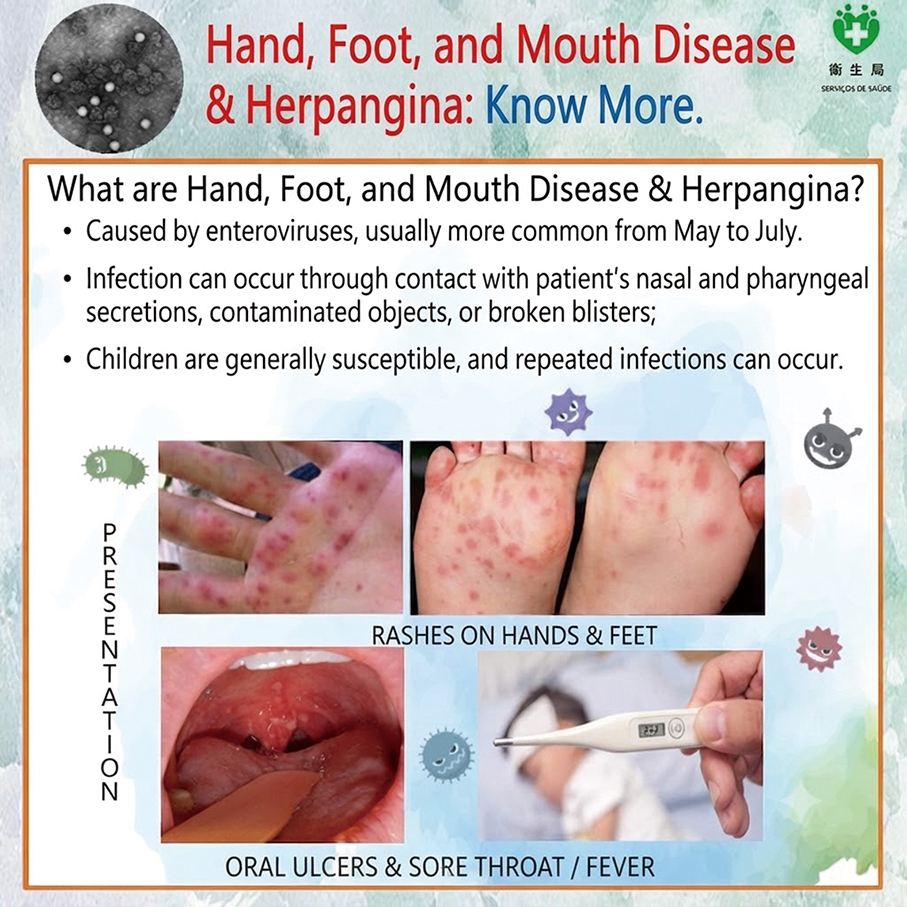
An infographic provided by the Health Bureau (SSM) on Saturday detailing hand, foot and mouth disease (HFMD) as well as herpangina. Translation of the Chinese-language original was arranged by the Post.