A 2003 Nobel laureate in Economic Sciences examined the growing challenges posed by climate change and geopolitical uncertainty in a lecture at the public University of Macau (UM) on Monday, highlighting their impact on global financial markets and the importance of understanding interconnected global risks, according to a UM statement that day.
The lecture, titled “Can We Stop Climate Change?”, was delivered by Robert F. Engle as part of the university’s 45th anniversary celebrations, the statement said.
Organised by the Faculty of Business Administration (FBA), the event attracted industry professionals, community members, faculty and students, the statement noted, adding that UM Vice Rector Michael Hui King Man pointed out in introductory remarks that Engle’s contributions to economics and finance earned him the Nobel Memorial Prize in Economic Sciences in 2003.
Engle, 83, is a professor emeritus of Finance at the Leonard N. Stern School of Business of New York University (NYU) and co-director of the NYU Stern Volatility and Risk Institute, according to a UM statement last week.
Hui noted that Engle is internationally recognised for developing the autoregressive conditional heteroskedasticity (ARCH)* model, a framework widely used to analyse financial market volatility and risk, the statement said, adding that FBA Dean Jun Yu (aka Yu Jun) said the lecture offered valuable perspectives on climate risk, financial stability and the interconnected challenges facing the modern world.
Yu added that understanding these issues is increasingly important as climate change and geopolitical developments continue to reshape global economies and markets, according to the statement.
During his presentation, Engle explored the relationship between climate change and geopolitical risk, elaborating on how major events such as wars, public health emergencies and elections can create volatility in global asset markets and investment environments, the statement said, adding that Engle also discussed both the physical and transition risks associated with climate change.
Sponsored by the university’s Development Foundation (UMDF), the lecture formed part of the university’s anniversary celebrations and provided attendees with insights into the financial implications of climate change and geopolitical uncertainty, the statement said, adding that the event was attended by university officials, members of the FBA Advisory Board and representatives from the financial sector.
* ARCH (Autoregressive Conditional Heteroskedasticity) and GARCH (Generalised ARCH) are statistical models used to analyse and forecast volatility in time series data. They are foundational tools in finance and econometrics, widely used to predict asset risk, price derivatives, and optimise portfolios. In statistics and econometrics, heteroskedasticity happens when the spread—or volatility—of data points is not constant across a dataset. To break it down simply: it means unequal variance. – Gemini
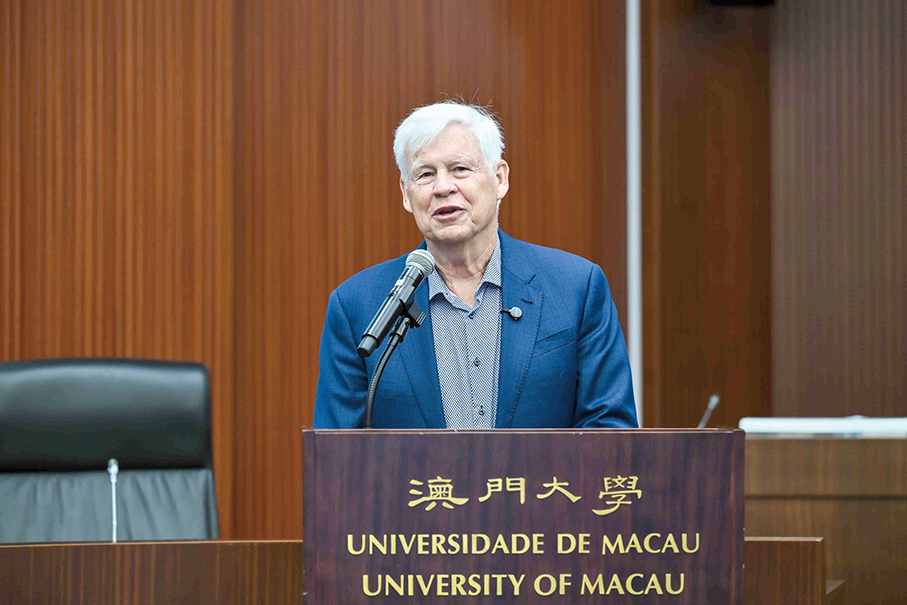
This handout photo provided by the public University of Macau (UM) on Monday shows 2003 Nobel laureate Robert F. Engle speaking during his “Can We Stop Climate Change?” lecture at the campus in Hengqin that day.