Macau’s Urban Planning Council (CPU) has recently released a revised version of the Taipa Northern Zone Urban Development Plan on the official website of the Lands and Urban Construction Bureau (DSSCU).
The updated blueprint aims to transform Taipa’s northern district into a vibrant, multi-functional community suitable for living, tourism, and business. By integrating cultural preservation, green mobility, innovative industries and public spaces, the project seeks to enhance residents’ quality of life and inject new development momentum into the region.
The aim of achieving green mobility, according to the plan, refers to the movement of people and goods using energy-efficient, low-impact modes of transport that reduce environmental degradation.
Last week, the Post interviewed Choi Seng Hon (徐承康) and Marquis Li (李永健), both vice presidents of the Associação Promotora para o Desenvolvimento da Comunidade da Taipa (“Taipa Community Development Promotion Association”), to gather their insights into the recently unveiled plan.
4 major adjustments: from profit to liveability
Both noted that, compared to the high-density development model proposed in the 2013 plan, the 2026 version represents a fundamental shift in philosophy. Instead of prioritising land revenue, the new vision establishes four primary goals: “liveability first, higher green space standards, a balance between housing and employment, and prioritised flood control.”
The most direct reflection of this shift is a significant reduction in development scale. The planned population has been cut from 36,500 in the previous version to approximately 20,000, while the total planned floor area has been scaled back from 1.26 million square metres to 1.05 million square metres. This reduction lowers development intensity at the source, easing the long-term burden on local infrastructure.
Furthermore, Choi and Li highlighted that the blueprint moves away from the outdated approach of “building houses first and patching up drainage later,” opting instead for a logic of “water management first, city building second.”
Ecological conservation has also been upgraded from a secondary supporting element to a binding requirement. The plan includes a clear commitment to preserving 23 native old trees by designating a dedicated old tree park. Additionally, features like the newly introduced “skywalk 2.0”, a designated “Research and Development (R&D) Cluster”, and a temporary activation mechanism for vacant land will help Taipa’s “Northern Zone” break away from a purely residential model, balancing immediate livelihood needs with long-term economic diversification, according to the plan cited by Choi and Li.
Infrastructure concerns: simultaneous construction is key
“Although the plan has lowered the expected population, adding 20,000 residents will still pose a major challenge to the surrounding infrastructure,” the vice presidents admitted frankly, noting that current facilities cannot accommodate such growth without upgrades.
The local government must adhere to the principle of ‘simultaneous planning, simultaneous construction, and simultaneous occupation’ to avoid repeating past mistakes where housing was built well ahead of supporting facilities, both said.
Taking transportation as an example, the areas surrounding Avenida de Guimarães, Caminho das Hortas, and Taipa’s old districts have long suffered from peak-hour traffic congestion, with the entrance to the Friendship Bridge acting as a major bottleneck. Choi and Li emphasised that Taipa’s road network will only be able to handle future demand once the eastward extension of Avenida de Guimarães and the widening of the Caminho das Hortas branch road are completed.
Regarding social infrastructure, they recommended optimising nearby schools, adding nurseries and childcare facilities, upgrading the local health centre, and establishing community clinics. They also suggested reserving small plots of land near the old tree park for an elderly services centre.
Flood control and conservation: ‘water-first’ win-win
To resolve the long-standing flooding issues plaguing Cheok Ka Chun (“Cheok Family Village”), Choi and Li said that cross-district drainage connectivity should be ensured before any major construction begins. Prioritising the dredging of blocked trunk channels in Cheok Ka Chun is essential to clear the bottleneck connecting to Taipa’s main rainwater drainage network, both said.
They also recommended utilising the area’s low-lying topography to build underground flood detention and storage facilities within planned green spaces, alongside a separate rainwater and sewage pipeline system. This would fundamentally upgrade the current system, which relies heavily on pumping stations to move sewage
Regarding whether preserving the 23 old trees would restrict local development, both remained optimistic. Because the trees are scattered across various points, creating the old tree park would only require localised adjustments to small plots of land.
They noted that enhancing the green environment could actually increase the value of surrounding real estate, achieving a win-win scenario for both ecology and development. While tensions between conservation and urban growth are inevitable given Macau’s limited land resources, they expressed confidence that the two can run in parallel if the government continues to pursue integrated solutions.
Complex land ownership and R&D cluster
Land ownership in northern Taipa is highly fragmented, consisting of a mix of government, private, and religious plots. Choi and Li suggested that the authorities adopt a “phased and rolling development” model, moving forward with individual plots as they become legally and logistically available.
Government-owned land should be utilised first for infrastructure construction, which will naturally incentivise surrounding private landowners to participate in the wider development, both noted.
As for the “R&D Cluster” designed to align with the government’s “1+4” strategy*, both civic leaders recommended a “small-scale, point-based layout”, i.e., space and location planning using specific point coordinates. They recommended focusing initially on niche sectors such as small-scale cultural and creative enterprises, digital micro-businesses, and the Big Health sector.
With housing and community services serving as the development’s foundation, commercial and industrial investments can be more effectively attracted once the residential population is established and community facilities are fully operational.
*According to previous reports by the Post, the government’s “1+4” strategy aims to consolidate Macau’s position as a “World Centre of Tourism and Leisure” (1) while pro-actively developing four emerging sectors (+4): Big Health (including traditional Chinese medicine); modern financial services (such as bond markets and FinTech); high-tech and innovation (specifically scientific research and the digital economy); and international conventions, exhibitions, and cultural and sports events.
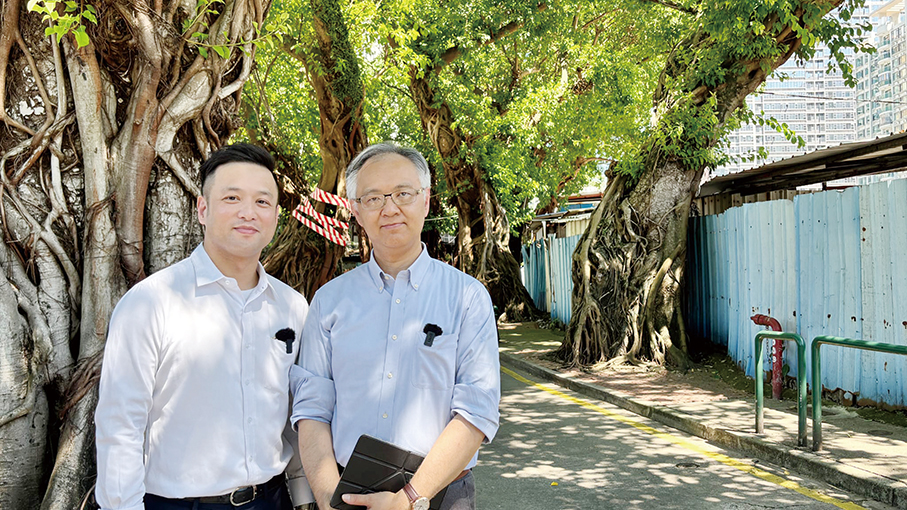
Associação Promotora para o Desenvolvimento da Comunidade da Taipa (“Taipa Community Development Promotion Association”) Vice Presidents Choi Seng Hon (right) and Marquis Li pose at Cheok Ka Chun (“Cheong Family Village”) in Taipa recently. – Photo courtesy of the association