The Legislative Assembly (AL) has passed a government-initiated bill establishing the licensing of a new type of private medical institution known as “day hospital” whose service level ranges between a hospital and a clinic.
Day hospitals are a new type of medical institution becoming increasingly popular elsewhere, providing certain medical services that previously could only be provided by hospitals. As its name suggests, day hospitals do not run inpatient services.
The bill passed by the local legislature will take effect on December 1.
Currently, Macau’s medical institutions in the private sector only comprise hospitals and clinics. According to the new law, the future day hospitals can provide less intensive, outpatient surgical procedures and other specialty medical services, which currently can only be provided by hospitals.
After the new law takes effect, the current private hospitals in the city can continue to operate as hospitals, or they will be required to switch to day hospitals, depending on whether their equipment and facilities can meet the new requirements.
The bill’s outline was passed during a plenary session of the legislature in November last year, after which the bill was reviewed by its 1st Standing Committee, before it was resubmitted to a plenary session on Tuesday, which Secretary for Social Affairs and Culture Wallis O Lam attended, when it was voted on article-by-article in its second and final reading.
The Macau Health Bureau’s (SSM) licensing of privately run medical institutions in Macau is currently regulated by two decree laws promulgated in the 1990s, respectively regulating hospitals and clinics, when Macau was still under temporary Portuguese administration.
The new law will establish a new legal system for licensing and regulating medical institutions in the private sector, replacing the two current decree laws. Under the new licensing system, Macau’s medical institutions in the private sector will comprise three categories – hospitals, day hospitals, and clinics.
According to the new law, day hospitals can provide certain non-hospitalised specialty medical services approved by the Health Bureau, which currently can only be provided by hospitals. The new law defines day hospitals as private medical institutions without inpatient facilities that provide certain specialty medical services with the expected length of diagnosis and treatment lasting up to 12 hours, except special circumstances.
Future hospitals must have emergency department, ICU
The new law regulating private medical institutions defines hospitals as private institutions with inpatient facilities providing comprehensive medical services, comprising emergency services, intensive care, outpatient services, and specialty medical services.
According to the new law, day hospitals will be barred from running inpatient services. The law defines day hospitals as private institutions providing outpatient services and certain specialty medical services approved by the Health Bureau.
Clinics are defined as private institutions providing outpatient services and certain other medical services green-lighted by the Health Bureau. The new law explicitly bars clinics from providing medical services that can only be provided by hospitals or day hospitals.
After the new law takes effect, a hospital must be equipped with inpatient facilities, an emergency department, an intensive care unit (ICU), operating rooms, and a pharmacy. A hospital can also choose to run a traditional Chinese medicine (TCM) pharmacy if it provides TCM services.
According to the new law, a day hospital will not have an emergency department and an ICU, but it must be equipped with a Western medicine pharmacy or a TCM pharmacy depending on the medical services that it provides.
2-year transition period
The new law provides for a two-year transition period after it takes effect, during which current private hospitals can continue to operate in line with the current decree law promulgated in the 1990s, after which they will have to meet the requirements listed by the new law in order to continue operating as hospitals, namely by setting up an emergency department and an ICU if they currently do not have them. During the two-year period, they will have to apply for a hospital licence to be issued in line with the new law’s requirements.
Current private hospitals can instead choose to apply for a day hospital licence if they decide not to upgrade their facilities in order to meet the new law’s requirements for a hospital.
If a current private hospital without an emergency department and an ICU has been operating for over five years by the time it files an application for a new licence, it can choose to set up a 24/7 outpatient department instead of setting up an emergency department and an ICU, in which case the government will also issue them a hospital licence.
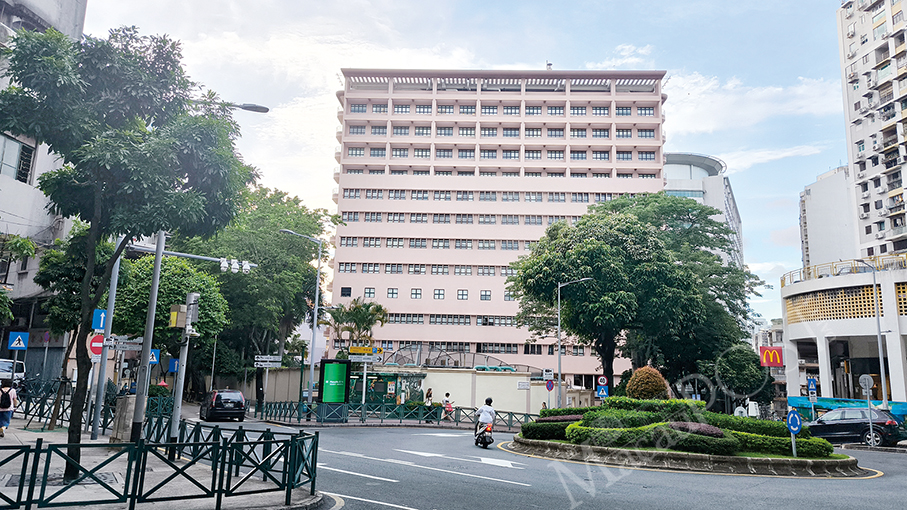
This file photo taken last year shows the inpatient building of the private Kiang Wu Hospital, which has long been providing comprehensive medical services comprising emergency, intensive care, outpatient, and specialty medical. – Photo: Tony Wong