The Macau Management Association (MMA) hosted a press conference yesterday about the findings of its survey, which it conducted last year, showing that Macau residents’ interest in working in the nine mainland cities of the Greater Bay Area has risen by 160 percent compared to 2024.
The Guangdong-Hong Kong-Macao Greater Bay Area (GBA) is a conurbation consisting of the nation’s two special administrative regions (Hong Kong and Macao) and nine cities in Guangdong Province – Dongguan, Foshan, Guangzhou, Huizhou, Jiangmen, Shenzhen, Zhaoqing Zhongshan and Zhuhai (collectively aka “9+2”), with a total population of 88 million and a land area of 56,000 km2.
With 688,900 people and 33.4 km² of land, Macau accounts for roughly 0.8 percent of the GBA’s population and just 0.06 percent of its total land area.
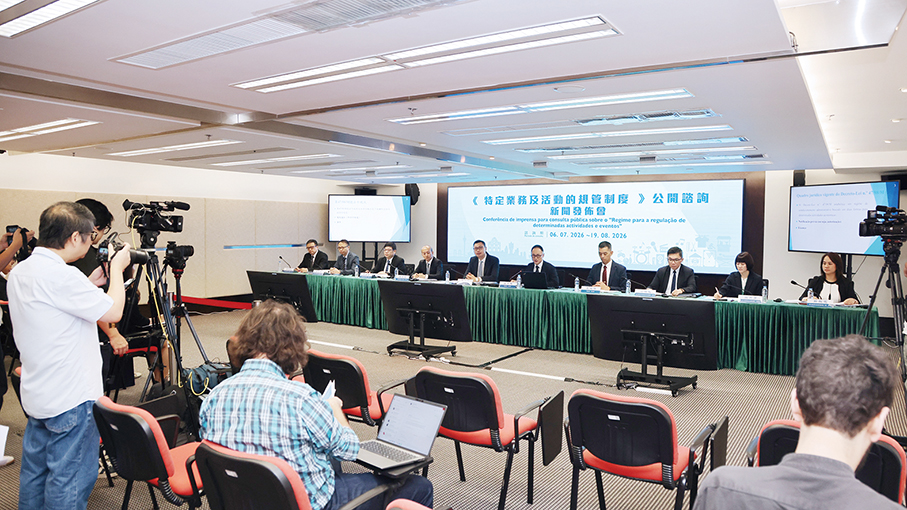
The press conference was held at the Macau Chamber of Commerce (ACM) building in Zape. The survey aimed to analyse local residents’ employment mobility. It was conducted between last May and September; 1,074 valid surveys were collected.
The findings show that while 59.5 percent of the respondents were employed full time, 20.9 percent worked part-time, 11.6 percent were self-employed, and 8.0 unemployed. More than 63 percent of the respondents had been in their latest position for three to 10 years, indicating a relatively stable job tenure, the findings show.
However, over the past three years, 40.1 percent of the respondents had changed jobs.
The findings also show that employees’ “pain points”* have shifted from material concerns to psychological and developmental issues – 52.3 percent of the respondents cited work pressure as their primary pain point, while 46.0 percent expressed a need for training.
Asked by the survey to look ahead to the next 12 months, while 49.3 percent of the respondents were unsure whether they would change their job, 89.2 percent had no clear career plans.
Meanwhile, the findings also show that 42.6 percent of the respondents expressed willingness to work in the Chinese mainland’s GBA cities, representing a 160 percent increase compared to 2024. Among these, Zhuhai was the preferred destination, chosen by 48 percent of the respondents, the findings show.
However, 65.4 percent of the respondents expressed concern about losing Macau’s income advantages, and 50.6 percent were unfamiliar with the Greater Bay Area.
Recommendations for staff, firms and govt
The association put forward three recommendations for employees, companies and the local government each during the conference.
For employees, the association recommended embracing lifelong learning and making good use of training and upskilling programmes to enhance their resilience; formulate a 12-month career mobility plan and participate in job fairs and internal promotion opportunities; and join workshops in Hengqin, learn cross-border skills and launch small-scale pilot ventures.
For companies, the association recommended setting up preventive retention frameworks and strengthening compensation along with flexible benefits; launching hybrid training models and AI matching tools to improve both professional and general skills; and establishing cross-border talent networks and offering business travel and cultural training to facilitate workforce mobility.
For the local government, the association recommended enhancing promotion of the Greater Bay Area and introducing a “Macau and business travel” benefits protection model; establish a hybrid training fund to subsidise skills development in areas such as AI and to ensure fair employment mechanisms; and set up a GBA employment database to foster an entrepreneurial ecosystem with incubators.
* “Pain points” is a term used to describe specific problems, frustrations, or challenges experienced by a particular group of people. While it originated in business and marketing to describe problems customers face, it is now used broadly in politics, urban planning, and daily life to identify areas that need improvement. – Gemini
An advertising sign-holder in Travessa do Soriano promotes a nearby “cha chaan teng” (Hong Kong and Macau-style diner) last night. – Photo: Armindo Neves