After attending the opening meeting of the fourth session of the 14th National People’s Congress (NPC) in Beijing yesterday morning, Chief Executive Sam Hou Fai underlined that the ongoing “two sessions” are of significant importance and far-reaching influence as this year marks the start of the nation’s 15th Five-Year Plan, pledging that his government will advance its administration and governance in full compliance with the spirit of the two sessions, firmly seize the development opportunities brought about by the nation’s development strategy, and unswervingly integrate into and serve the nation’s overall development, thereby writing a new chapter in the implementation of the “One Country, Two Systems” principle, according to a statement by the Macau Government Information Bureau (GCS) yesterday.
The nation’s two sessions refer to the annual sessions of the NPC and the National Committee of the Chinese People’s Political Consultative Conference (CPPCC).
Sam and his Hong Kong counterpart, John Lee Ka-chiu, attended yesterday morning’s opening meeting of the fourth session of the 14th NPC at the Great Hall of the People, when Premier Li Qiang delivered his annual government work report.
Sam and Lee returned to Macau and Hong Kong respectively yesterday afternoon.
Premier’s work report mentions HK & Macau
Yesterday’s GCS statement noted that in his government work report, Li reaffirmed the central government’s unswerving commitment to implementing the principles of “One Country, Two Systems”, “Hong Kong people governing Hong Kong” and “Macau people governing Macau”, and maintaining a high degree of autonomy for the nation’s two special administrative regions (SARs).
In his work report, the GCS statement noted, Li underlined the need to ensure the implementation of the “patriots governing Hong Kong” and “patriots governing Macau” principles, enhance governance effectiveness in Hong Kong and Macau, and promote their economic and social development.
Li also said in his work report that the central government will support Hong Kong and Macau in better integrating into and serving the nation’s overall development, and leveraging their unique advantages and important roles of being backed by the motherland and connected to the world, thereby fostering their long-term prosperity and stability.
The fourth session of the 14th NPC, which began yesterday morning and is scheduled to conclude on Thursday afternoon next week, is now reviewing the central government’s annual work report, which Li delivered yesterday, as well as the draft outline of the nation’s 15th Five-Year Plan.
The nation will start implementing its 15th Five-Year Plan after the expected passage of its outline by the NPC on Thursday next week.
The plan, officially known as 15th Five-Year Plan for Economic and Social Development, covers the period between 2026 and 2030.
Sam thanks central govt’s fundamental guarantee
Yesterday’s GCS statement quoted Sam as saying that the central government has always attached great importance to Macau’s long-term prosperity and stability and sustainable development, and has consistently provided Macau with profound care and strong support, offering a fundamental guarantee for Macau in addressing risks and challenges, promoting appropriate economic diversification and high-quality development, and improving residents’ well-being.
On behalf of the Macau Special Administrative Region (MSAR) government and all residents, Sam expressed the highest respect and sincere gratitude to the central government, the statement said.
In the GCS statement released after yesterday morning’s opening meeting, Sam noted that, building upon the beneficial experience and positive outcomes of the nation’s 14th Five-Year Plan, the draft outline of the nation’s 15th Five-Year Plan continues to include a dedicated chapter on fostering the long-term prosperity and stability of Hong Kong and Macau, outlining the nation’s strategic plan to support Hong Kong and Macau in consolidating and enhancing their competitive advantages and better integrating into and serving the nation’s overall development.
15th Five-Year Plan’s dedicated chapter for HK & Macau
The dedicated chapter, Sam noted, includes the nation’s commitment to further supporting Macau’s appropriate economic diversification, supporting Macau in advancing its “One Centre, One Platform, One Base” campaign, supporting Macau in enhancing its competitiveness of industries such as big health driven by traditional Chinese medicine (TCM), finance with “special features”, high-tech, MICE and commerce, supporting Macau in strengthening cooperation with the Chinese mainland in areas such as economy, trade, technology and culture, and rolling out new policies and measures to make it more convenient for Macau residents to live and pursue personal development in the Chinese mainland.
The Macau government’s “One Centre, One Platform, One Base” concept refers to Macau developing itself into a World Centre of Tourism and Leisure, a commercial and trade cooperation service platform between China and Portuguese-speaking countries, and an exchange and cooperation base with Chinese culture as its mainstream and co-existence of different cultures.
Sam noted that the 15th Five-Year Plan’s dedicated chapter for Hong Kong and Macau also includes the nation’s commitment to deepening Guangdong-Hong Kong-Macau cooperation, deepening the Macau-Hengqin integrated development, and advancing the construction of major projects such as a new high-speed railway between Guangzhou and Zhuhai (Macau), the Macau-Hengqin International Education (University) Town, and Macau International Airport’s upstream cargo terminal in Hengqin.
The dedicated chapter, Sam noted, also includes improving the mechanisms for Macau to better play its role in the country’s opening up to the outside world, and leveraging Macau’s role as an important window of exchanges and mutual learning between Chinese and Western civilisations.
In the statement, Sam underlined that integrating into and serving the nation’s overall development is the fundamental foundation for Macau’s sustainable development and an inevitable requirement for the steady and far-reaching implementation of the “One Country, Two Systems” principle.
Sam noted that this year marks the start of the MSAR’s drawing-up and implementation of its third five-year socioeconomic development plan, adding that with the aim of aligning with the strategic plans outlined by the nation’s 15th Five-Year Plan, particularly those concerning Macau, his government will scientifically draw up Macau’s third five-year plan covering the period between 2026 and 2030.
Sam underlined that Macau’s third five-year plan will outline the MSAR government’s commitment to fully leveraging the institutional advantages of the “One Country, Two Systems” principle and Macau’s unique advantage of its blending of Chinese and Western cultures, comprehensively enhancing the city’s overall competitiveness, vigorously participating in the development of the Guangdong-Hong Kong-Macao Greater Bay Area (GBA) and the nation’s Belt and Road Initiative (BRI), deepening Macau-Hengqin coordinated development, and accelerating the development of key industries such as modern finance, big health driven by TCM, technological innovation, MICE and commerce as well as culture and sport.
Moreover, Sam also acknowledged Macau’s deputies to the NPC and the local members of the CPPCC National Committee as being an important bridge connecting Macau with national governance at the highest level.

Macau Chief Executive Sam Hou Fai (left) listens to Premier Li Qiang delivering his annual government work report during yesterday’s opening meeting of the fourth session of the 14th NPC at the Great Hall of the People in Beijing as his Hong Kong counterpart John Lee Ka-chiu reads the report. – Photo: GCS
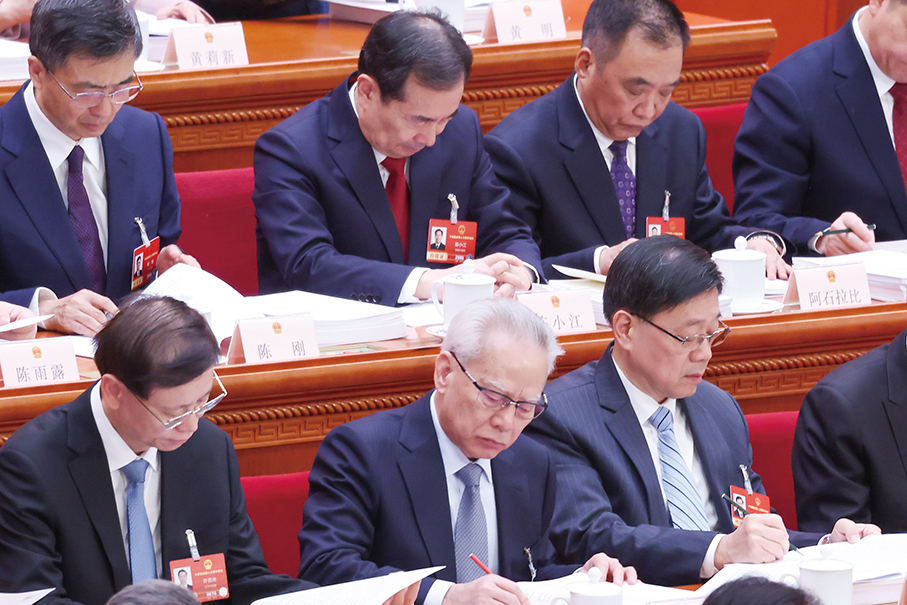
Macau Chief Executive Sam Hou Fai (front, centre) and his Hong Kong counterpart John Lee Ka-chiu (front, right) take notes while listening to Premier Li Qiang delivering his annual government work report during yesterday’s opening meeting of the fourth session of the 14th NPC at the Great Hall of the People. – Photo: GCS