Interview with Central Conservatory bassoon Prof. Li Lansong
William Chan in Zhuhai, interview and review
Since joining the Macau Youth Symphony Orchestra in 2013, I have been immersed in the world of wind instruments. From quintet rehearsals and masterclasses with renowned musicians to performances with the orchestra’s wind ensemble and youth band, the bassoon* has become a steadfast partner in my musical journey.
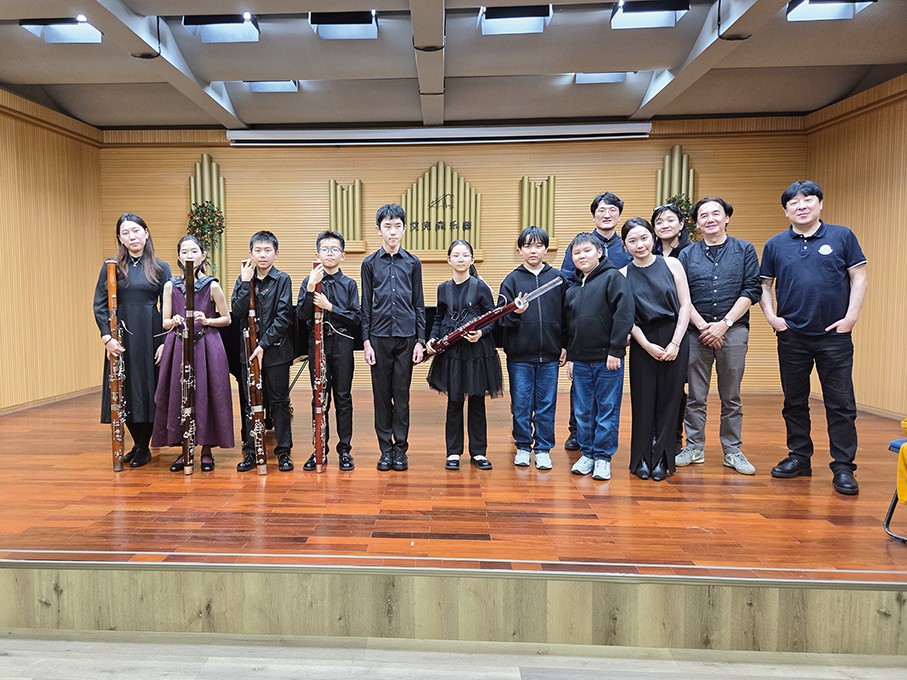
At my bassoon teacher Zhu Wukun’s invitation, I attended a masterclass and concert early this month in Zhuhai, led by acclaimed Central Conservatory of Music bassoon professor Li Lansong.
Li leads China’s bassoon scene – not just with virtuoso playing but as a judge at premier international competitions. His scholarly and artistic renown echoes worldwide.
The venue, Aksen Concert Hall, is hidden inside a nondescript industrial building in Zhuhai. Its plain façade belies pro-level interior finishes and stellar acoustics—a gem of a space tailored for chamber music and intimate shows, something Macau desperately needs.
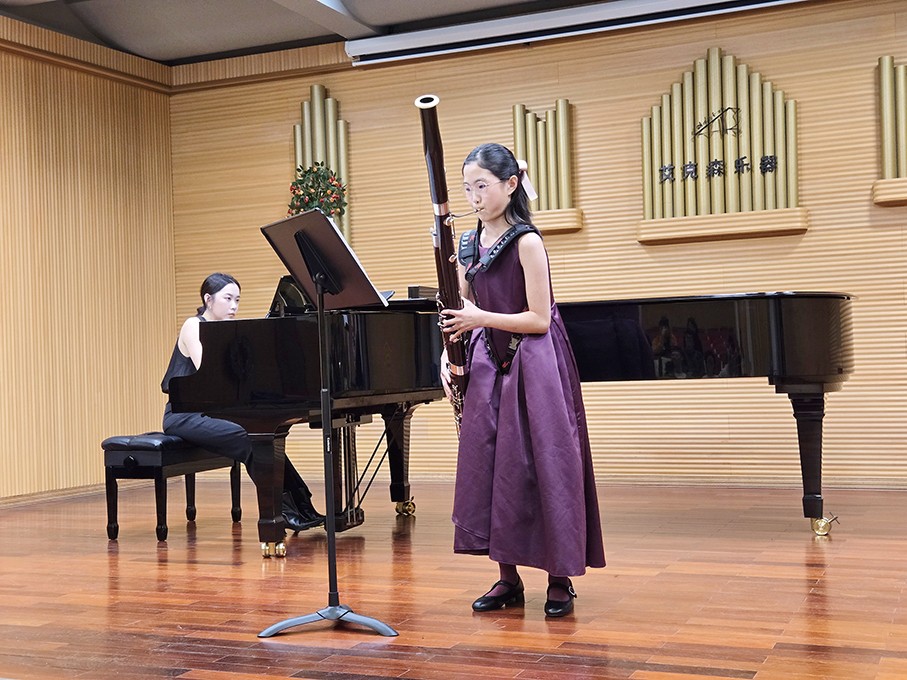
Eight of Zhu’s students, all from the Greater Bay Area (GBA), took part, honing skills in the noon masterclass provided by Li before shining at the evening concert. The highlight? 11-year-old Chen Xuxin’s flawless take on the first movement of Hummel’s** F Major Bassoon Concerto. This piece is infamous for its daunting technical demands – a staple in major bassoon competitions that tests breath control, fingerwork, tonguing, and musical expressiveness to the extreme. Yet Chen delivered a near-flawless performance; “prodigy” seems the only fitting label. He navigated every challenging passage with complete fluency, exuding a poise and confidence beyond his years. His effortless command of the stage made it easy to forget he’s just a middle schooler.
In our interview, Li lavished praise on the young talent: “That was simply phenomenal – it shocked me. It’s not just that he could play the piece; from a stylistic, technical, tonal colour, and rhythmic standpoint, he handles the instrument with such ease and masters the music so confidently.” Li’s assessment pinpointed the essence of Chen’s appeal: a wholehearted immersion in the music paired with masterful control of the instrument.
Teaching breeds excellence
Crediting Chen’s flair to Zhu Wukun’s nurturing, Li underlined: a teacher’s artistic peak sets the student’s ceiling. “You can only guide students to your own heights,” he said. As Li’s own pupil, Zhu exemplifies artistic succession: channelling techniques and pedagogy across generations to raise the bar. This lineage fuels the Greater Bay Area’s recent bassoon boom.
Li noted that boosting regional or national music standards demands widespread access. Since 2009, Li’s team has run the Beijing International Bassoon Festival to popularise the instrument across China. Over a decade on, he noted that the bassoon has gone from niche to hot ticket, with enrolment soaring. The Great Bay Area youths at Zhuhai’s masterclass embodied this shift, swelling the talent pool for standouts.
Li also spotlighted his partnership with Jinbao*** ethnic instruments, as their endorsed artiste. In their bassoon’s nascent days, he advised on tuning, keys, even cases. Such artiste-maker synergy propels China from maker to marque.
Li candidly admitted that a decade ago, domestic bassoons faced quality scepticism. But through persistent efforts, makers like Jinbao have made strides in craftsmanship and standards. “I believe Jinbao now holds a solid place in China, and their exports to Asia and South America are going great,” he said, adding that while top-tier materials still lag behind global leaders, Jinbao bassoons excel in intonation, tone, and overall quality.
I also own a Jinbao bassoon that’s met all my band-playing needs, at just a fraction of the cost of European student models.
Coda
I recall Zhu emphasising inter-city collaboration in a prior interview****: “Macau has just 600,000 people, Zhuhai two million—less than a district in my birthplace Chengdu or Beijing.” He argued that pooling teaching resources, sharing venues, and fostering musician exchanges would create regional win-wins and elevate standards.
This aligned perfectly with that evening’s revelations. If venues like Aksen Concert Hall were shared across the Greater Bay Area, their value would multiply. Likewise, frequent circulation of master teachers like professors Li and Zhu, plus talented players like Chen, would immensely benefit students everywhere.
*The bassoon is a woodwind instrument known for its distinctive, rich tone and wide range. It is typically made of wood, although some modern versions are made from synthetic materials. The bassoon has a long, tubular body with a conical shape, a double reed mouthpiece, and multiple keys that allow the player to produce different pitches. – Poe
**Johann Nepomuk Hummel (1778–1837) was a prominent Austrian composer, pianist, and conductor, known for his contributions to the Classical and early Romantic music eras.
***Jinbao is a well-known Chinese manufacturer of musical instruments, particularly recognised for producing brass and woodwind instruments. - Poe
****Past interview with Zhu:
https://macaupostdaily.com/news/15287
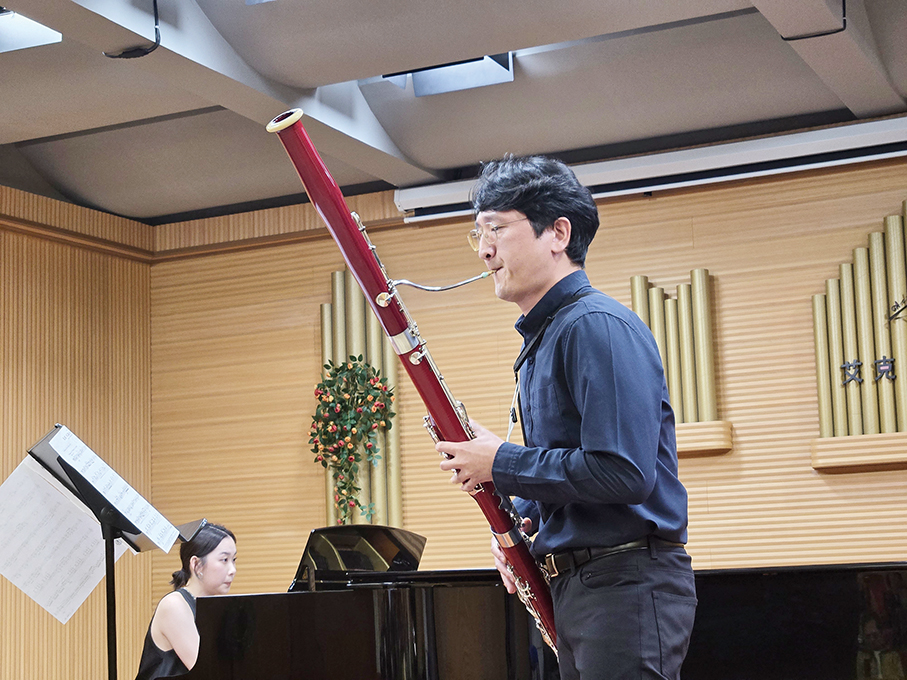
Zhu Wukun performs a tango piece originally written for cello at Aksen Concert Hall, accompanied by pianist Irene Leong.
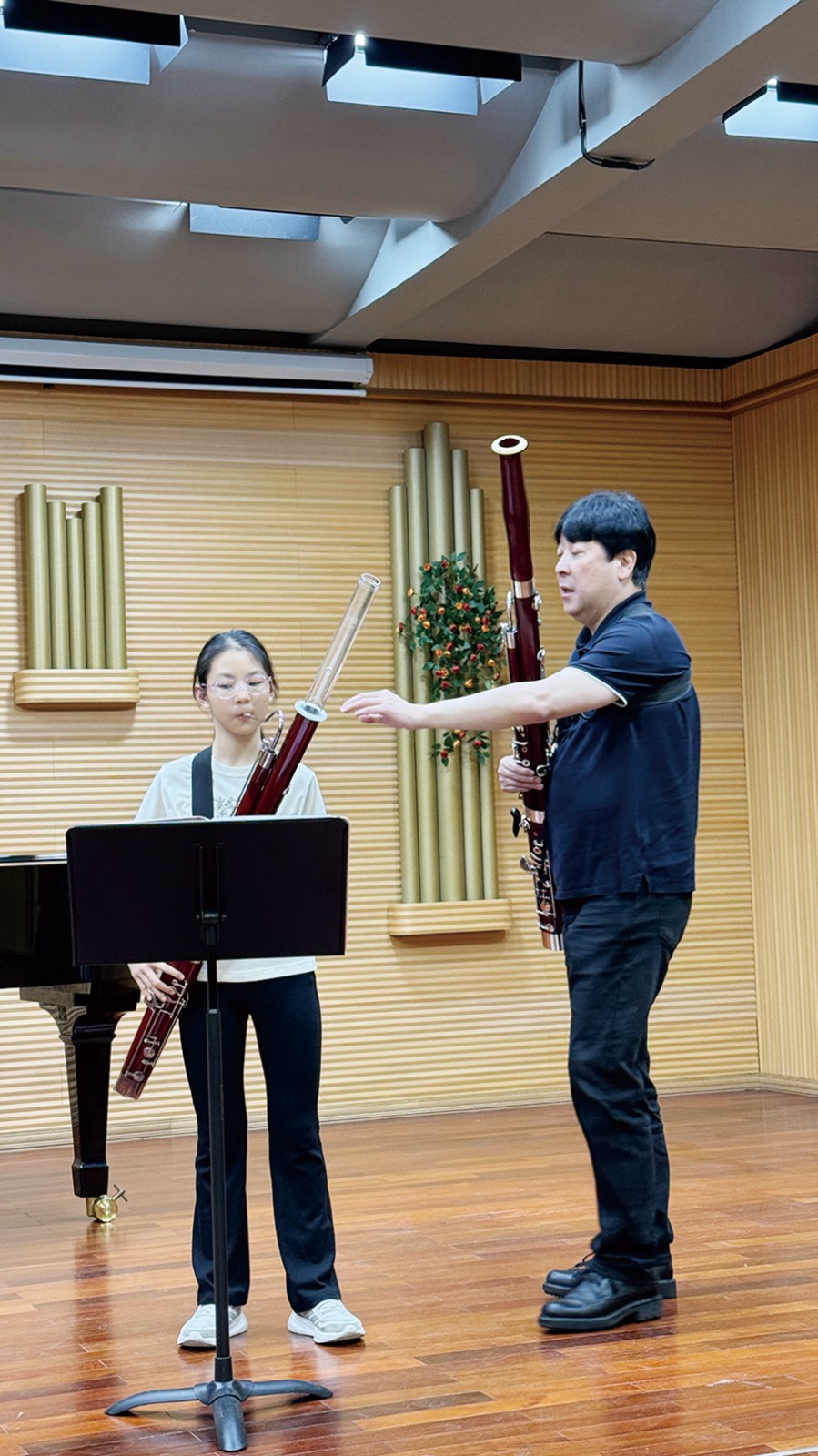
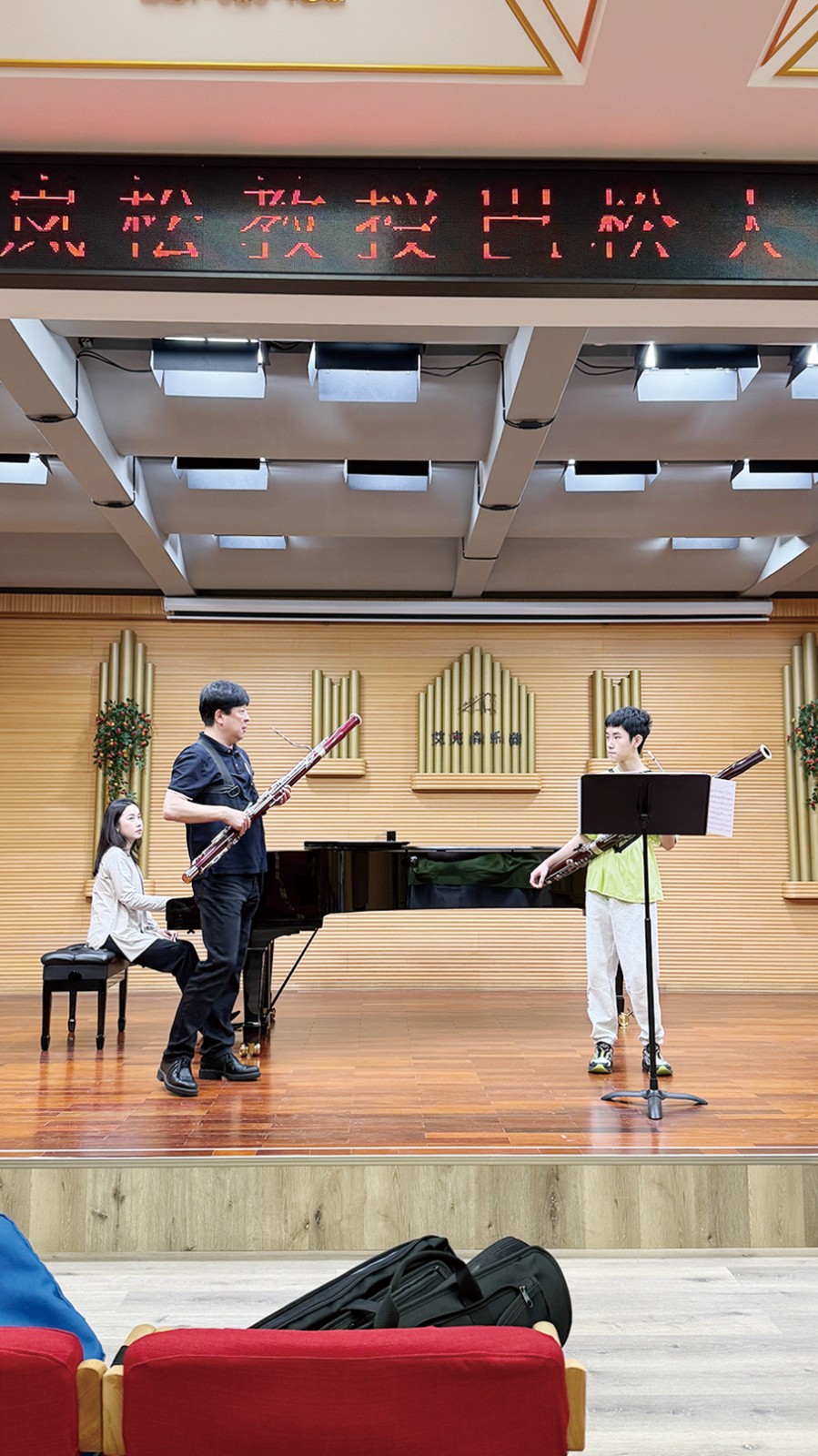
Bassoon professor Li Lansong teaches young bassoonists from the Greater Bay Area (GBA) during the master class in Zhuhai earlier this month. – Photos provided by the students’ parents
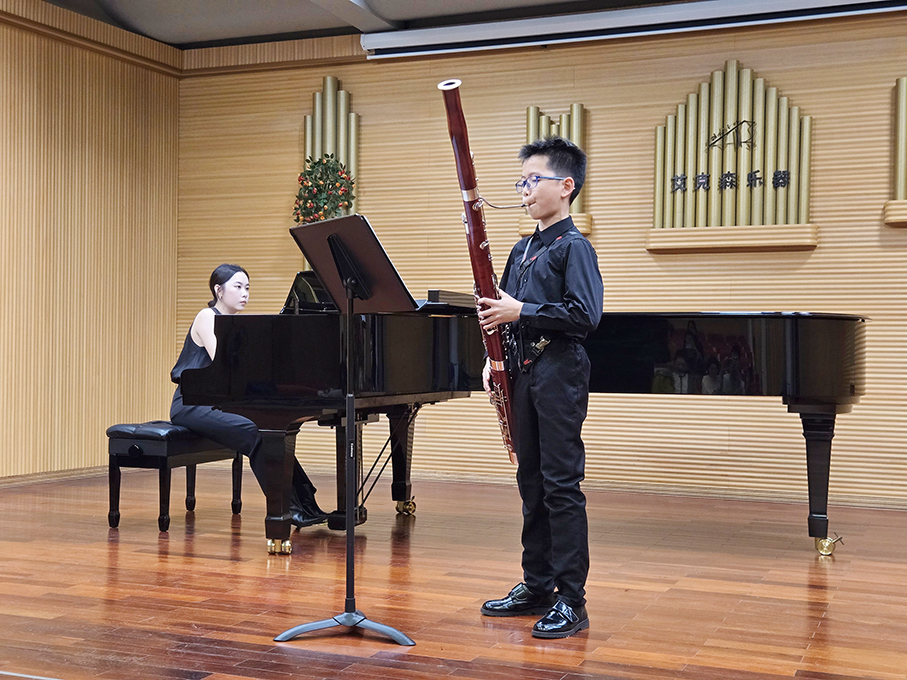
11-year-old Chen Xuxin’s performs the first movement of Hummel’s F Major Bassoon Concerto, accompanied by pianist Irene Leong. – Photo: William Chan