Interview and review by William Chan
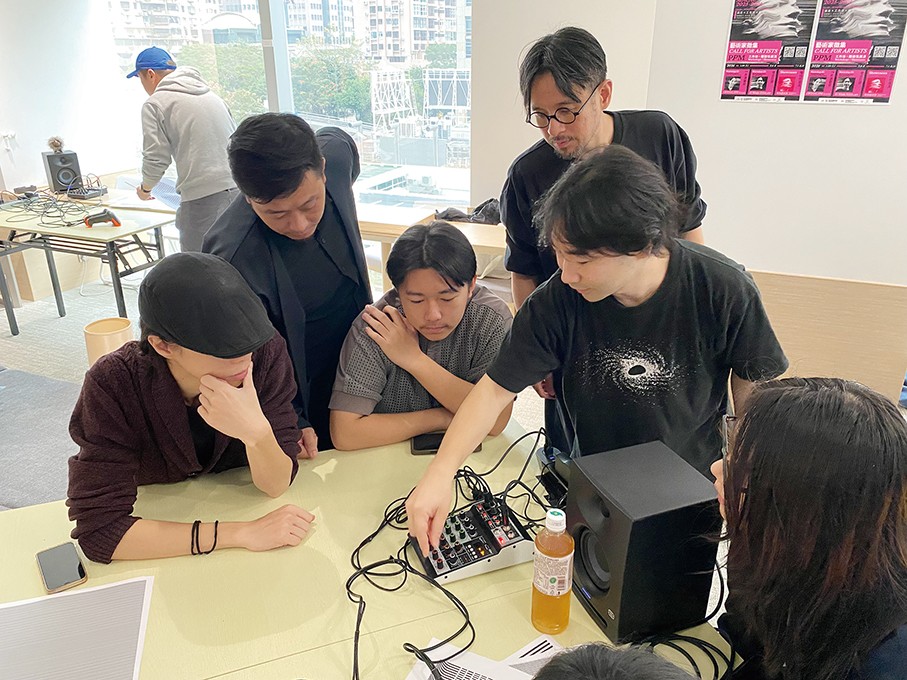
ProjectPlayaround Macau, the second three-day session of the TouchDesigner Performing Arts Workshop, featured a captivating performance and insightful interview with renowned Japanese sound artist, Ei Wada.
I attended the first section on Friday, where Wada showcased his unique brand of electronic music, followed by an in-depth interview.
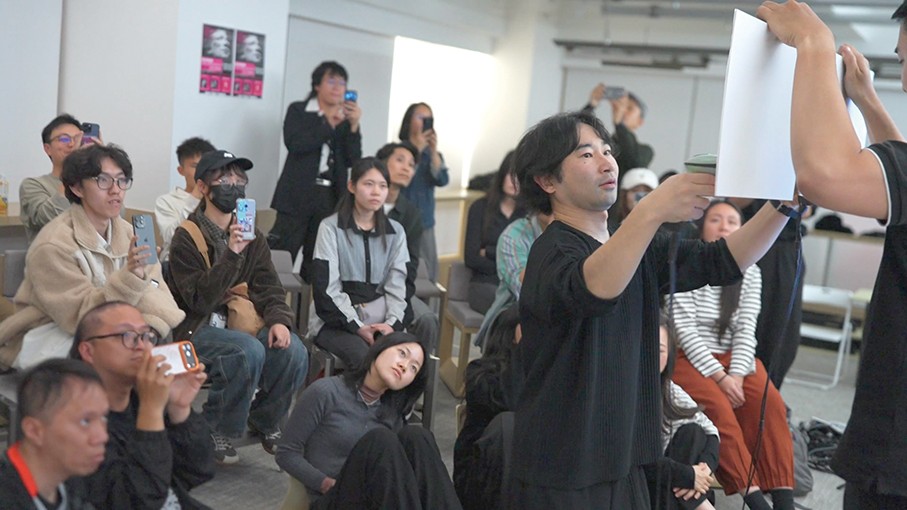
Many, including myself, were first introduced to Wada through a viral video where he ingeniously transformed the mundane act of scanning barcodes into a musical performance. The intriguing and unconventional nature of his work left a lasting impression, and the opportunity to witness it live was not to be missed.
During the workshop, the atmosphere was electric, with many participants even dressing in zebra-striped clothing, a nod to the barcodes that have become synonymous with Wada’s art.
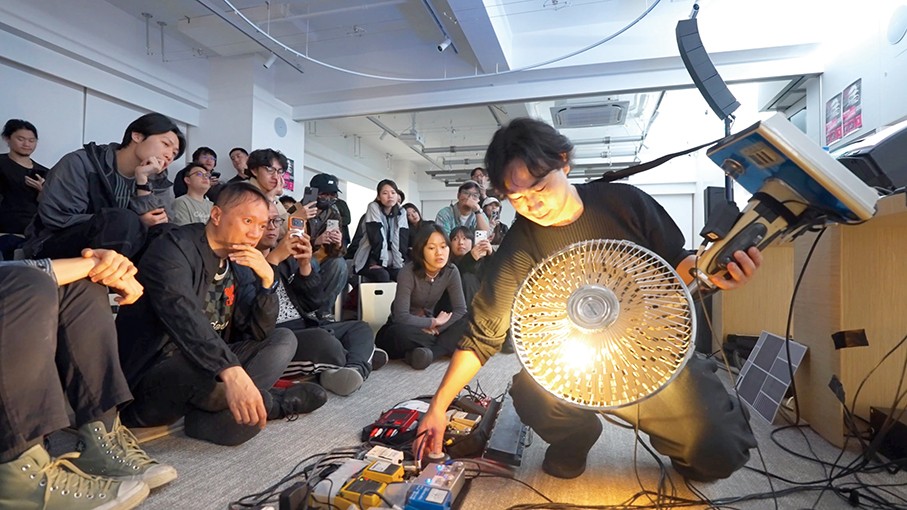
As a programmer and artist, Wada utilises a variety of self-made appliances to create his music. In one mesmerising performance, a stationary scanning device changed the pitch of the sound based on the performer’s distance from it, effectively turning movement into melody. The highlight, however, was when Wada transformed an ordinary electric fan into a guitar-like instrument. Beyond the initial gimmickry, the performance was sonically captivating, a work of contemporary art.
In our interview, Wada delved into the philosophy that underpins his creative practice. He expressed a deep fascination with primitive and original sounds, a theme evident in his work. For Wada, who has been researching new ways of transforming daily items into musical instruments for decades, said that creating music for him is a process of constant experimentation and discovery.
This approach is rooted in the understanding that all instruments were once not instruments. “A guitar, for example, is just a string that you pluck. The first sound is very simple. But over a long period of time, it became a guitar.”
Wada sees his work as a continuation of this tradition, exploring the sonic potential of everyday objects.
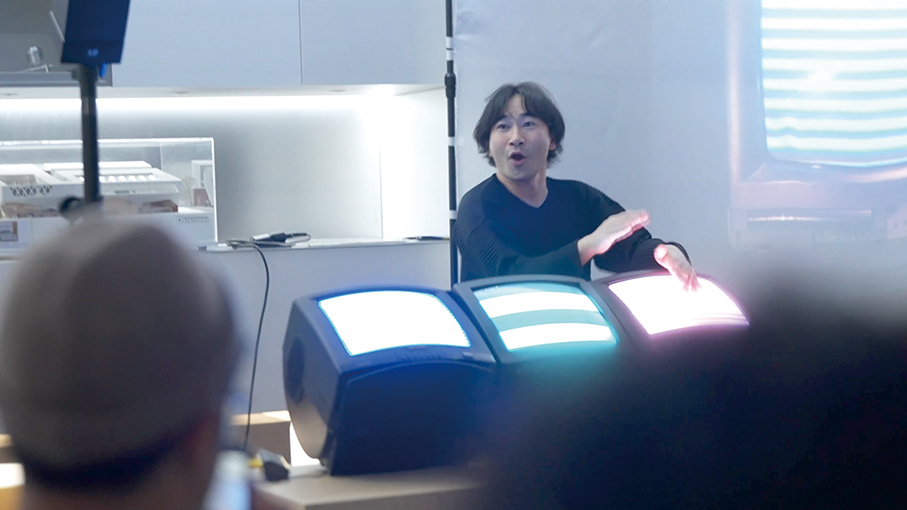
One of the most compelling aspects of Wada’s work is his use of outdated technology, such as CRT* televisions. He said that he uses the static electricity from the old televisions to create sound. These obsolete objects are given a new life in his performances. “For me, it’s like a festival,” he said, comparing the large, heavy televisions to the drums used in traditional Japanese festivals. “The size, on the contrary, is like a festival-like thing, and I can see it like a taiko drum*.”
Looking towards the future, Wada envisions his music evolving into a more interactive and participatory experience. He is less interested in big stages and more focused on creating a festival-like atmosphere where the audience can participate. “I want to make it a festival where people can participate,” he underlined. “It’s more like folk music, something that is born in the present day.”
During the presentation, Wada also gave a profound reflection on the nature of media and expression, which was written in Chinese in the original article. Translated, it reads:
“The medium is both a ‘container’ and can become a constituent element of expression at the same time. We are already accustomed to the premise that the narrative must be contained within the ‘interior’ of the medium. However, when we begin to consciously pay attention to the structure, materiality, and system of the medium itself, we can reorganise it as a theme, material, and object of operation. The medium is no longer just a simple container, but can become the narrative itself. This understanding can leap over existing dimensions and generate new experiences and time structures. This is a creative act of re-understanding expression from a higher dimension.”
When asked about the possibility of his experimental approach becoming institutionalised, Wada expressed a thoughtful ambivalence. He acknowledged that many forms of music have followed a similar path, eventually becoming codified and taught in formal settings. However, he cautioned against the rigidity that can come with institutionalisation. “If it becomes fixed in a certain format, it might not be interesting anymore,” he reflected.
For Wada, the most important lesson is not how to play a television as an instrument, but rather the practice of looking at familiar objects from an outside perspective and becoming conscious of the medium itself. This critical innovativeness, he believes, is more valuable than any specific technique. “It is about cultivating the ability to see beyond prescribed uses and to imagine alternative possibilities, a skill that remains vital regardless of how music evolves,” he said.
*CRT Television refers to a television set that uses a cathode ray tube (CRT) as its display technology. CRT televisions were the dominant display technology for several decades before the transition to flat-screen models began in the early 2000s. - Poe
**Taiko (太鼓) is the Japanese word for “drum.” In a broad sense, it refers to any drum from Japan. However, in modern global usage, “taiko” most commonly refers to the art of Japanese ensemble drumming (known as kumi-daiko), which involves a variety of these drums played in a highly physical, rhythmic, and theatrical style. – DeepSeek
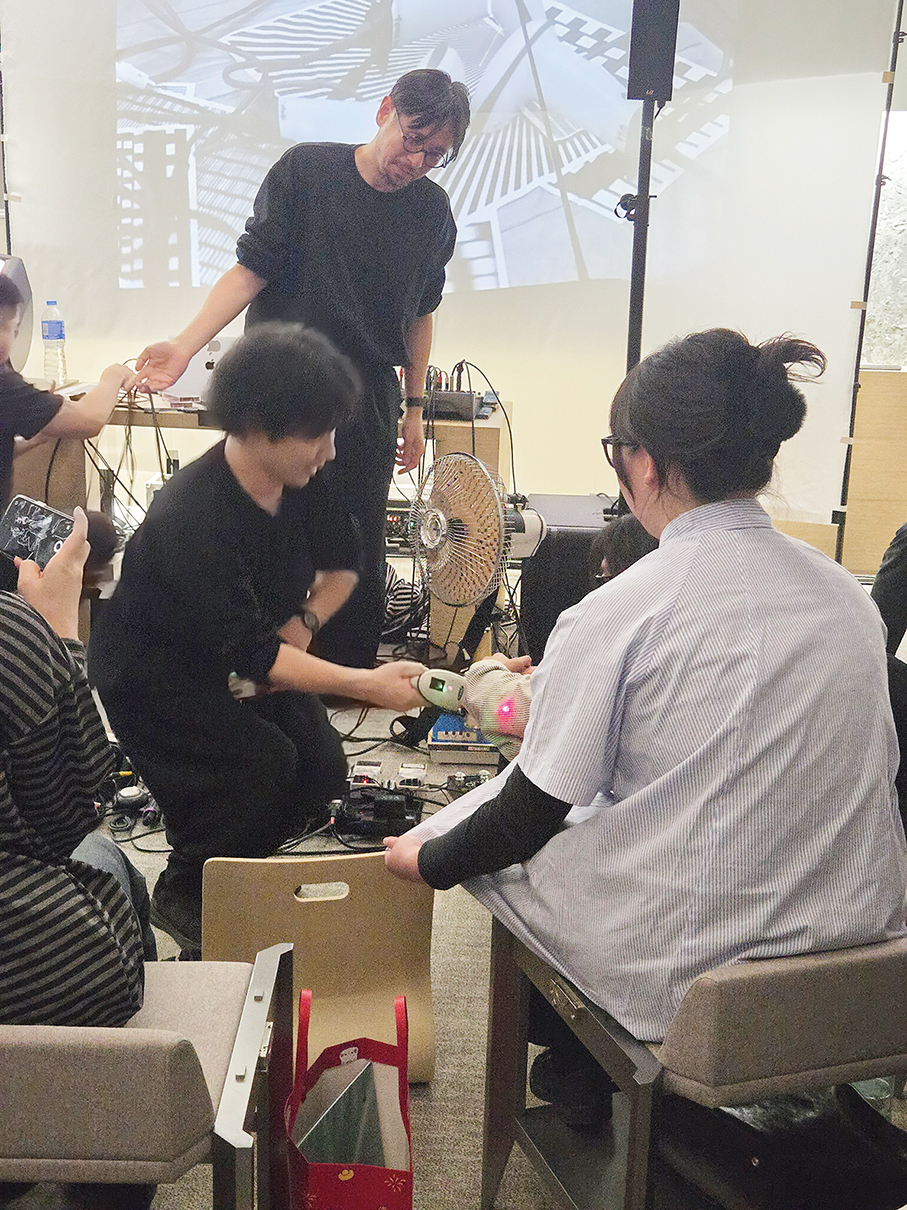
Ei Wada scans a participant’s clothes with a barcode scanner on Friday night at his workshop. – Photo: William Chan
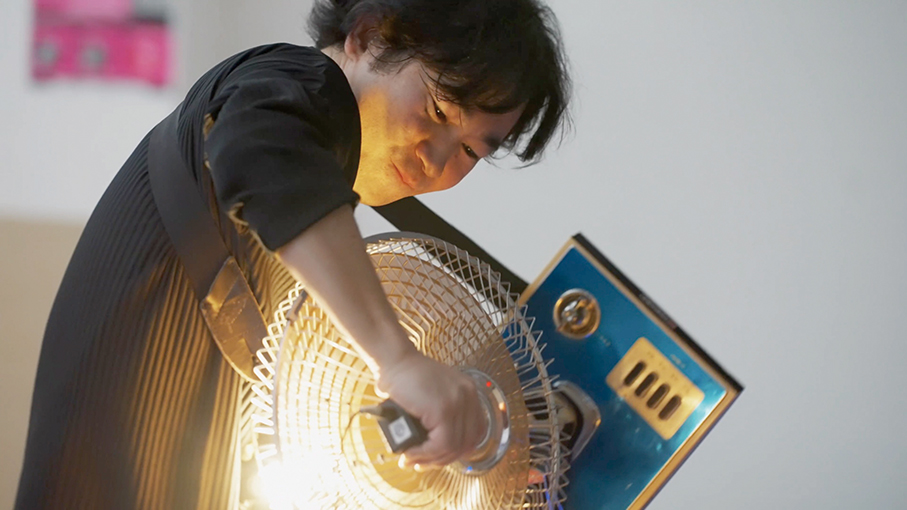
Ei Wada performs with his electric fan, posing as a guitarist. – Photos provided by New Media Art Macau