Macau’s statutory minimum wage will increase from the current 34 patacas an hour to 35 patacas per hour from January 1 next year, representing an increase of 2.94 percent, after the Legislative Assembly (AL) yesterday passed a government-initiated bill amending the city’s overall minimum wage law.
The implementation of Macau’s overall minimum wage system started on November 1, 2020. Since then, all employees in the private sector, except domestic helpers and those with disabilities, had been covered by a statutory minimum wage of 32 patacas an hour – or 256 patacas a day, or 1,536 patacas a week, or 6,656 patacas a month, before the amount was raised to the current 34 patacas an hour – or 272 patacas a day, or 1,632 patacas a week, or 7,072 patacas a month – on January 1 last year, an increase of 6.25 percent.
The amendment bill’s outline was passed during a plenary session of the legislature last month, after which the bill was reviewed by its 1st Standing Committee, before it was resubmitted to yesterday’s plenary session, which Secretary for Economy and Finance Anton Tai Kin Ip attended, when it was voted on article-by-article in its second and final reading.
According to the amended overall minimum wage law, Macau’s statutory minimum wage will be increased to 35 patacas an hour, or 280 patacas a day, or 1,680 patacas a week, or 7,280 patacas a month from January 1 next year.
Consequently, the upcoming one-pataca rise will be the second increase in the statutory minimum wage since the implementation of the overall minimum wage system.
The city’s overall minimum wage law requires the government to review the amount of the statutory minimum wage every two years.
The government completed its first review of the minimum wage amount in 2023, assessing the implementation between November 1, 2020 and October 31, 2022. Later that year, the government submitted a minimum wage amendment bill proposing to raise the hourly amount by two patacas to 34 patacas an hour to the Legislative Assembly, which passed the bill in its final reading in December 2023. The current minimum wage of 34 patacas an hour has been in force since January 1 last year.
The government completed its second review of the minimum wage amount earlier this year, assessing the implementation between November 1, 2022 and October 31, 2024, after which it submitted another minimum wage amendment bill proposing a one-pataca increase in the hourly minimum wage to the legislature, i.e., the one passed in its final reading yesterday and will take legal effect on January 1 next year.
The government has indicated that the upcoming minimum wage increase is estimated to benefit 18,200 workers, most of them employed in the property management and cleaning service sectors.
‘Flexibility’ provisions
During yesterday’s plenary session, Tai noted that most government entities, in their respective agreements with outsourced cleaning service companies, have listed “flexibility” provisions allowing the respective companies to adjust the prices of their services in line with any possible increases in the city’s statutory minimum wage during their contractual period.
Tai pledged that the government will require all respective public entities hiring companies to provide cleaning services on their premises to add such flexibility provisions in their agreements signed with the companies, with the aim of enabling the companies to better adapt to a minimum wage hike.
Lawmakers’ remarks
After the bill was voted on during yesterday’s plenary session, lawmaker-cum-unionist Lam Lon Wai urged the government to strengthen its promotional campaigns concerning the upcoming minimum wage increase, particularly targeting the property management and cleaning service sectors.
Lam also urged the government to streamline its administrative procedures for reviewing the minimum wage amount in the future.
Lam made his remarks also representing his fellow legislators-cum-unionists Ella Lei Cheng I, Leong Sun Iok and Leong Pou U.
Also speaking after the bill was voted on, lawmaker-cum-banker Ip Sio Kai said that the business sector understands the government’s decision to propose the one-pataca increase in the hourly minimum wage after striking a balance between improved protection of low-income workers’ rights and benefits and the potential impact of a minimum wage hike on local small- and medium-sized enterprises (SMEs).
Ip also urged the government, when studying the feasibility of rolling out any measures to increase employees’ welfare protection in the future, to also fully consider the ability of local SMEs to adapt to such measures.
Ip made his remarks also representing his three fellow indirectly-elected legislators representing the city’s business sector, José Chui Sai Peng, Si Ka Lon and Kevin Ho King Lun.
Lawmakers pass 2026 budget bill
Meanwhile, yesterday’s plenary session also passed the government’s 2026 budget bill, which expects a budget surplus of 5.31 billion patacas next year.
According to its 2026 budget bill, the outline of which was passed by the legislature last month, the government expects its revenues to reach 118.80 billion patacas next year, while its expenditure is expected to amount to 113.48 billion patacas.
Moreover, according to its 2026 budget bill, the government will roll out a waiver of real-estate stamp duty for the first six million patacas of a residential unit’s value for local residents purchasing a home, a 100 percent increase in the threshold of the waiver from the current three million patacas.
Currently, there is a waiver of real-estate stamp duty for the first three million patacas of a residential unit’s value for permanent local residents purchasing a residential property for the first time. This means that if a first-time residential property buyer purchases a home for up to three million patacas, they do not have to pay the real-estate stamp duty. For properties exceeding this value, the stamp duty will apply to the amount over three million patacas.
When the 2026 budget bill was reviewed by the legislature’s 2nd Standing Committee, government officials indicated that thanks to the 100 percent increase in the threshold of the waiver, a residential property buyer purchasing a home for six million patacas or more next year will be exempted from a stamp duty of 120,000 patacas.
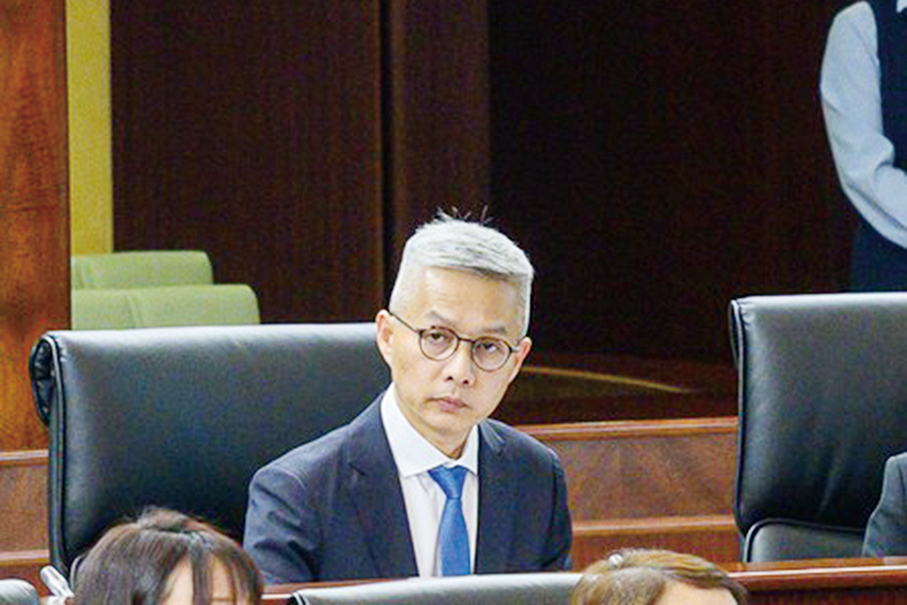
Secretary for Economy and Finance Anton Tai Kin Ip addresses yesterday’s plenary session in the Legislative Assembly’s (AL) hemicycle. – Photo: GCS