The government announced yesterday that its wealth-sharing cash handouts this year will, in general, only be issued to Macau residents who stayed in Macau for at least 183 days in 2024, while those not staying in Macau due to at least one of eight formally defined reasons can submit their applications from June 18 requesting that they be officially exempted from the minimum stay requirement.
This year’s cash handouts will be issued to eligible local residents from the middle of July.
Since the government’s annual wealth-sharing programme was launched in 2008, the cash handouts had previously been paid out to every Macau permanent and non-permanent resident ID card holders, irrespective of place of birth, nationality, age, and current place of residence.
It is now the first time that the government has introduced major amendments to the modus operandi of its annual wealth-sharing programme since its launch in 2008, by now rolling out the 183-day requirement.
Since its inception, the only major changes to the scheme over time have been the gradual increases in the amounts.
Eligible permanent local residents will receive 10,000 patacas each this year, while eligible non-permanent local residents will get 6,000 patacas each, with the amounts of the handouts for each beneficiary unchanged from last year.
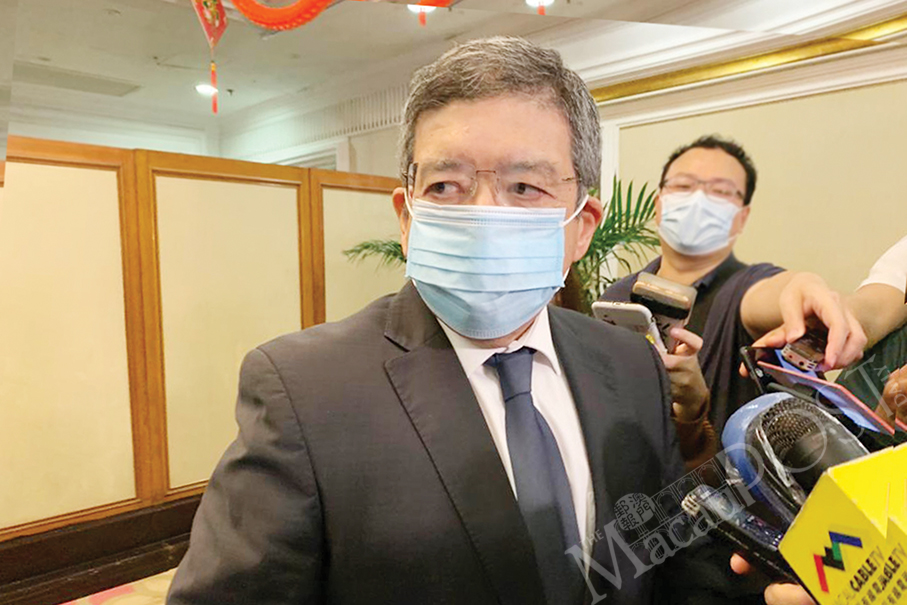
The government’s revamp of its annual wealth-sharing programme was announced by Secretary for Administration and Justice André Cheong Weng Chon in a press conference at Government Headquarters yesterday, after the government’s top advisory Executive Council, of which Cheong is the spokesman, had completed its discussion of the newly drawn-up administrative regulation (by-law) on the 2025 wealth-sharing programme.
According to Cheong, the government lists eight reasons in its 2025 wealth-sharing programme enabling those not having stayed in Macau for at least 183 days last year to be officially exempted from the requirement, after referencing the current system for the government’s cash injections into permanent local residents’ Central Provident Fund accounts listed in the law on its Non-mandatory Central Provident Fund system (Law 7/2017).
According to Law 7/2017, which has been in force since January 2018, only permanent local residents aged at least 22 who stay in Macau for at least 183 days a year are eligible to receive the government’s cash injections into their Central Provident Fund accounts in the subsequent year.
Law 7/2017 lists six reasons enabling those not staying in Macau to be officially regarded as if they were staying in Macau.
According to the revamped wealth-sharing programme, which was announced by Cheong yesterday, those not staying in Macau due to one of eight officially defined reasons can submit their applications between June 18 and December 31 requesting that they be officially exempted from the rule in order to benefit from this year’s wealth-sharing programme, namely:
1) Those studying for a higher education degree anywhere outside Macau officially recognised by the respective countries or regions’ authorities.
2) Those undergoing hospitalisation anywhere outside Macau.
3) Seniors aged at least 65 living in the mainland, or those under 65 living in the mainland because of the need to receive non-hospital care, palliative care or rehabilitation there.
4) Those working anywhere outside Macau for local employers registered with the Macau government’s Social Security Fund (FSS).
5) Those working anywhere outside Macau because of the need to support their family members in Macau.
6) Those performing official duties anywhere outside Macau.
7) Those working in the Guangdong-Macau In-Depth Cooperation Zone in Hengqin, or studying there either for a higher education degree or being enrolled in a school, or merely living there.
8) Those working in one of the nine mainland cities in the Guangdong-Hong Kong-Macau Greater Bay Area (GBA).
The first six reasons listed in the government’s 2025 wealth-sharing programme are the same as the six reasons listed in the Law 7/2017.
Cheong pointed out that the seventh and eighth reasons listed in the 2025 wealth-sharing programme are newly created ones compared to the current system for the government’s cash injections into permanent local residents’ Central Provident Fund accounts.
Cheong underlined that the local government has come up with these two new reasons in line with its current policy of promoting the integrated development between Macau and Hengqin and encouraging local residents, young people in particular, to pursue career developments or launch business start-ups in the GBA mainland cities.
When asked by reporters why the local government has decided not to include those not staying in Macau due to working in Hong Kong, which is also part of the GBA, as also being eligible to apply to be officially exempted from the 183-day rule, Cheong noted that the local government, according to its 2025 Policy Address delivered last month, will launch a 5,000-pataca monthly subsidy for young locals up to the age of 35 who work in the mainland cities in the GBA, for which the beneficiaries must have graduated from tertiary education institutions in Macau or elsewhere in order to receive the subsidy lasting up to 18 months, adding that the eighth reason listed in the 2025 wealth-sharing programme is in compliance with the subsidy.
Moreover, Cheong said that according to the 2025 wealth-sharing programme, three special groups of Macau residents who stayed in Macau for less than 183 days last year but do not meet any of the eight reasons will also be eligible to receive this year’s cash handouts, without having to make an application, namely:
1) Those aged below 22 by the end of last year but either their father or mother is eligible to receive the 2025 cash handouts.
2) Those who were eligible last year to receive an annual allowance for those with disabilities issued by the Social Security Fund (FSS).
3) Those eligible last year to receive an annual subsidy for those with disabilities issued by the Social Welfare Bureau (IAS).
Cheong also underlined that the government has decided to “improve” its wealth-sharing programme’s eligibility after studying various opinions raised by various segments of civil society, including those on social media.
Cheong underlined that the revamp aims to enable the cash handouts to more precisely benefit Macau residents who have close ties with the city.
Cheong also said that he expects the modus operandi of next year’s wealth-sharing programme to be the same as this year if “nothing special happens”.
Those who apply to be officially exempted from the 183-day requirement can submit the required documents via the Macau One Account e-government app, the scheme’s dedicated website, or at one of the various service centres. The applications will be handled by the Social Security Fund.
Cheong also said that there were 753,000 Macau ID card holders at the end of last year.
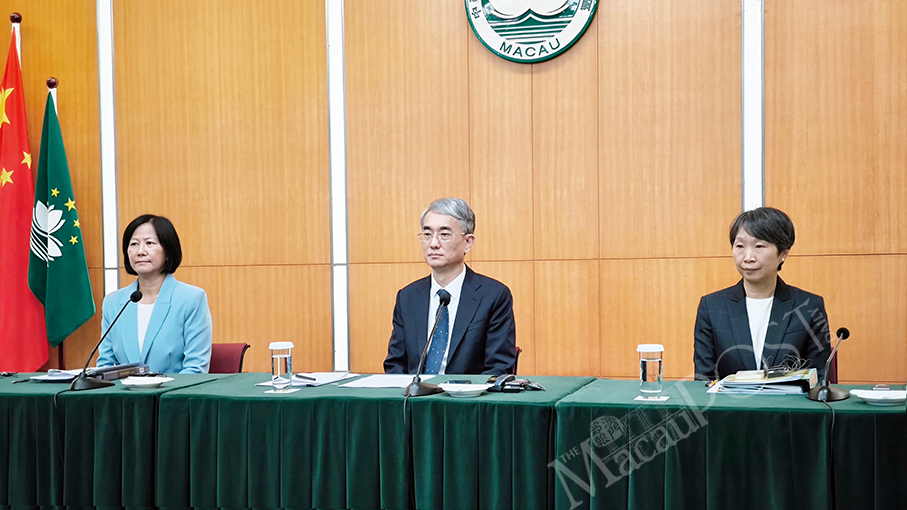
Secretary for Administration and Justice André Cheong Weng Chon (centre) addresses yesterday’s press conference at Government Headquarters, flanked by Social Security Fund (FSS) Acting President Chan Pou Wan (left) and Financial Services Bureau (DSF) Deputy Director Chong Seng Sam. – Photo: Tony Wong