Secretary for Economy and Finance Anton Tai Kin Ip said yesterday that this year’s government revenues would possibly be lower than what the government had initially forecast, because Macau’s average monthly gross gaming revenue (GGR) so far this year has remained below the monthly average of 20 billion patacas that the government is aiming for Macau to reach this year.
The Gaming Inspection and Coordination Bureau (DICJ) announced yesterday that the total GGR in the first three months of this year amounted to 57.657 billion patacas, equivalent to 19.219 billion patacas per month on average, just up 0.6 percent from the first three months of last year.
Tai made the remarks when addressing a conference with senior representatives from the city’s various business sectors. The conference was hosted by the Macau Chamber of Commerce (ACM), colloquially known in Cantonese as Chung Chung, at its headquarters in Zape.
Tai said that while Macau’s economy has been maintaining overall stability, it is still being affected by different uncertainties that the government needs to tackle.
Tai said that since early this year, Macau’s number of visitor arrivals has continued to rise thanks to the central government’s favourable measures and policies implemented for Macau including its new policies of issuing “one-trip-per-week” travel permits for Zhuhai residents and “multiple-entry” travel permits for Hengqin residents.
Starting on New Year’s Day this year, permanent residents of Zhuhai City can apply for a “one-trip-per-week” travel permit to Macau, enabling them to visit Macau once per calendar week, with a maximum stay of seven days per trip, within a one-year validity period, while permanent residents or residence permit holders in the Guangdong-Macau In-Depth Cooperation Zone in Hengqin can apply for a multi-entry travel permit to Macau, granting them unlimited visits to Macau within a one-year period, with a maximum stay of seven days per trip.
Tai pointed out yesterday that in the first two months of this year, Macau recorded 6.79 million visitor arrivals, a year-on-year increase of 10.4 percent, with the number of those from foreign countries rising by 19.5 percent year on year, while the average hotel occupancy rate stood at 90.7 percent, up 5.2 percentage points from the same period of last year.
Concerning the job market, Tai noted that the unemployment rate for local residents stands at 2.3 percent, remaining at a relatively low level.
Tai also noted that Macau’s inflation rate stood at 0.74 percent last year, indicating stability in the overall price level, while Macau’s gross domestic product (GDP) grew 8.8 percent in real terms last year.
However, Tai said, unilateralism and protectionism are clearly on the rise, where the global economic development is facing many instabilities and uncertainties, adding that as a highly open and externally orientated micro-economy, Macau cannot remain immune to these influences.
Tai underlined that while the local government has been intensively expanding Macau’s visitor source markets and segments, the city’s tourism industry is being affected by a significant change in visitors’ consumption patterns and behaviours.
Tai pointed out that while visitors’ non-gaming spending last year increased by 5.8 percent year on year, last year’s per-capita spending dropped by 14.6 percent year on year to 2,157 patacas.
Tai said that the uneven recovery of the global economy has also created new challenges for local businesses.
Moreover, Tai noted that in the first three months of this year, Macau’s gross gaming revenue (GGR) amounted to 57.66 billion patacas, around the same as in the same period of last year, meaning that the average monthly GGR so far this year still has not reached a monthly average of 20 billion patacas that the local government targeted for this year, because of which, Tai said, this year’s government revenues would possibly be lower than initially forecast.
Consequently, Tai said, the local government must carefully study and assess Macau’s future economic situation and adhere to prudent financial management based on the Macau Basic Law’s principle of keeping expenditures within the limits of revenues.
According to Article 105 of the Macau Basic Law, the Macau Special Administrative Region (MSAR) shall follow the principle of keeping expenditure within the limits of revenues in drawing up its budget, strive to achieve a fiscal balance, avoid deficits, and keep the budget commensurate with the growth rate of its gross domestic product (GDP).
According to the government’s 2025 budget bill, which was passed by the legislature in its final reading late last year, the government expects Macau’s GGR to reach 240 billion patacas in 2025, or a monthly average of 20 billion patacas, a sum that constitutes the main source of budgeted government revenues proposed by the 2025 budget bill. The forecast of 2025 GGR reaching 240 billion patacas was made as the government expected Macau’s economic recovery to continue in 2025.
According to the DICJ website, Macau’s GGR stood at 18.254 billion patacas, 19.744 billion patacas and 19.659 billion patacas in January, February and March this year respectively, all lower than 20 billion patacas.
Since its post-COVID-19 recovery, Macau’s monthly GGR only exceeded 20 billion patacas in May and October 2024, amounting to 20.188 billion patacas and 20.787 billion patacas respectively.
Meanwhile, Tai also pledged yesterday that the government will continue to improve the city’s business environment where it will step up its efforts to support the operations and development of local small- and medium-sized enterprises (SMEs).
Tai underlined that the local government will continue to advance its appropriate economic diversification campaign and to integrate Macau’s development into the nation’s overall development.
Chief Executive Sam Hou Fai will deliver his 2025 Policy Address in the hemicycle of the Legislative Assembly on April 14.
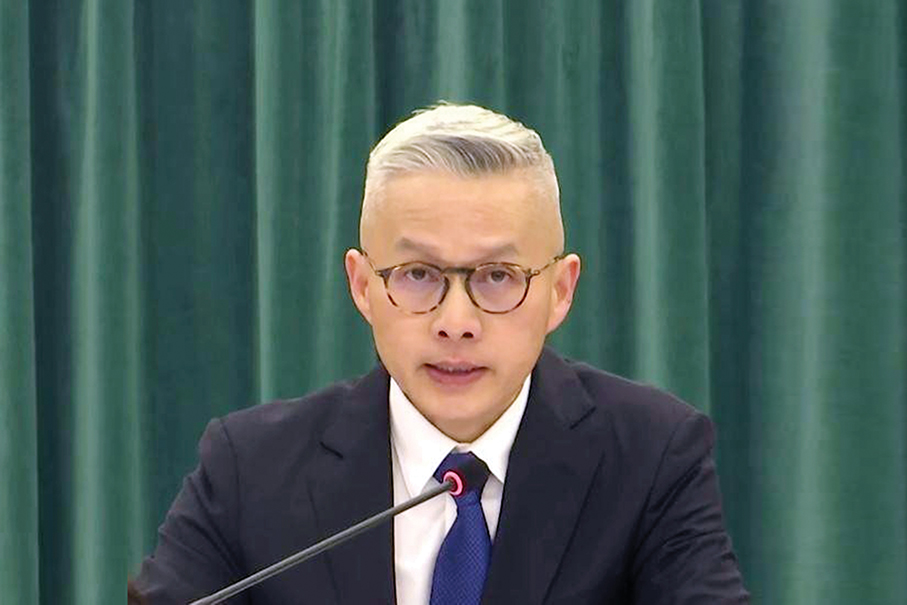
Secretary for Economy and Finance Anton Tai Kin Ip addresses yesterday’s conference with senior business representatives at the Macau Chamber of Commerce (ACM) headquarters in Zape. – Photo courtesy of TDM