China Daily Editorial
China’s LineShine has retained its status as the world’s fastest supercomputer. It took pole position in both the TOP500 rankings and the High Performance Conjugate Gradients Benchmark results that were released in Chicago on Monday. Retaining the top spot it claimed in June, the supercomputer installed at the National Supercomputing Center in Shenzhen highlights the resilience of the country’s technological innovation in the face of some developed economies’ technology restrictions.
The system achieved a sustained performance of 2.198 exaflops, or 2.198 quintillion floating-point operations per second on the High Performance Linpack benchmark, which put it about 21 percent ahead of the United States-based El Capitan supercomputer.
LineShine also retained the lead in the HPCG Benchmark tests with 22 petaflops, ahead of El Capitan’s 17.41 petaflops. This made it the first supercomputer in TOP500 history to exceed 2 exaflops of sustained double-precision performance using only central processing units (CPUs), according to the organization.
Despite Washington’s efforts to cut off China’s access to advanced technologies and high-end GPU accelerators, years of investment in homegrown supercomputing have paid off. That is what makes these results more than a technical achievement. LineShine achieved its performance using only domestically developed CPUs.
Washington, however, appears determined not to acknowledge this. On Monday, the US Commerce Department released an interim final rule titled “Addressing Remote Access to Advanced Semiconductors”, requiring licenses for the export of advanced chips to Singapore, Thailand, Malaysia, Indonesia and Brazil, which the US considers as potential conduits for chips destined for China.
But as Chinese Foreign Ministry spokesman Guo Jiakun rightfully pointed out, the move is yet another case of the US overstretching the concept of “national security”. Indeed, Washington remains obsessed with viewing what should be normal competition over artificial intelligence with China as a zero-sum game, going so far as to blatantly abuse export control measures to interfere in normal trade and technological cooperation between China and other countries, and targeting China’s high-tech industry.
Notably, the new rule retains exemptions for eligible US companies while imposing stricter restrictions on companies from other countries. The discriminatory nature of the rule raises questions about whether “national security” concerns are being used to advance US commercial interests and maintain its technological dominance.
Such economic coercion and long-arm jurisdiction run counter to the common understandings between the two countries, harm the legitimate rights and interests of Chinese companies, and disrupt global supply chains. It is only natural that China will do what is necessary to firmly safeguard its legitimate rights and interests.
The AI competition between China and the US highlights the contrast in what the two countries are offering the world. While the US is setting up all kinds of restrictions on healthy competition and coercing other countries to join and side with its exclusive closed-source ecosystems, China is promoting open source, inclusivity and sharing.
Chinese open-source models regularly dominate OpenRouter’s popularity rankings. They are used by US companies and by developers across the developing world alike. This is what it looks like to let everyone board the AI development train and share the convenience and benefits of this cutting-edge technology. The danger of the alternative is far greater than an innovation slowdown – LineShine shows it will not. The real danger is a more fragmented AI landscape that leaves many countries, especially developing economies, lagging behind in the next technological revolution.
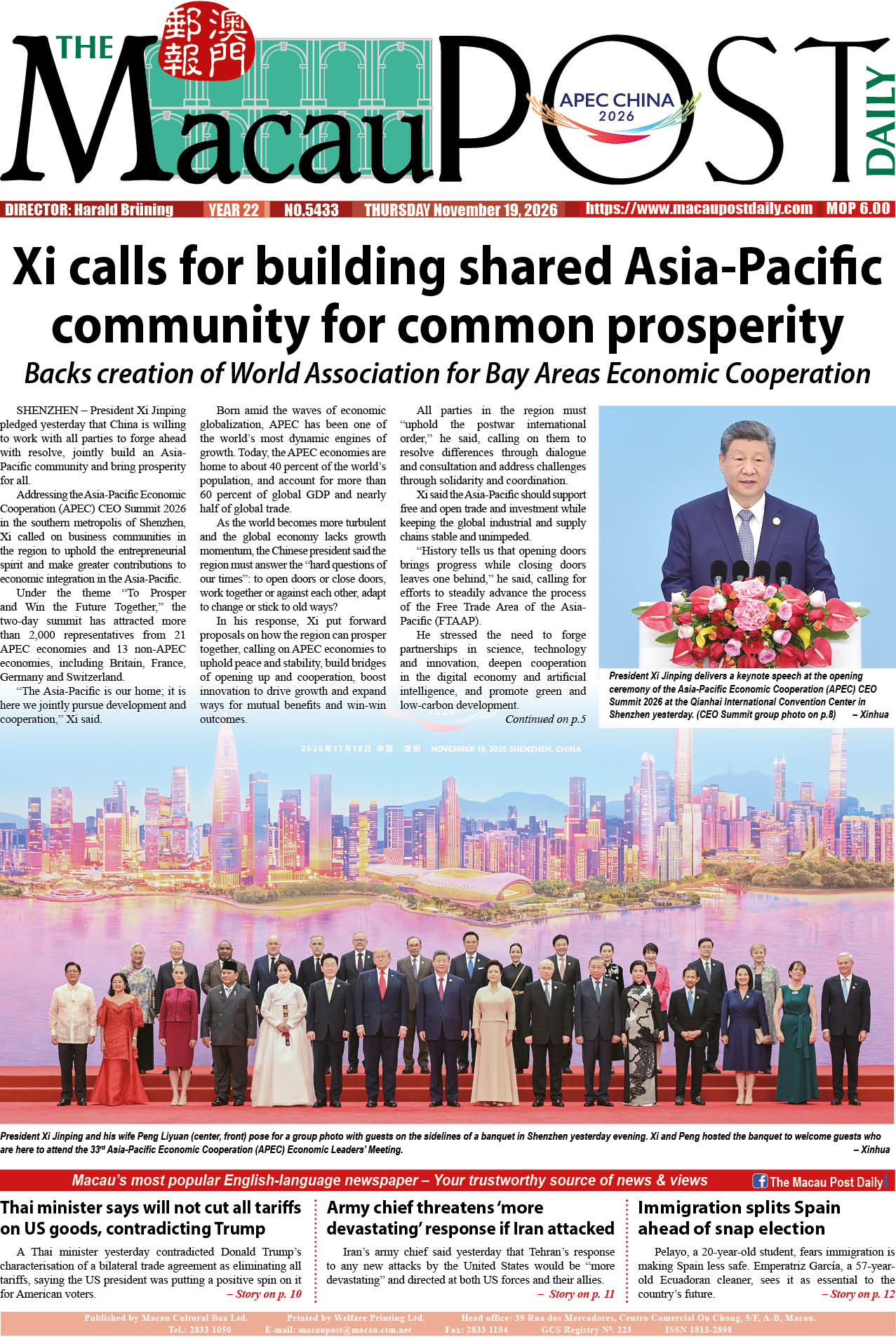
This week’s APEC meetings in Shenzhen offer China and the US an opportunity to turn their consensus on strengthening AI communication into practice. In September, the two sides agreed to establish a dedicated communication channel for addressing unexpected AI-related incidents and for exchanging best practices on evaluating and testing models before release.
As major countries in AI, China and the US share a common responsibility to work together to keep AI under human control, uphold a people-centered approach and the principle of AI for good, and ensure that AI advances human progress.
– Courtesy of China Daily