Dr Sun Yat-sen’s Macau years are usually told as the story of a gifted young doctor who opened the territory’s first Western clinic, treated a hundred patients a day, was hounded out by jealous colleagues, and founded the newspaper Echo Macaense (鏡海叢報)* to spread his ideas. At a University of Macau (UM) Centre of Macau Studies (CMS) symposium marking the 160th anniversary of his birth on Thursday, scholars argued that nearly every element of it is unsupported or demonstrably wrong.
A loan, not a fortune
Prof. Wong Man Fai, speaking at the “Echoes of the Mirror Sea” symposium at the University of Macau, said the surviving material on Dr Sun’s Macau period is almost entirely medical, and must be read as medical history – set within the Western medical practice of late nineteenth-century Guangdong, Hong Kong and Macau – before it can be trusted.
His documents are loan receipts. Dr Sun borrowed twice from the charitable fund at Kiang Wu Hospital; the second, of 2,400 silver dollars in 1893, carried interest of one per cent a month, earmarked for medicines given away free. He attended the hospital for two hours each morning and took no fee. That, Wong said, followed the hospital’s established practice of “free consultations but not free medicine”; it was not the self-financed venture described in the Echo Macaense.
Nor does the arithmetic support the paper’s claim that Dr Sun treated “a hundred or more patients a day”: fifty patients in two hours would allow 2.4 minutes each, whereas a hospital in Hong Kong averaged 27 outpatients a day in 1892.
The famous line that Dr Sun was “resented by the hospital’s staff, doctors and managers” appears one time in Echo Macaense of December 19, 1893, and became a popular legend. It was written, Wong said, by the paper’s Chinese editor, who attributed it to the Portuguese editor while using it to attack Kiang Wu, two months after Dr Sun had left for Guangzhou.
The institutional record points the other way. Kiang Wu set aside a consulting room for him and allowed him to treat patients with Western medicine and to perform surgery, at a time where Western medicine was still widely rejected by Chinese. Sun himself later wrote in “Kidnapped in London”** that no Chinese hospital’s board had ever given Western medicine “such direct and formal encouragement”.
The newspaper he did not found
Prof. Agnes Lam Iok Fong, director of the Centre for Macau Studies, took the second legend apart with three questions: was the Echo Macaense Macau’s first Chinese newspaper, did Dr Sun found it, and did he run it with the publisher Francisco H. Fernandes?
To the first, the answer is no. The Tsu-Wan-Pien (雜聞篇), or “A Miscellaneous Paper”, was printed in Macau in 1833, 60 years earlier. To the second and third, there is no primary evidence at all. In the surviving issues the publisher is Fernandes and the editor-in-chief Wang Zhenqing, a Guizhou native. When the editor was jailed in 1895 for offending the governor, and when the paper faced litigation, the man responsible was never Dr Sun.
According to Lam, the legend has a traceable beginning: an oral-history interview with Fernandes’s friend’s descendants in Lisbon in 1986, which entered popular literature in the 1990s and passed from there into Wikipedia, local newspapers, and AI-generated summaries – each retelling it more confident than the last.
Kidnapped in London, Sun’s own later recollections and Portuguese-language scholarship say nothing of the kind. Nevertheless, because the Echo Macaense emerged from a special reformist circle in modern Macau, Dr Sun’s close ties to the paper demonstrate that he was an indelible member of this circle.
What the sources describe is less heroic and more interesting: a young doctor who borrowed money to give free consultations inside a Chinese charitable hospital willing to let him try Western medicine, and a newspaper he did not own that carried his views, advertisements and distribution. Macau, on this reading, was not the scene of his martyrdom but the place where an institution took a calculated risk on him.
* Founded on July 18, 1893, Echo Macaense was Macau’s first Chinese-Portuguese bilingual weekly newspaper, which published its Chinese edition for two and a half years and featured Francisco H. Fernandes as the masthead publisher, Wang Zhenqing as the Chinese chief editor, and Dr Sun Yat-sen as a prominent figure in its medical and advertising content. This information was provided during Lam Iok Fong’s presentation. – Gemini
** Kidnapped in London is Sun Yat-sen’s first-person account of his 1896 abduction and 12-day imprisonment by the Qing legation in London, written to expose the Qing government’s persecution and clear his name after his release. – Gemini
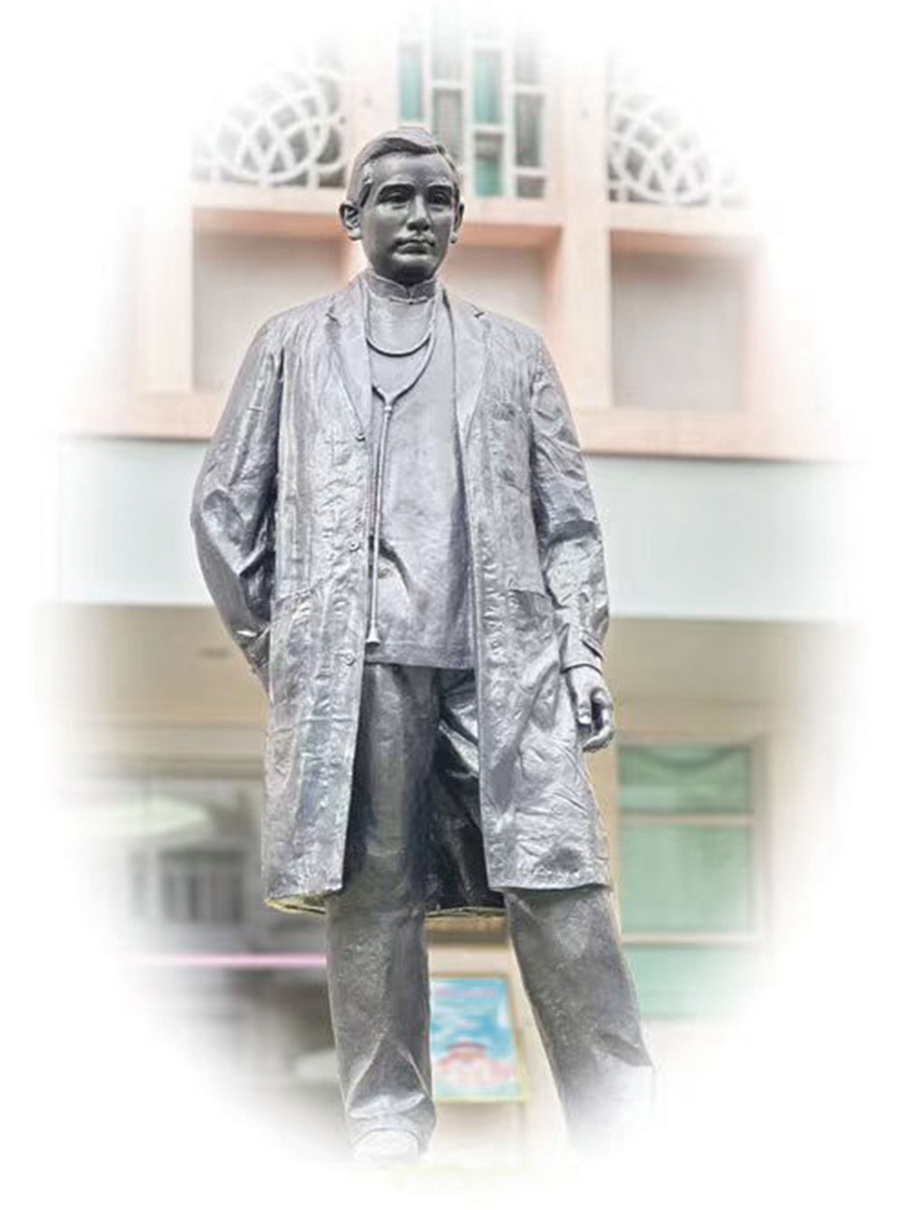
This undated file photo, downloaded from the Kiang Wu Hospital website, shows a bronze statue of Dr Sun Yat-sen standing at the hospital’s main entrance since 1986.
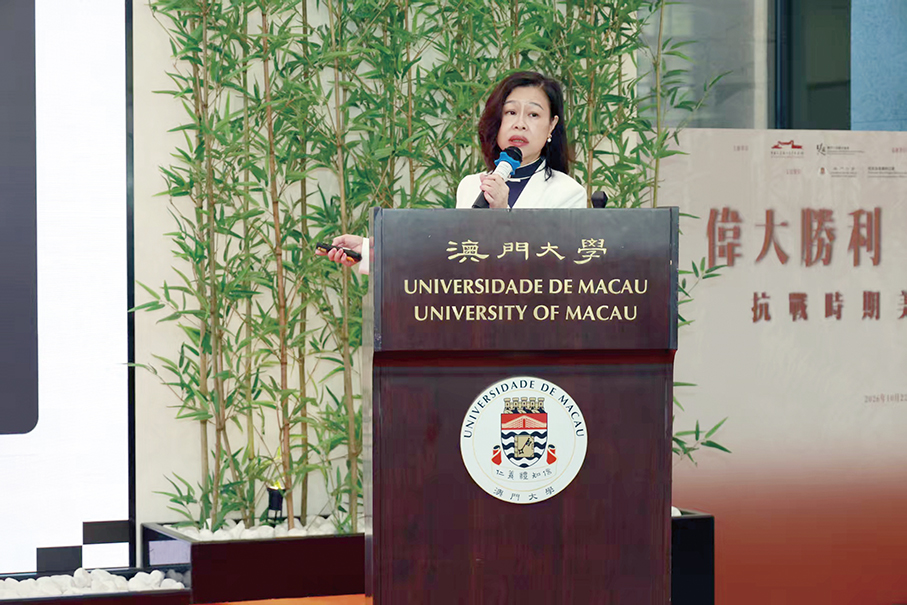
Prof. Agnes Lam Iok Fong, director of the Centre for Macau Studies (CMS), speaks during Thursday morning’s symposium on the UM campus.
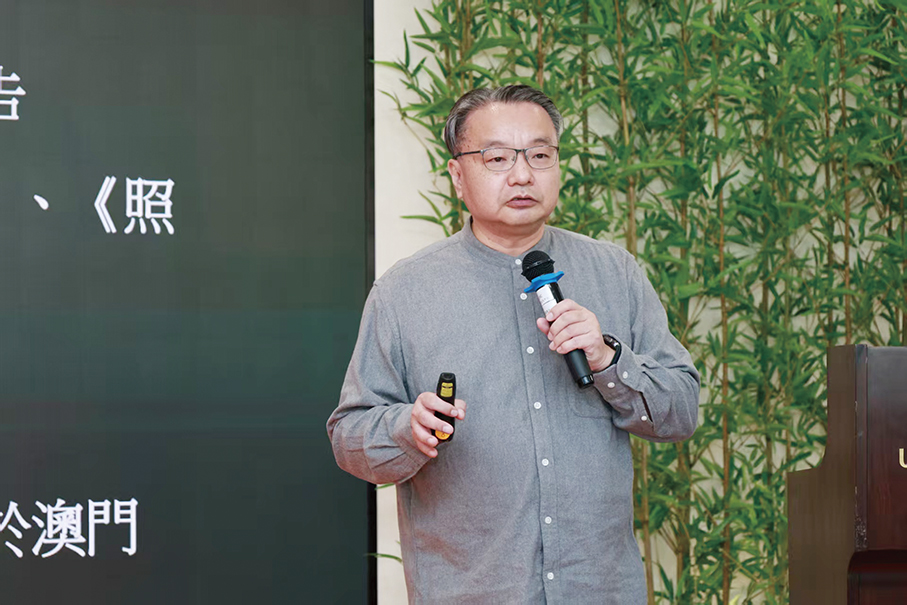
Prof. Wong Man Fai delivers the symposium’s keynote speech on Thursday morning. – Photos: Alex Kot
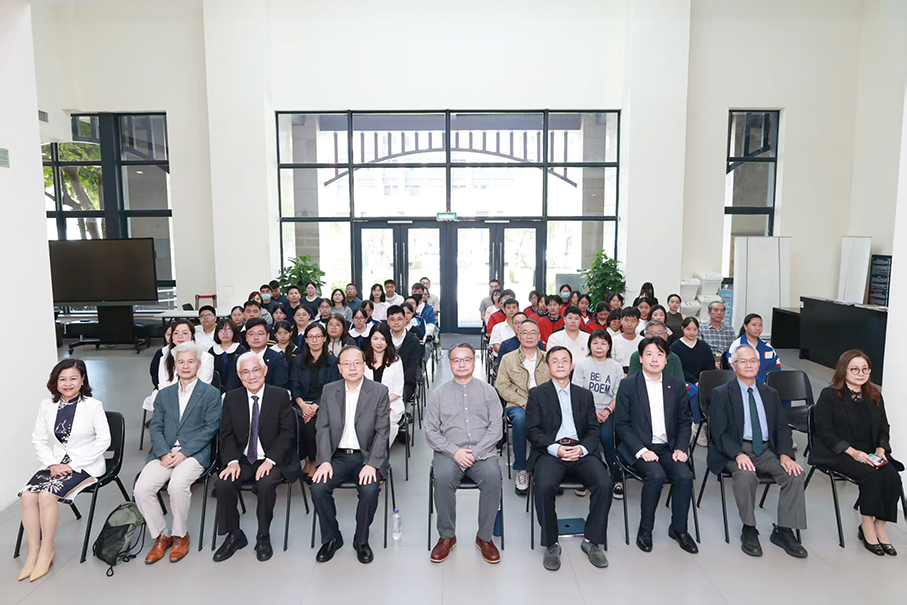
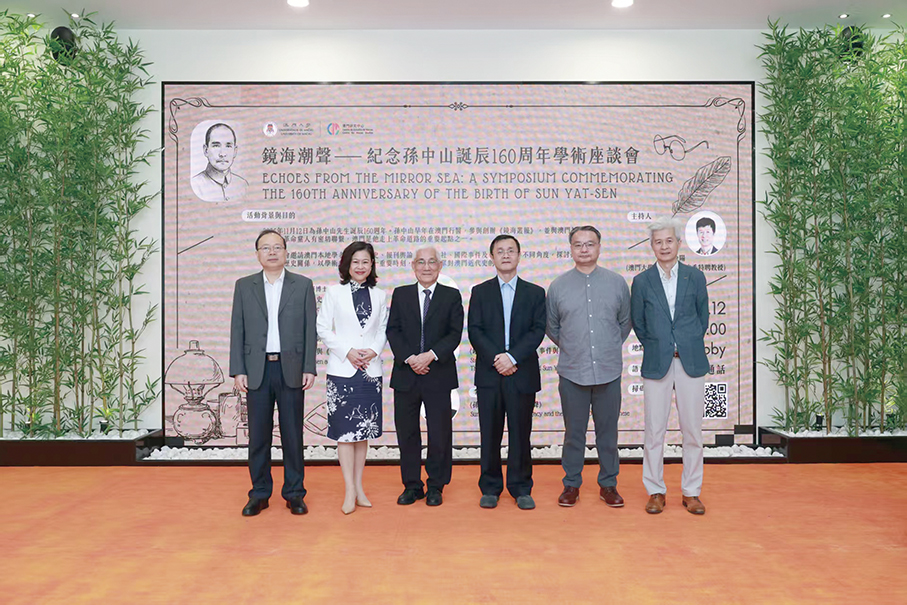
Group photo of the symposium’s speakers, guests and attendees seated at E34 on the UM campus last Thursday.