The Macao New Chinese Youth Association (MNCYA) hosted a press conference on Friday to present the findings of its Survey on Financial Management Concepts and Consumption Behaviours of Secondary School Students in Macau, which shows that 83 percent of respondents are aware of pocket money management.
According to a statement released after the event on Friday, the press conference took place at the group’s headquarters in the Macao Daily News Building.
The survey collected a total of 1,550 valid questionnaires.
The results showed that over 85 percent of secondary school students most commonly use e-wallets for their daily spending, nearly 90 percent have online shopping habits, and over 80 percent have experience spending on the mainland.
For both online shopping and spending on the mainland, the core considerations were “lower prices” and a “greater variety of products and brands”. However, the findings also showed that only 16 per cent of secondary school students set clear savings goals, 36 per cent said they never record their personal income and expenditure, and only 15 percent “often record” or “record after every purchase” their income and expenses.
According to the findings, students’ financial concepts mainly come from “their own spending experience” and “the words and example of parents and family members”. Among them, high school students showed significantly higher recognition of school-based financial education than junior secondary students, the findings showed.
Students considered the three most important financial skills to be, in order of importance as ranked by respondents: “distinguishing between ‘needs’ and ‘wants’”, “developing saving habits”, and “identifying consumer traps”.
In the statement, MNCYA Vice President Chu On Kio said that the widespread use of electronic payments, online shopping, and cross-border spending has made secondary school students’ consumption decisions increasingly instantaneous.
3 recommendations
In its statement, the Macao New Chinese Youth Association put forward three recommendations:
First, parents should discuss pocket money budgeting with their children and set specific savings goals together to cultivate the habit of planning their finances independently.
Second, schools should integrate financial education into subjects such as economics, liberal studies, or life education, and design practical, real-life activities such as recording income and expenditure and identifying promotional tactics.
Third, the local government could study the formulation of curriculum guidelines for financial education and regulate marketing practices targeting minors.
Finally, the MNCYA vowed that it will offer diverse platforms – through activities such as hands-on financial planning workshops and discussion sessions on consumer attitudes – for students to experience different consumption scenarios and learn financial knowledge, working together to create a sound financial education and consumer environment for secondary school students.
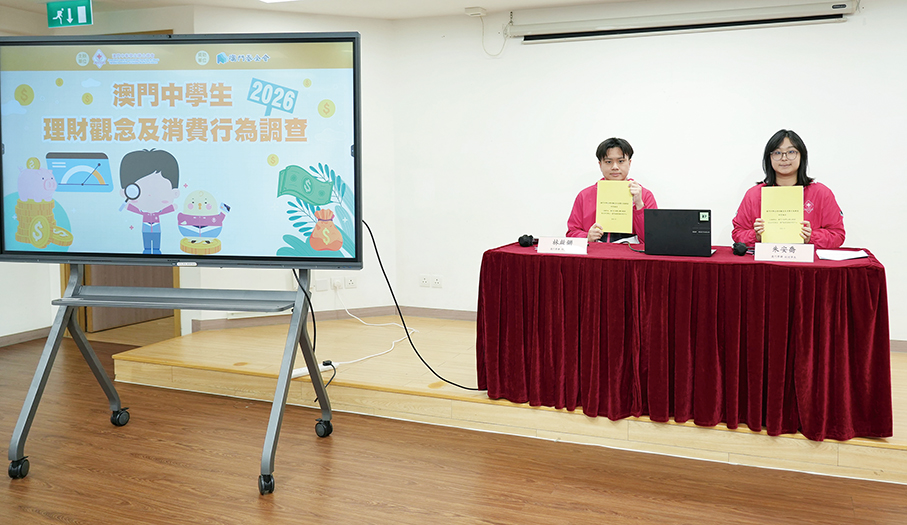
This handout photo provided by the Macao New Chinese Youth Association (MNCYA) on Friday shows its Vice-President Chu On Kio (right) and a fellow member posing with the survey findings during Friday’s press conference at its headquarters at Macao Daily News Building