The government-appointed Central District Community Service Consultative Council held its regular monthly meeting yesterday, where members raised various ideas regarding the just concluded National Day ‘Golden Week” temporary pedestrianisation drive, calling for more car-free zones during public holidays and weekends.
The first part of the meeting at the Patane Activity Centre was open to the media, during which committee members raised several issues in their speeches. The meeting then proceeded behind closed doors, where Economic and Technological Development Bureau (DSEDT) Business Promotion Division Chief Lai Chi Wai and senior official Choi Hong Iong presented an overview of the pedestrianisation scheme during the “Golden Week” and outlined measures to boost the economy in the city’s central district.
Councillor Pun Sio Nam submitted a written proposal recommending that consideration be given to transforming the city’s two temporarily pedestrianised zones – which were set up specifically for Golden Week – into a “regular weekend” arrangement or a recurring scheme on designated public holidays.
This, Pun suggested, could help Rua de Nossa Senhora do Amparo (關前後街) in the Laahn Gwai Lau neighbourhood become a new engine for economic development in the old quarters of the central district. Committee member Chan Meng Kei, meanwhile, expressed concern that the current plan is too heavily concentrated on specific main roads, and suggested studying ways to divert visitors into surrounding alleys and neighbouring areas.
In the post-meeting press briefing, fellow councillor Ieong Chon cited a DSEDT statement released to councillors during the meeting. According to the bureau, during the operation of the pedestrian zones from last Thursday through Tuesday, crowd and traffic management was optimised in the Old Taipa Village area and around Rua de Nossa Senhora do Amparo. The objective was to ensure the safe and orderly movement of pedestrians and vehicles while balancing the impact on residents’ travel, school drop-offs and pick-ups, and merchants’ business operations. During the implementation period, a total of 13 performances and activities were organised in collaboration with community organisations to attract residents and tourists to visit and spend, Ieong said.
The council’s deputy convenor, Chang Ka Wa, cited fellow councillors’ concerns that, in addition to the pedestrian zones themselves, activities in nearby areas were causing traffic disruption. Chang suggested that for future events, advance communication with businesspeople should be conducted and publicity efforts targeting local residents should be strengthened. According to Chang, the DSEDT officials said that the bureau will continue to engage with all sectors of civil society, gather opinions, and conduct a comprehensive assessment of the results.
Regarding the new consumption scheme starting this coming Friday, Chang noted that newly added discount vouchers provided by the bureau will enable businesses to offer a wider range of promotions to consumers, with participating shops and eateries identified by stickers. As for card-tapping points, the bureau will extend the scheme to public health centres for a period of 10 weeks, making it more convenient for residents to tap their cards across staggered locations, Chang added.
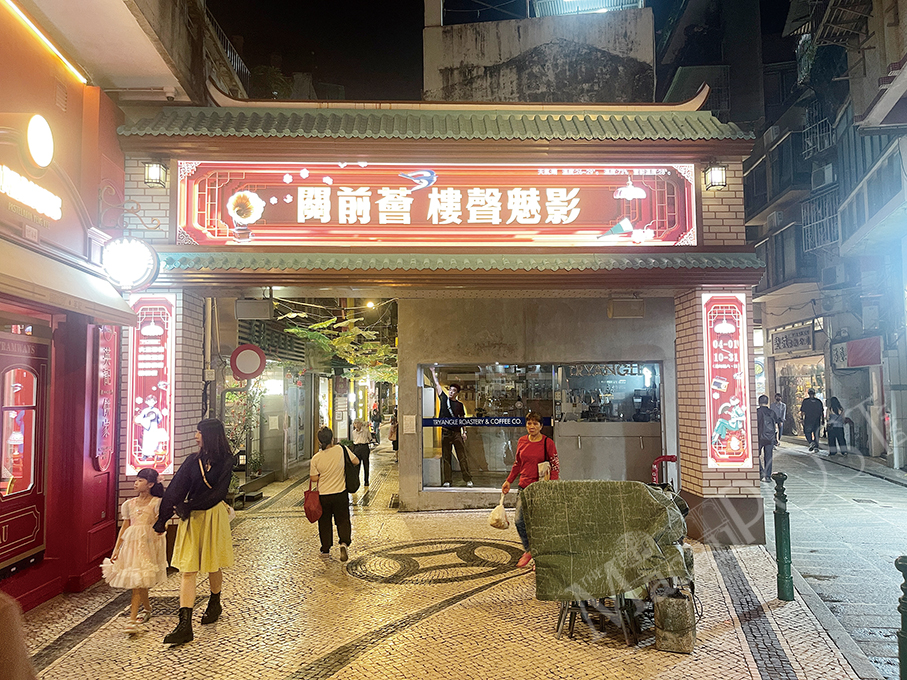
Pedestrians walk along Rua de Nossa Senhora do Amparo in the UNESCO-listed Historic Centre of Macao’s “Laahn Gwai Lau” neighbourhood yesterday. – Photo: Armindo Neves