Chief Executive Sam Hou Fai has convened and chaired this year’s annual plenary meeting of the Cybersecurity Commission, underlining the importance of strengthening coordination between the safeguarding of cybersecurity and national security.
According to a statement by the commission yesterday, the meeting was held at Government Headquarters on Monday.
The commission was established in December 2019 when Macau’s Cybersecurity Law came into force.
During the closed-door meeting, Sam said that cybersecurity is a crucial component of the system for safeguarding national security and a fundamental pillar in consolidating Macau’s defence line for safeguarding national security. Facing continuous and profound shifts in the international landscape, geopolitical risks have worsened, aggravating instability and uncertainty, the statement quoted him as saying.
Therefore, while advancing the implementation of Macau’s 3rd Five-Year Plan in close alignment with the nation’s 15th Five-Year Plan, it is imperative for the local government to effectively coordinate development and security, maintain a mindset prepared for worst-case scenarios, and adopt a proactive stance to systematically prevent and resolve major security risks, Sam said.
The Macau government announced and published the final version of the 3rd Five-Year Plan last month.
Sam noted that new information technologies – such as AI, big data, and cloud computing – have evolved rapidly, bringing emerging issues like data security, privacy protection, and technology misuse to the fore. Cyberattacks now display new features, including high intelligence and automation, posing threats to social order, the public interest, and national security.
Consequently, the local government must continuously bolster its coordination capacity for cybersecurity, firmly safeguard the security and controllability of government IT infrastructure, proactively address new risks posed by emerging technologies through a systematic approach, and formulate comprehensive, detailed, and pragmatic top-level planning and strategic action plans for cybersecurity, Sam said.
Sam said that coordinating the safeguarding of cybersecurity and fostering positive interactions between high-level security and high-quality development are key to accelerating Macau’s appropriate economic diversification, deeply integrating Macau’s development into the nation’s overall development, and ensuring the full implementation of all government policy initiatives.
According to the statement, Sam urged all respective public entities to rigorously advance the security and controllability of government IT systems, implement cybersecurity development initiatives in an orderly manner in line with plans, and strengthen support for cybersecurity technology talent based on actual needs.
Sam also instructed the government’s Cybersecurity Incident Alert and Response Centre to effectively fulfil its coordinating role and work with relevant public entities to advance initiatives in an orderly fashion, ensuring that all tasks are completed in a timely and high-quality manner.
According to the Cybersecurity Law, Macau’s cybersecurity system comprises three parts: (1) the Cybersecurity Commission, (2) the Cybersecurity Incident Alert and Response Centre, and (3) various government entities supervising the operators of the city’s “critical infrastructure” – officially known as Cybersecurity Supervisory Entities.
The Cybersecurity Commission, headed by the Chief Executive, is tasked with strategic planning and decision-making for Macau’s cybersecurity while overseeing the operations of the Cybersecurity Incident Alert and Response Centre and the Cybersecurity Supervisory Entities.
The Cybersecurity Incident Alert and Response Centre comprises officials from the Judiciary Police (PJ), the Public Administration and Civil Service Bureau (SAFP), and the Post and Telecommunications Bureau (CTT).
According to the Cybersecurity Law, “critical infrastructure” refers to assets, information networks, and computer systems important to the normal functioning of civil society whose disruption, destruction, data leakage, suspension of operation, or significant decrease in operational performance is likely to cause serious harm to public well-being, public safety, public order, or other important matters of public interest.
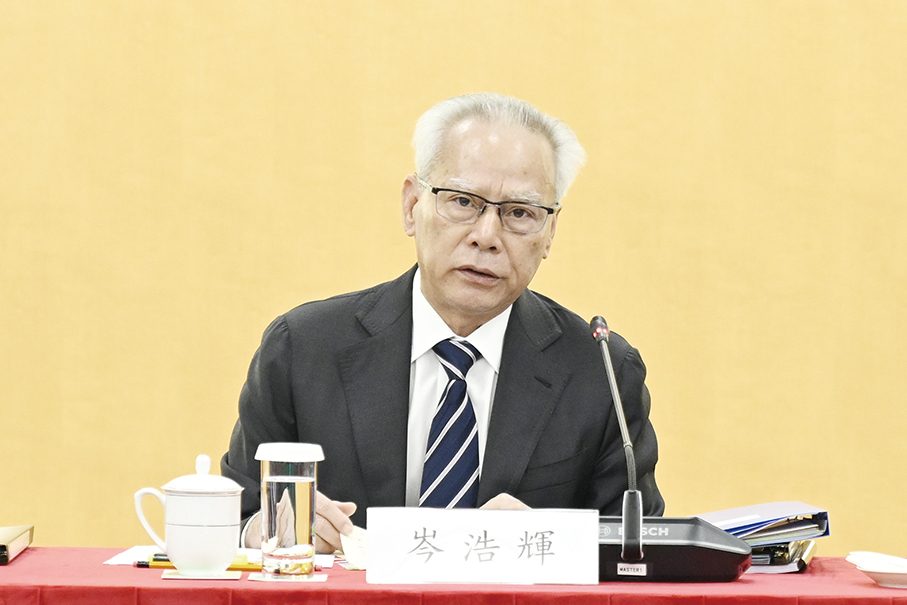
Chief Executive Sam Hou Fai addresses Monday’s meeting of the Cybersecurity Commission at Government Headquarters in Nam Van district. – Photo: GCS