The local government said yesterday that Macau residents’ average life expectancy reached 83.5 years last year – men at 80.6 years and women at 86.3 years, ranking amongst the highest in the world.
The Macau Government Information Bureau (GCS) made the remarks in a statement on its official WeChat account yesterday.
“Since Macau’s return to the motherland, local residents’ life expectancy has risen substantially”, the statement said.
The statement noted that Macau’s average life expectancy was 77.9 years shortly before its return to the motherland. Over the past two-plus decades, the statement said, the figure has seen a substantial increase, outstripping the growth rate of most developed economies, which it said has “directly” been attributed to the local government’s increased investment in public health following Macau’s return to the motherland, with healthcare expenditure as a share of gross domestic product (GDP) rising from 2.1 percent to 3.8 percent in 2023.
The Macau Special Administrative Region (MSAR) was established on December 20, 1999, marking Macau’s return to the motherland and the end of Portugal’s temporary administration of the city.
According to historical data from the Statistics and Census Bureau (DSEC), Macau’s official statistics agency, Macau residents’ average life expectancy at birth stood at 76.6 years in the 1993-1996 period (the earliest available data on the DSEC online database) and 77.9 years in the 1996-1999 period. The figure had gradually risen to the highest, 84.2 years, in the 2018-2021 period, men at 81.3 years and women at 87.1 years. Afterwards, the figure stood at 83.8 years (2019-2022), 83.1 years (2020-2023), 83.3 years (2021-2024), and 83.5 years (2022-2025).
Yesterday’s GCS statement noted that in alignment with the Outline of the Healthy China 2030 Plan, the MSAR government released its Healthy Macau Blueprint in July 2024, integrating health-related aspects into all public policies. Currently, the statement said, Macau has established a healthcare network comprising “public hospitals + private hospitals + primary health centres”. In 2025, the number of registered doctors, nurses, and hospital beds per 1,000 population in Macau reached 3.0, 4.4, and 2.7, respectively, the statement said.
Backed by an extensive primary healthcare network, the statement said, Macau’s nine public health centres provide a wide range of services such as vaccinations and chronic disease management, with the coverage rate for routine immunisation vaccines consistently maintained above 98 percent.
Addressing health threats such as hypertension and diabetes, the statement said, Macau has been implementing a programme facilitating full-cycle management for chronic disease patients through the city’s network of family doctors. Compared to Hong Kong, which is also a city with a high level of average life expectancy, Macau’s mortality rate from cardiovascular diseases is currently 17 percent lower, the statement said.
Hong Kong’s average life expectancy also ranks among the top in the world. According to Hong Kong’s Census and Statistics Department, the city’s average life expectancy at birth reached 83.3 years for men and 88.7 years for women last year. Hong Kong’s official statistics agency publishes average life expectancy at birth for men and women as separate figures, but does not provide a combined average for the population as a whole.
Yesterday’s GCS statement also noted that Macau is one of the strictest regions in the world as far as tobacco control is concerned, with a blanket ban on smoking in all indoor public venues and facilities. Macau’s smoking rate dropped to 11.6 percent in 2023 from 16.9 percent before the current Tobacco Prevention and Control Law took effect on January 1, 2012.
The statement also said that the density of fitness equipment in public parks and sitting-out areas across the city has increased annually, while the proportion of local residents exercising regularly now exceeds 60 percent.
Macau’s experience, the statement said, can serve as a reference for the development of healthy city clusters within the Guangdong-Hong Kong-Macao Greater Bay Area (GBA).
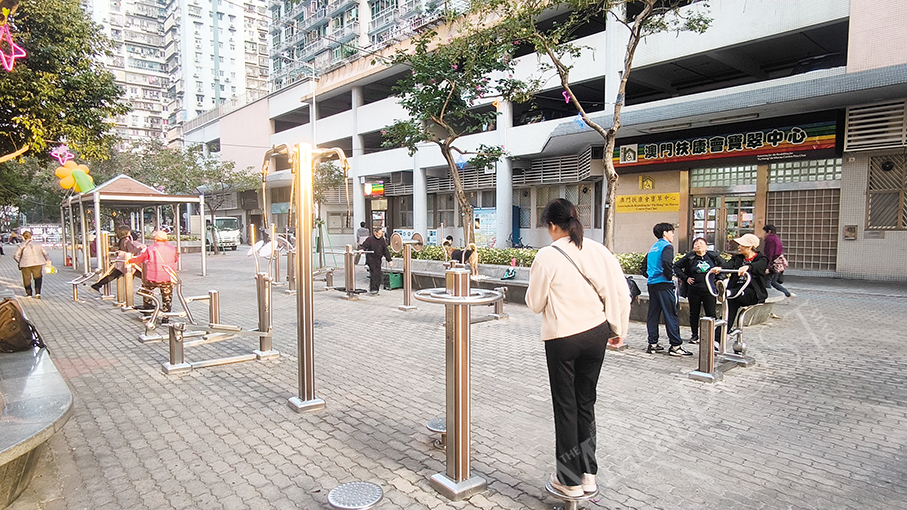
This file photo taken earlier this year shows residents exercising on fitness equipment at the sitting-out area outside the Lok Yeung Fa Yuen residential estate in Fai Chi Kei. – Photo: Tony Wong