Judiciary Police (PJ) Director Sit Chong Meng told reporters at the PJ’s headquarters in Zape earlier this year that its Youth Concern Section had received a total of 250 requests for assistance last year, representing an increase of 64.5 percent compared to 2024.
Sit said that most of these cases involved self-harm among students and expressed the hope that schools and parents would pay closer attention to the emotional well-being of young people.
In the wake of Sit’s remarks, the Post interviewed Clarissa Mok Chi Ian, in charge of the Bosco Youth Service Network’s Family Wellness Centre, and Michelle Chan Mei Ha, in charge of the Bosco Youth Service Network’s School Social Work Department, at the centre on Rua de Francisco António recently.
According to Chan, the main sources of young people’s stress fall into four categories, namely family, peer relationships, academic pressure, and social media comparison.
Mok pointed out that although the government has established a four-part collaborative mechanism involving schools, communities, hospitals and parents, the healthcare system suffers from a shortage of personnel, resulting in cases not receiving adequate follow-up after being referred to mental health specialists. Chan recommended increasing mental health resources to strengthen the support network.
Chan said that school counsellors are those most likely to meet young people at risk of self-harm.
Chan pointed out that such cases are typically identified initially either by teachers observing unusual behaviour in students – such as wearing long sleeves in hot weather, or through students actively seeking help.
The process involves conducting interviews for assessment and providing psychological counselling, according to Chan, adding that in severe cases, referrals are made to the psychiatric department of the public Conde de São Januário Hospital Centre.
However, Chan pointed out that the medical system has long waiting times, and due to the high volume of cases, doctors are often unable to provide an in-depth follow-up. As a result, cases are quickly referred back to the community for counsellors to continue monitoring and support, Chan said.
While civil society’s acceptance of mental health issues has improved compared to a decade ago, Chan said, some parents remain resistant to their children receiving psychiatric treatment or medication, primarily due to concerns about labelling.
Mok added that in recent years, the Social Welfare Bureau (IAS) has strengthened public education and destigmatisation efforts through initiatives such as its “Guardian of Lives” programme and “Mental Health Support Group”. The bureau has also developed resource kits and promotional materials, distributing them through schools, street booths, and social media to encourage citizens to look after their own mental health and that of those around them, Mok said.
Regarding the prevalence of negative information online, Mok said that it was necessary to continuously counter this by promoting positive content and disseminating information about where to seek help to young people and parents through diverse channels, such as Instagram and WeChat.
Mok urged members of the public to intervene early if they notice someone around them experiencing emotional distress, and to make good use of the bureau’s 24-hour counselling hotline and community resources to prevent problems from escalating to self-harm or suicide.
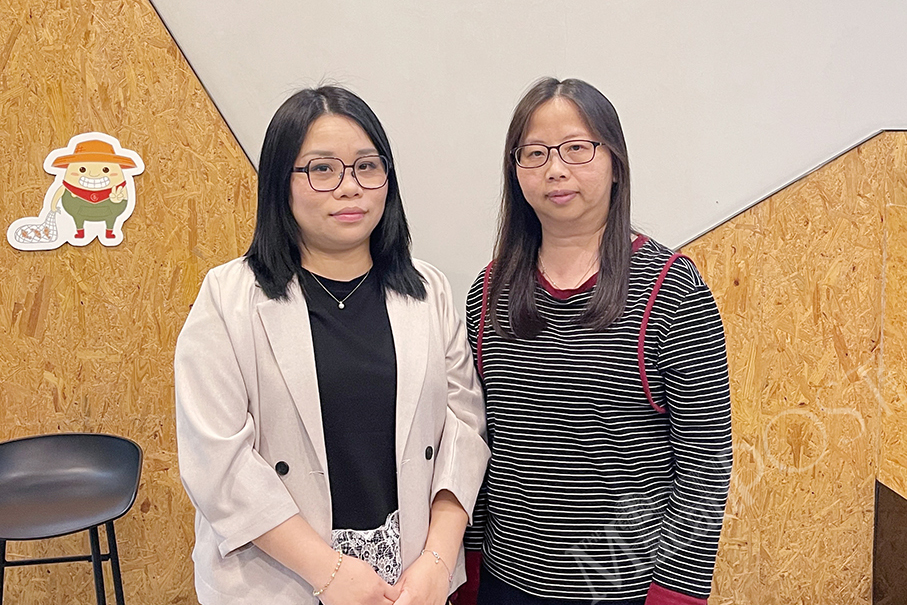
Clarissa Mok Chi Ian (right), in charge of the Bosco Youth Services Network’s Family Wellness Centre, and Michelle Chan Mei Ha, in charge of the Bosco Youth Services Network’s School Social Work Department, pose at the centre on Rua de Francisco António during their recent Post interview. – Photo: Armindo Neves