The University of Macau (UM) announced in a recent statement that it conducted a session of the Macao Humanities Forum featuring a lecture on the poetic sequence “Twenty Poems about Dunhuang”.
The lecture, titled “Land of Marvels: Twenty Poems about Dunhuang,” was delivered by Charles Sanft, professor of History at the University of Tennessee in Knoxville and guest professor at the Ludwig Maximilian University of Munich (LMU), the statement said.
Dunhuang is a city in northwestern Gansu Province, on the edge of the Gobi Desert that once served as a frontier garrison on the Silk Road, also known for its Mogao Caves.
The event was organised by the Faculty of Arts and Humanities (FAH), which was attended by students and faculty members, the statement noted. In his welcome remarks, FAH Assistant Dean Joaquim Kuong Io-Kei noted that the lecture focused on Chinese history and poetry, highlighting similarities between Macau and Dunhuang as cultural crossroads with rich artistic and literary traditions, the statement said, adding that Zhang Yue, another FAH assistant dean, also introduced Sanft’s academic background, noting his research on ancient Chinese history and culture.
Sanft, a sinologist who graduated from universities in the US and Germany, is the author of works including “Communication and Cooperation in Early Imperial China: Publicizing the Qin Dynasty” and “Literate Community in Early Imperial China: The Northwestern Frontier in Han Times”.
During the lecture, Sanft presented historical photographs of the Mogao Caves while discussing the theme of “topophilia,” describing the emotional bond between poets and the places they write about, the statement said, adding that he analysed selected poems from “Twenty Poems about Dunhuang”, emphasising how the works reflect both literal descriptions and metaphorical portrayals of social realities.
The Mogao Caves are also known as the Caves of the Thousand Buddhas or the Buddha Grottoes.
Sanft also noted that the first and final poems in the sequence echo one another, representing the poet’s inner journey and attachment to the place, the statement said.
During the Q&A session, Sanft discussed topics such as poetry translation and regional literary characteristics, the statement noted. Sanft said that effective translation requires balancing literal accuracy with explanatory notes while allowing readers space to interpret metaphors.
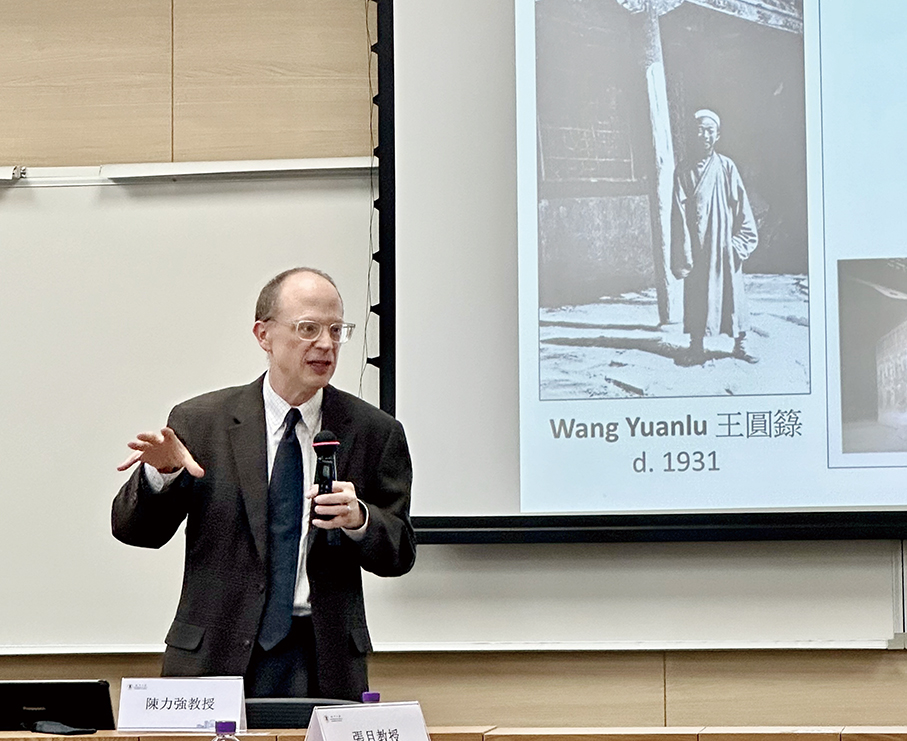
This handout photo provided by the University of Macau (UM) recently shows US sinologist and historian Prof. Charles Sanft lecturing on “Land of Marvels: Twenty Poems about Dunhuang” during the Macao Humanities Forum held at the public university in Hengqin on February 4.