Several local residents told the Post in a vox pop earlier this week that while the local government provides some support for people with disabilities (PWDs), more could be done to improve accessibility, employment opportunities, and social attitudes.
Twenty-four-year-old Tyron, a master’s degree candidate, said that although support exists, PWDs often lack visibility in society. “I think people with disabilities in Macau do not get enough visibility. Sometimes when you see PWDs out on the streets, people, particularly the older generation, tend to stare at them,” he said. Tyron acknowledged that the government provides financial support and that organisations such as Caritas offer training programmes, but noted that public attitudes can range from positive to apathetic.
Tyron also recalled seeing commuters express impatience when a wheelchair user boarded a public bus during rush hour. He complained that some passengers “cannot stand having to wait two minutes”. Regarding infrastructure, Tyron said transportation is relatively accessible, especially the Light Rapid Transit (LRT), but pavements in older districts can be too narrow for wheelchair users. He added that employment opportunities remain limited for PWDs.
Meanwhile, a student from a private school nicknamed “Jarhead”, 16, shared a more positive view, citing his personal experience with a family member who has a disability. “I believe that the government and the community do support people with disabilities. I, for one, have an older sister who has a disability and she’s been taken care of very well,” he said, mentioning benefits such as free bus fares, housing and activity programmes. However, “Jarhead” also acknowledged that social attitudes can still be challenging, noting that some people “publicly humiliate or even bully or mock” individuals with disabilities.
Moreover, Jessica, a 25-year-old university student, said that Macau generally does well in accommodating people with a disability, but accessibility remains limited in older neighbourhoods. “In older areas, it seems to be scarce,” she said, suggesting that more improvement projects should focus on historic districts.
Twenty-three-year-old Ela, who declined to reveal her occupation, pointed out that subsidies and services exist but may not always be easy for people to access independently. “Some may only benefit if a caretaker or close family member can help them apply,” she said, adding that narrow and uneven pavements in parts of Macau remain a major accessibility challenge.
Ela also said that PWDs may struggle to find employment because companies often prioritise efficiency and speed. “I think the most reoccurring challenge they may face is that people judge them every day, give disapproving looks and keep their distance instead of being kind and open,” she added.
Khaela, a 21-year-old university student, said that although government assistance is available, community support can sometimes fall short. “While benefiting from government aid, it does not overall cover all essential needs for every resident,” she said, also highlighting issues such as loneliness and financial pressure among vulnerable groups. Khaela added that even when inclusivity policies exist, PWDs may still struggle to secure employment due to health conditions or age.
Overall, the vox pop interview suggests that Macau has made progress in supporting PWDs, but further improvements in accessibility, job opportunities and public awareness could help create a more inclusive society.
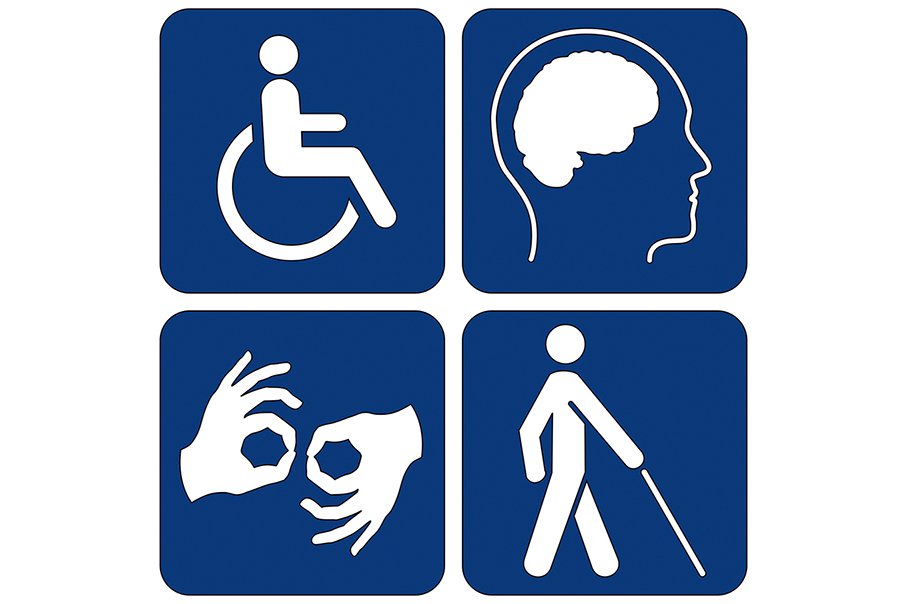
This image downloaded courtesy of Wikimedia shows four disability symbols.