The public Macao Polytechnic University (MPU) announced in a statement yesterday that its research team from the Centre for Artificial Intelligence-Driven Drug Discovery, Faculty of Applied Sciences, has made significant progress in the field of AI-assisted drug development for Alzheimer’s disease.
The statement pointed out that the research team consists of Prof. Yao Xiaojun, Prof. Liu Huanxiang, Lecturer Zhang Qiangian from the MPU AI centre, and doctoral student Gong Xiaoqing.
The statement noted that through a systematic review, the research team comprehensively analysed the latest groundbreaking applications of AI and computational methods in Alzheimer’s disease drug development, providing important theoretical support for accelerating drug research in this area.
The statement added that the team systematically reviewed innovative applications of AI and computational methods in Alzheimer’s disease drug development, with a particular focus on the entire process from target identification and molecular design to precision clinical medicine.
The review suggests that future therapeutic approaches for Alzheimer’s disease will increasingly emphasise multi-target drug (MTDs) design and precision medicine to achieve efficient and low-cost treatment solutions, offering valuable insights for research into innovative treatment strategies for Alzheimer’s disease, the statement said.
The research findings have been published under the title “Application of computational methods in the drug discovery and development of Alzheimer’s disease” in the internationally renowned journal Acta Pharmaceutica Sinica B, according to the statement.
The full content of the research findings can be found at https://doi.org/10.1016/j.apsb.2025.07.038.
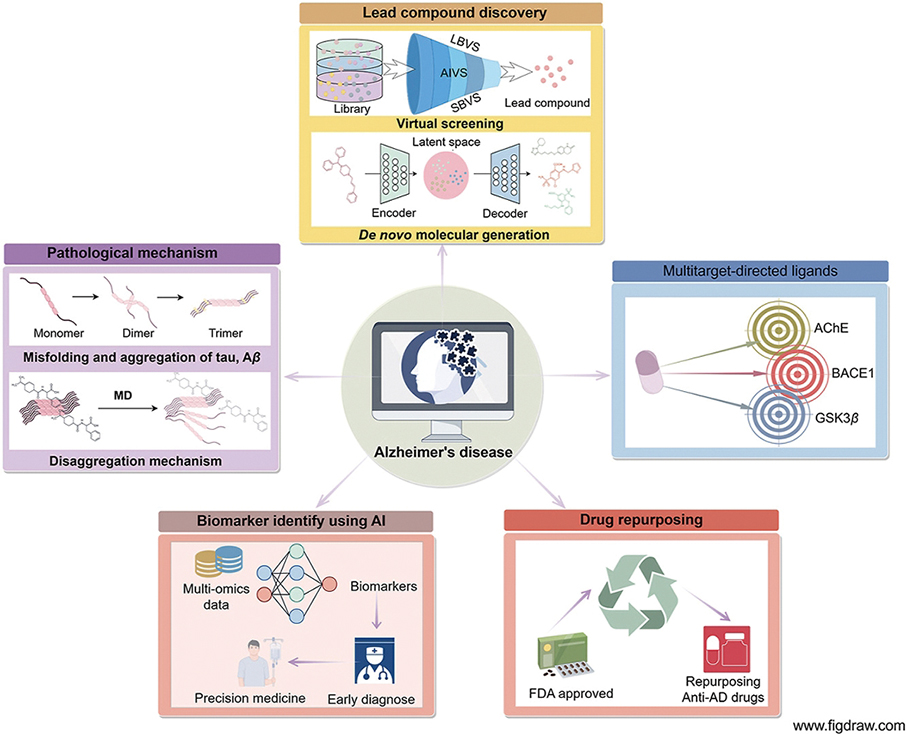
This image provided by the Macao Polytechnic University (MPU) yesterday shows how artificial intelligence (AI) assists Alzheimer’s drug development progress.