Secretary for Economy and Finance Anton Tai Kin Ip said yesterday that the local government’s ongoing efforts to promote deeper integration among culture, tourism and commerce in Macau is set to inject new impetus into the city’s appropriate economic diversification.
Tai made the remarks while delivering a speech at the opening ceremony of the 6th China-Central and Eastern European Countries (CEEC) Cultural and Creative Industry Forum held at the Wynn Palace integrated resort in Cotai yesterday.
The forum, which also includes the International Conference on Creative Economy and Trade Development, was jointly organised by Beijing International Studies University, the Macau-based Silk Road Satellite Television, and the newly established Macau-based International Creative Economy and Trade Organisation.
The three-day event started on Monday and is scheduled to end today, with its opening ceremony held yesterday.
In his speech, Tai noted that the global development landscape is currently undergoing profound transformation, because of which, he said, “strengthening dialogue, deepening cooperation, and jointly promoting innovation” are the inevitable choices to tackle challenges and seize opportunities, adding that the creative economy* is not only a “new engine” driving economic recovery and transformation but also a “golden key” promoting dialogue among civilisations and people-to-people connectivity.
Tai noted that the nation’s 15th Five-Year Plan, the implementation of which will start next year, lays out policies of leveraging culture to empower economic and social development, deepening mutual exchanges and learning among civilisations, and broadly promoting international cultural cooperation. The policy secretary said that all these have provided Macau with fundamental guidance for deepening international collaboration and driving industrial development.
Macau hosts for 1st time
Tai pointed out that the China-CEEC Cultural and Creative Industry Forum has been held in various countries, having become an important platform for gathering wisdom, aligning resources, and promoting cooperation. He said that hosting the forum in Macau for the first time not only represents a significant practice in jointly advancing the high-quality development of the nation’s Belt and Road Initiative (BRI), but also acknowledges Macau’s role as an international exchange platform.
The previous five editions of the forum were held in Serbia’s Belgrade in 2016, Beijing in 2017, Poland’s Lodz and Katowice in 2018, Hungary’s Budapest in 2019, and Bulgaria’s Sofia in 2024.
Tai noted that as an important node of the BRI, Macau possesses a unique history of over 400 years of cultural exchange between China and the West, enabling the city to leverage its unique role in promoting international economic and trade cooperation and stimulating innovative inspiration.
Tai underlined that with the central government’s strong leadership and support and with Macau’s institutional advantages brought about by the implementation of the “One Country, Two Systems” principle and its blending of Chinese and Western cultures, the local government is vigorously advancing its “One Centre, One Platform, One Base” campaign.
The Macau government’s “One Centre, One Platform, One Base” concept refers to Macau developing itself into a World Centre of Tourism and Leisure, a commercial and trade cooperation service platform between China and Portuguese-speaking countries, and an exchange and cooperation base with Chinese culture as its mainstream and co-existence of different cultures.
Tai said yesterday that one of the “One Base” component aims is to promote deeper integration among culture, tourism, and commerce, injecting new impetus into Macau’s appropriate economic diversification.
Tai also underlined the local government’s commitment to developing the city into a high ground for gathering international high-end talent, with the aim of pooling intellectual resources and innovative energy across the globe.
Tai also stressed the local government’s ongoing efforts to improve the policy environment in order to attract creative talent and enterprises, while vigorously planning the establishment of its Macau International Integrated Tourism and Cultural Zone project and its Macau Science and Technology Research and Development Industrial Park project, with the aim of providing more comprehensive hardware facilities for Macau to further promote international cultural exchange and trade cooperation and support the development of cutting-edge projects.
Tai said that the local government expects Macau to be able to make greater contributions to promoting creative economic collaboration and cultural exchange between China and Central and Eastern European countries and even the rest of the world.
*The creative economy is an economic system where value is generated primarily from human creativity, intellectual property, knowledge, and cultural heritage. It transforms ideas into tangible goods, services, and experiences, often protected by copyright, patents, and trademarks. It is not just about the arts or culture in isolation, but about the intersection of creativity, commerce, technology, and innovation. – DeepSeek
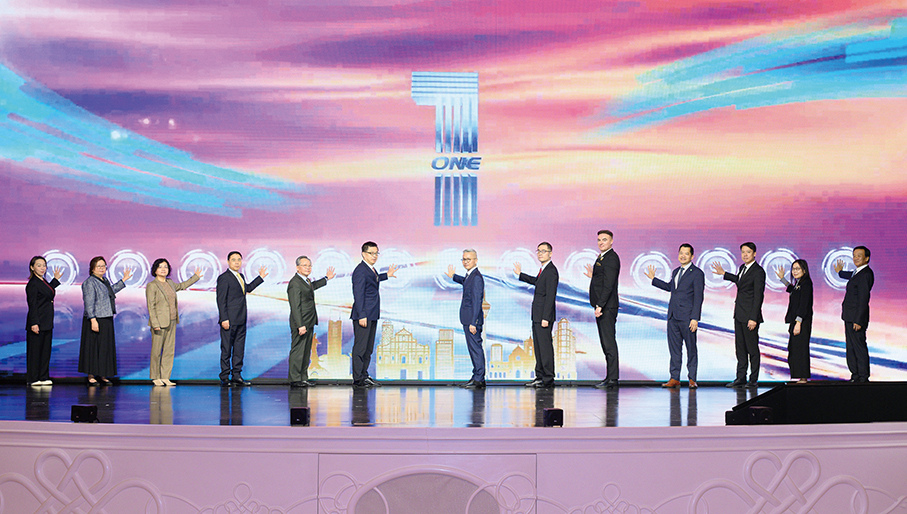
Dignitaries and others symbolically launch the 6th China-CEEC Cultural and Creative Industry Forum during yesterday’s opening ceremony at the Wynn Palace integrated resort in Cotai, such as Secretary for Economy and Finance Anton Tai Kin Ip (centre), Foreign Ministry Deputy Commissioner Cheng Lei (sixth from right), and Wan Sucheng (sixth from left), who heads the Publicity and Culture Department of the Central People’s Government Liaison Office. – Photo: GCS