Secretary for Transport and Public Works Raymond Tam Vai Man said yesterday that 800 new taxis are scheduled to gradually hit the road next year, raising the total number of taxis in the city to over 2,000.
The policy secretary also said that the government was planning to propose amendments to the current taxi law with the aim of enabling the establishment of a system for licensing private cars to provide online ride-hailing services.
Tam made the remarks during yesterday’s one-day Q&A session in the Legislative Assembly’s (AL) hemicycle about his portfolio’s policy guidelines for next year.
According to the latest data on the Transport Bureau’s (DSAT) website, at the end of the third quarter, there were 1,573 taxis in service in the city, comprising 1,273 “common” taxis and 300 “special” taxis.
Common taxis – as opposed to special radio taxis – are colloquially known as “black taxis” (“hak dik” in Cantonese), as the colour of the common taxis is black.
Currently, the city’s common taxis are either operated by licenced individuals or companies.
The government granted two concessions for the city’s radio taxi services, which were granted to the same company, Macau Radio Taxi Services Limited, at two different times. The first concession, with 100 radio taxis (blue), commenced on April 1, 2017 and expired on September 30 this year, while the second concession, with 200 radio taxis (red), began on December 1, 2019 and is now scheduled to end on May 31, 2028.
The company’s radio taxis are officially known as “special taxis”.
The “blue” taxis, unlike their “red” counterparts, had a calling fee of five patacas.
Consequently, since October 1, the company has operated only 200 “special taxis”.
The company’s taxis, i.e., the red ones currently in operation, are not allowed to pick up those hailing a cab in the street. To use the company’s ride-hailing service, prospective passengers can phone its call centre or use its own mobile ride-hailing app.
In addition to being allowed to pick up passengers while travelling around the city, common taxis are also legally allowed to provide a radio taxi or online ride-hailing service. For instance, more and more common taxis have joined the online ride-hailing platform run by mainland web-mapping giant Amap since its launch in Macau earlier this year. Prospective passengers can use its taxi ride-hailing service through either the Amap mapping app or the MPay app (the mobile payment app run by Macau Pass).
According to the current law regulating the city’s taxi sector, which took effect in June 2019, only companies are allowed to bid for a licence to operate common taxis. Before the current taxi law came into force, common taxi-vehicle licences were granted to individuals.
Following a public tender process, the government granted 10 company licences last year to operate common taxis, valid for eight years, with each company to operate 50 vehicles. The 500 new common taxis have gradually come into service since late last year. Many of the 500 new common taxis were to replace the numerous taxi-vehicle licences having expired one after another over the past few years. This tender was the first one launched since the current taxi law took effect in 2019.
With the aim of increasing the number of common taxis in the city in a shorter time, the government decided in September this year to grant two more company licences to operate common taxis without launching a public tender, enabling 100 new taxis to hit the roads.
During yesterday’s Q&A session, Tam noted that there are currently over 1,400 taxis, comprising common and special taxis, in operation in the city. He said that 100 new common taxis are scheduled to come into service “in the near future”, adding that the government will also launch a public tender for the granting of new company licences to operate common taxis, involving 700 new vehicles expected to gradually come into service next year.
Tam noted that the number of taxis in the city will then increase by 800 in total to over 2,000.
Moreover, Tam said, the future 700 new common taxis will also include a number of wheelchair-accessible taxis, raising the number of such taxis from the current 7 to 28.
Macau’s current seven wheelchair-accessible taxis are all operated by Macau Radio Taxi Services Limited.
Legislation on online ride-hailing services
Meanwhile, Tam also said that the government is planning to propose amendments to the current taxi law with the aim of “creating favourable conditions” for the establishment of a system for licensing private cars to provide online ride-hailing services.
Tam said that the government will launch a public consultation about the proposed amendments. After the consultation process, he said, the government will start drafting the legislation.
Amendments to laws proposed by the government must be passed by the legislature to take effect.
LRT network’s expansion
Meanwhile, Tam also revealed during yesterday’s Q&A session that the government has completed drafting a plan to expand the city’s Light Rapid Transit (LRT) network in the long term, adding that the government will launch a public consultation on the matter in the near future, when the plan’s full version will be released.
Tam yesterday revealed basic details of the plan, according to which the government proposes to build an LRT South Line, running from the Hong Kong-Zhuhai-Macao Bridge’s (HZMB) Macau checkpoint to the future ES5 station in the Zone A land reclamation area (a station of the ongoing LRT East Line project), from where it would run to the peninsula’s Nam Van and Sai Van districts via Nape before finally arriving at Barra.
The LRT East Line is scheduled to open in 2029.
According to the plan, Tam said, the government proposes to build an LRT West Line, connecting the Qingmao pedestrian border checkpoint in Ilha Verde with Fai Chi Kei, from where it would run along the Inner Harbour to Barra at the peninsula’s south-western tip.
Basic details of the proposed South Line and West Line were first revealed by Tam to lawmakers earlier this year.
Tam revealed yesterday that the plan also proposes building a Taipa North Line, running from the future ES6 station in the Zone E1 land reclamation area (a station of the ongoing LRT East Line project) to the future Zone D land reclamation area (reclamation scheduled to be completed in November 2029), to the current Zone C land reclamation area (reclaimed but not yet developed), and to the current Ocean Station located near the Ocean Gardens residential estate.
According to Tam, the plan also proposes building a spur line on the current Seac Pai Van Line, connecting Coloane’s sprawling Seac Pai Van public housing estate and Coloane Village.
Tam also said that the proposed Seac Pai Van Spur Line can be expected to get off the ground earlier than all other proposed lines as it is the least difficult one. He said that the proposed Seac Pai Van Spur Line, which will serve Coloane Village, will benefit residents living there as well as Macau’s tourism a great deal.
Tam also said that as the future East Line and South Line will be underground lines, they can remain operational during the hoisting of the No.8 typhoon signal.
Meanwhile, Tam also said that the government aims for the ticket gates at LRT stations to be able to accept mobile payment apps in the third quarter of next year.
Currently, LRT passengers can merely swipe their stored-value LRT card or Macau Pass card at the ticket gates.
Study on peninsula-Taipa tunnel
Meanwhile, Tam also said that the government will relaunch a study on the feasibility of building the fifth sea-crossing link between the peninsula and Taipa.
Tam said that with the launch of the Zone D land reclamation project, this time the government was planning for the fifth link to connect the peninsula’s Nape and Zone D off Taipa’s northern coast.
Tam underlined that the fifth link can be expected to relieve the traffic pressure in Nape.
He said that the fifth link would be a tunnel.
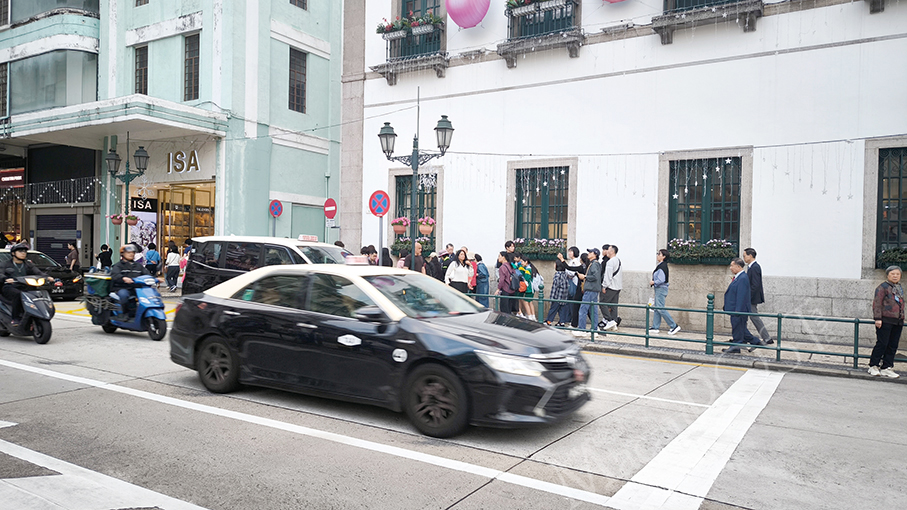
Taxis are driven along Avenida de Almeida Ribeiro, the city’s main thoroughfare, yesterday. – Photo: Tony Wong

Secretary for Transport and Public Works Raymond Tam Vai Man addresses yesterday’s Q&A session about his portfolio’s 2026 policy guidelines in the Legislative Assembly’s (AL) hemicycle.
– Photo: GCS