The government’s 7-day “Golden Week pedestrianisation” concluded in the peninsula’s Laahn Gwai Lau old quarters about a month ago, and last week the Post talked to F&B staff in the area about what their thoughts on it.
The temporary pedestrianisation drive, according to a Macau Government Tourism Office (MGTO) statement on September 29, aimed to create a comfortable and safe pedestrian environment for residents and tourists alike during the Chinese mainland’s National Day Golden Week holiday, and also to stimulate the community economy in that area.
The pedestrianisation was in effect between October 1 and October 7, between 12 noon and 7 p.m. daily, in Rua de Nossa Senhora do Amparo (關前後街) – a narrow street colloquially known in Cantonese as “Laahn Gwai Lau (爛鬼樓).
“Laahn Gwai Lau” (爛鬼樓), which literally translated means “Rotten Devil Building”, is a sarcastic nickname for a dilapidated tenement building long gone, in the neighbourhood close to Rua dos Mercadores (營地大街) which is part of the UNESCO-listed Historic Centre of Macau.
The Post interviewed several food and beverage staff members working in the “Laahn Gwai Lau” area last Thursday about their response to the temporary arrangement.
Two coffee shop baristas said that the pedestrianisation zone established during the “Golden Week” had had a negative impact on nearby businesses.
They pointed out that the road closures diverted pedestrian traffic, ultimately reducing footfall. Instead of the expected holiday crowds, the area remained as quiet as on a regular weekday, they said.
The duo said they believe the measure was ineffective and suggested that if the government pedestrianises certain streets in the future, they should target main streets such as Rua dos Ervanários (關前正街) to better attract visitors.
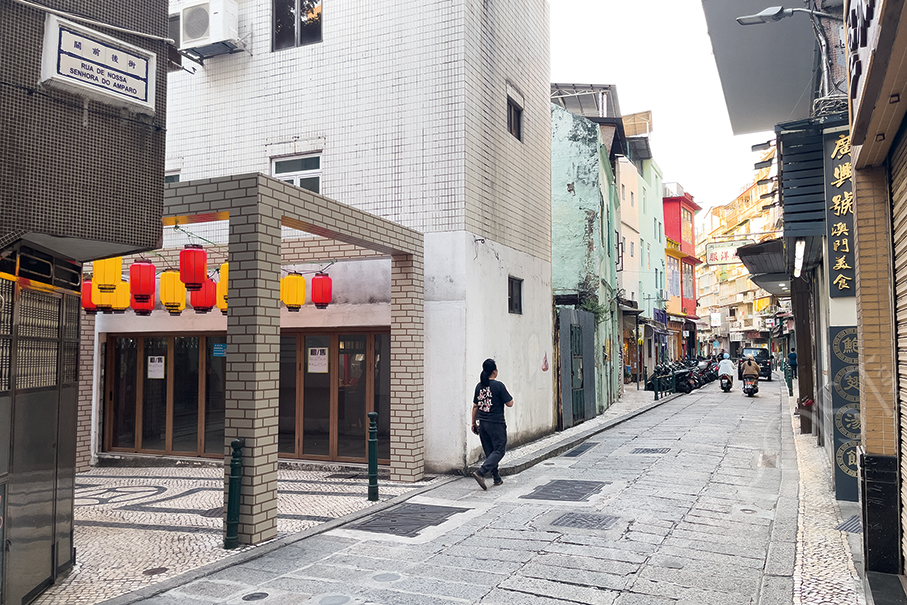
Pedestrians walk past shops on Rua de Nossa Senhora do Amparo in the UNESCO-listed Historic Centre of Macau’s “Laahn Gwai Lau” neighbourhood last Thursday. – Photo: Armindo Neves
A bubble tea maker said that the pedestrianisation zone implemented during the “Golden Week” had limited practical effect.
Although the zone increased foot traffic in front of the store, most pedestrians merely walked past without making any purchases, leading to an actual decrease in consumer spending, she said.
Compared to a narrow street such as Rua de Nossa Senhora do Amparo, she said, holding events on thoroughfares such as Rua dos Ervanários would be more effective in attracting customers to the area as a whole and stimulating consumption there. She also said that the Golden Week pedestrianisation ultimately turned out to be a waste of resources and failed to effectively boost business in the area.
However, a ramen chef said that the dedicated pedestrianisation zone during the Golden Week positively affected his business. “The road closure led to a doubling of pedestrian flow,” he said.
The chef explained that before the zone was set up, the narrow pavement in front of his premises had deterred customers, who preferred walking on the wider, opposite side for safety reasons.
He said that the pedestrianisation zone significantly boosted his number of customers and their inclination to patronise his restaurant.
Having benefited from the initiative, he voiced clear support for continuing the pedestrianisation drive during long holidays such as the mainland’s “Golden Week” periods.