A one-day cleanup campaign at the traditional Pátio do Espinho community, funded by the Municipal Affairs Bureau (IAM) and organised by the Chi Lam Vai Concern Group, took place yesterday, Ip Tat, the convener of the group and president of the Na Tcha Temple Association, told the Post and Macao Daily News during the cleanup yesterday, stressing that the initiative aimed to optimise community spaces.
Pátio do Espinho (茨林圍 – Chi Lam Vai – in Cantonese), is a 400-year-old, formerly walled village that lies just a street away from the UNESCO World Heritage-protected Na Tcha Temple, one of Macau’s two temples dedicated to the divinity known in Putonghua as Nezha. It is also close to the UNESCO World Heritage-listed Ruins of St Paul’s.
According to Ip, the cleanup drive included removing old trees at risk of collapse and trimming branches that could affect surrounding lanes. It also aligned with government policies on preventing the infectious dengue fever and Chikungunya disease by clearing areas prone to mosquito breeding, Ip said.
Ip noted that half of the funding was allocated to hiring professional cleaning services, while the other half was earmarked for community greening projects. He emphasised that besides the contracted cleaners, residents also voluntarily participated in the cleanup effort.
Ip also said that the second phase of a one-month cleanup project for an ancient well in the village will commence on November 3 or 4. He explained that the well requires restoration because 40 years ago, workers from a nearby construction site illegally dumped construction waste into it. Ip pointed out that during the first phase of cleanup, nearly over eight feet (2.44 metres) of discarded materials were removed. Ip said he hoped that the well one day will be restored to its original state.
When asked about the recent market held in the square in front of Na Tcha Temple next to the Ruins of St. Paul’s, Ip said that the market has helped attract visitors to Chi Lam Vai, allowing tourists to explore the area and learn about its history and stories. The market will conclude on October 25.
According to “Anecdotes of Macao” by Wang Wenda, and “Cadastro das Vias Públicas de Macau” (“Macau Public Road Registry”), the name of “茨林 (“Chi Lam” in Cantonese) has two meanings. The one from Wang’s book is said to derive from the Japanese living in the village when settlers in Chi Lam Vai cleared land to cultivate potatoes (馬鈴薯) as a food source, as the vast potato fields resembled a dense forest, thus giving the area its name. According to the registry, “茨林” also means there were a lot of thatched cottages located in the village. “Pátio do Espinho”, the Portuguese name of the village, means “Courtyard of the Thorn”.
Chi Lam Vai includes a café dedicated to the Taoist Na Tcha belief.
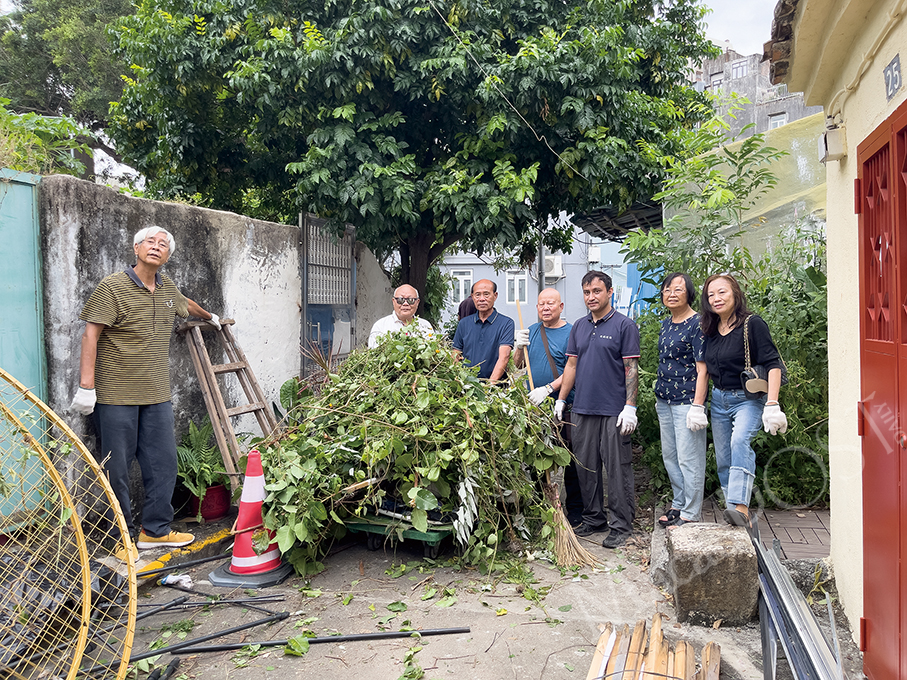
Macau General Union of Neighbourhood Associations (Kai Fong) Honorary President Leong Heng Teng (left), Chi Lam Vai Concern Group Convener-cum- Na Tcha Temple Association President Ip Tat (third from left), Chi Lam Vai villagers and a cleaning services company worker (third from right) pose during yesterday’s cleanup drive at Chi Lam Village. – Photo: Armindo Neves