Since Macau recorded its first imported case of Chikungunya fever at the end of July, as of yesterday, 24 imported cases and eight local Chikungunya* cases have recorded, bringing the total to 32, the Health Bureau (SSM) announced in special press conference yesterday.
The press conference, entitled “Dengue Fever and Chikungunya Prevention and Control”, was held at the bureau’s Public Health Emergency Personnel Residence Hall.
SSM Director Alvis Lo Iek Long said in a speech during the press conference that, considering the epidemic situation in neighbouring regions and the flow of people, the risk of imported Chikungunya fever cases in Macau remains persistent.
From July to September, the bureau has completed 5,300 inspections and clean-ups of stagnant water in high-risk neighbourhoods, carried out 1,228 routine chemical mosquito treatments at key sanitation locations, and performed chemical mosquito treatments at 200 risk sites, adding that body temperature screenings at border checkpoints have been strengthened, Dr Lo said.
Chan Choi Wan, who heads the bureau’s Communicable Disease Prevention and Control Division, pointed out that about 21,500 households have been briefed about mosquito prevention measures, of which 1,400 households were given in-home consultations, and the results revealed that, on average, mosquito larvae were found in containers at approximately 16 out of every 100 households inspected.
Moreover, Dr Lo urged residents to seek medical attention early if symptoms, such as fever, joint pain, and rash, appear and seek immediate medical attention, to consistently implement the “Three Key Mosquito Prevention Measures”**, and to cooperate fully with the government’s overall prevention, control strategy and specific implementation measures for Chikungunya fever by conducting indoor and outdoor mosquito eradication, adding that, currently, medical institutions across Macau are testing more than 20 persons for the disease daily.
Dr Lo added that his bureau has trained over 400 personnel from schools, private enterprises and the property management sector in mosquito eradication, as well as reserved about 300 mosquito eradication foggers. He also said that private enterprises had already reserved 40 foggers, while schools were in the process of procuring 198 foggers.
Dr Lo urged residents who live in mosquito-prone environments to stock up on items such as mosquito coils, mosquito spray, or mosquito traps, for ten days’ use.
SSM Disease Control and Prevention Centre Chief Leong Iek Hou added that over the past two weeks, 40 locations in Macau have been identified as potential risk areas for Chikungunya transmission, which are concentrated in the old quarters of the city, including the Inner Harbour, Ruins of St. Paul’s, and Barrier Gate areas, which all are also known for high tourist flows.
2 more local Chikungunya cases
Meanwhile, the Health Bureau announced in a statement on Saturday that it confirmed two more local Chikungunya cases, the 7th and 8th recorded in Macau so far this year, and one imported case, the 24th.
The statement noted that a 68-year-old local male, living in U I Kok Building on Istmo de Ferreira do Amaral (關閘馬路), developed a fever, muscle pain and fatigue on Thursday, and sought medical attention at the private Kiang Wu Hospital on Friday. On Saturday, the patient was confirmed to be the 7th local Chikungunya case.
A 62-year-old local woman, residing at Jardim de Luís de Camões Building on Rua da Gruta (洞穴街), developed a fever, rash, and foot pain on Saturday, and sought medical attention at the public Conde de São Januário Hospital Centre on the same day, when she was confirmed as the 8th local Chikungunya case, the statement said.
The statement pointed out that both patients were in a stable condition on Saturday, with no symptoms reported among their cohabitants, and no recent travel history. Laboratory tests by the Public Health Laboratory confirmed their Chikungunya virus infection.
In another case, a 68-year-old local female, who lives at Rua dos Hortelãos (菜園路), visited Kaiping City in Guangdong Province with her family from October 4 to October 8. She developed fever, joint pain and muscle pain on Friday and sought medical treatment at the public Conde de São Januário Hospital Centre on Saturday.
Laboratory tests by the Public Health Laboratory confirmed her Chikungunya infection. On Saturday, the patient was in a stable condition, with no symptoms reported among her cohabitants, based on the patient’s travel history, symptoms onset time, and laboratory test results, the statement said.
According to the statement, the case has been listed as the 24th imported case of Chikungunya fever this year.
*Chikungunya is a viral disease transmitted to humans by infected mosquitoes, primarily Aedes aegypti and Aedes albopictus (the same mosquitoes that spread dengue fever and zika).
The word “Chikungunya” comes from the Kimakonde language (spoken in Tanzania and Mozambique) and means “to become contorted” or “that which bends up,” describing the stooped posture of patients due to severe joint pain. In colloquial Cantonese, the disease is known as “wat gung beng”.
**The SSM website lists the following “Three Key Mosquito Prevention Measures” – (1) removing stagnant water regularly in workplace and residential environments, (2) installing window screens, mosquito nets, or air conditioning at home to reduce the chance of mosquito bites, (3) wearing light-coloured long-sleeved shirts and trousers, and applying insect repellent to exposed skin or clothing to prevent mosquito bites.

Health Bureau (SSM) Director Alvis Lo Iek Long poses during yesterdays’ press conference, entitled “Dengue Fever and Chikungunya Prevention and Control”, at the bureau’s Public Health Emergency Personnel Residence Hall.
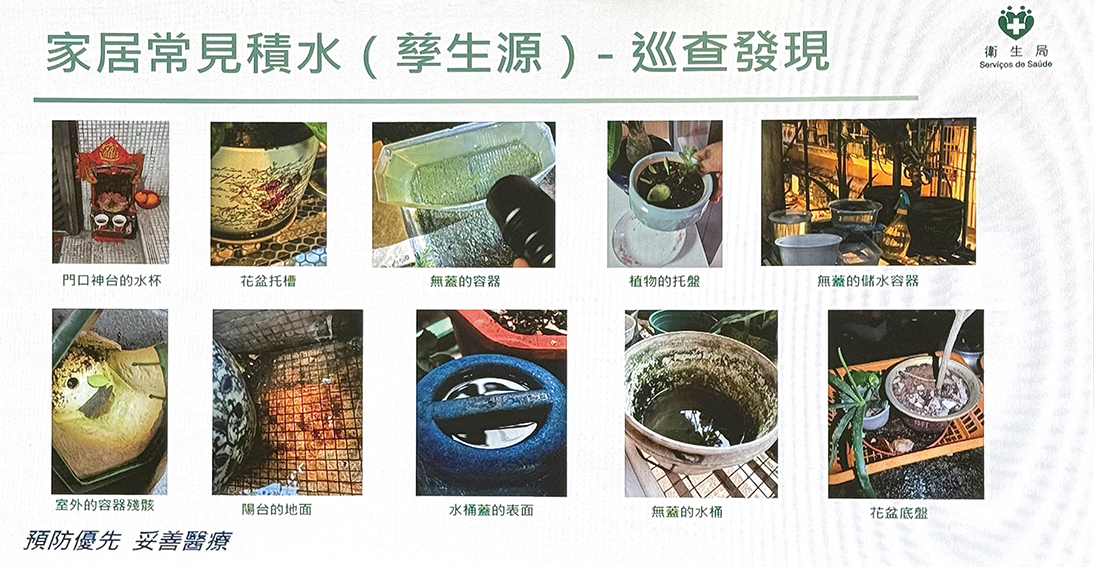
This power point presentation by the Health Bureau (SSM) yesterday shows mosquito larvae found in different types of containers in households during inspections by SSM inspectors. – Photos: Ida Cheong