The Cultural Affairs Bureau (IC) announced in a statement on Thursday that the exhibition proposal “Jacone’s Polyphony”* was chosen to represent Macau at the Biennale in Venice, northern Italy, in May next year for the “61st International Art Exhibition of La Biennale di Venezia – Collateral Event from Macao, China”.
The proposal, chosen among the six proposals received based on various criteria, was submitted by curators Feng Yan and Ng Sio Ieng, and was created by local artists Fok Hoi Seng, O Chi Wai, and Lei Fung Ieng.
According to the statement, the proposal focuses on “the creative trajectory and cultural integration and exploration of artist Wu Li (known in Portuguese as Jacone), who studied theology in Macau in the early Qing Dynasty”.
Wu Li (吳歷), according to chatbot Poe, was a prominent figure in Chinese history, particularly known as a poet and a painter during the late Ming and early Qing dynasties. He lived from 1632 to 1718 and travelled to Macau in the late 1600s.
“With ‘polyphony’ as the narrative logic, the work creates a multicultural dialogue across time and space between history and contemporary times”, the statement said, adding that it explores the integration of culture, faith, and spirit in the context of globalisation, altogether echoing the upcoming biennale’s theme “In Minor Keys”.
The statement said that curators Feng Yan and Ng Sio Ieng are active in contemporary art, while young local artists Fok Hoi Seng, O Chi Wai, and Lei Fung Ieng have taken part in notable international exhibitions and projects, adding that they are good at exploring cultural identity and cross-regional dialogue.
*Polyphony (which means “many sounds” in Greek) is a texture in music where two or more independent melodies are played or sung simultaneously.
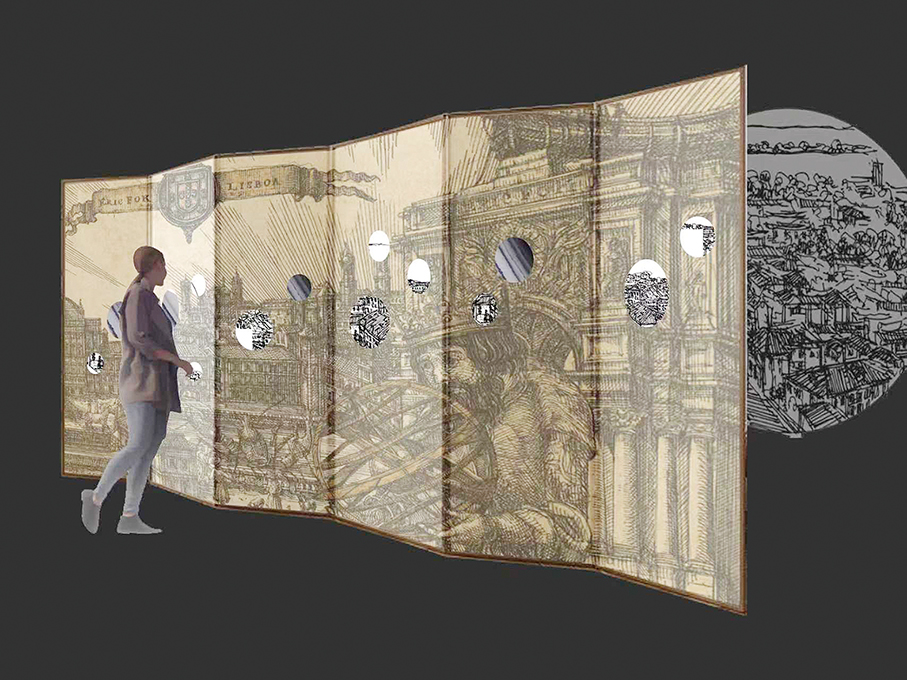
This image provided by the Cultural Affairs Bureau (IC) on Thursday shows an artist’s rendition of one of the exhibits for “Jacone’s Polyphony”.