The Health Bureau (SSM) announced in a statement that Macau yesterday confirmed its third imported case of malaria so far this year.
The bureau said it received a report confirming the case from the private Kiang Wu Hospital earlier yesterday.
The bureau identified the patient as a 39-year-old female non-resident-worker (NRW). She arrived in Macau from Myanmar via Thailand on June 2. On July 19, she developed a fever and sought medical attention at a local healthcare facility. As symptoms persisted, the patient was admitted to Kiang Wu Hospital yesterday where she was diagnosed with malaria.
The statement said that based on the patient’s travel history, symptom onset timeline, and laboratory test results, her case has been classified as imported malaria. The patient was in a stable condition yesterday, with no similar symptoms observed among her cohabitants.
The statement noted that malaria is a vector-borne communicable disease transmitted by infected female Anopheline mosquitoes.
Details in English about malaria can be found at: https://www.chp.gov.hk/en/healthtopics/content/24/30.html
Macau records year’s 1st Chikungunya case
Meanwhile, in a separate statement on Friday, the Health Bureau said in a statement that Macau recorded its first imported case of Chikungunya* so far this year.
The statement noted that the patient is a 61-year-old male Macau resident living at Cheng I Building on Avenida de Coelho do Amaral. He visited relatives in Shunde District, Foshan City, Guangdong Province, from July 8 to 17. On the morning of July 17, he came down with a fever, headache, and muscle and joint pain and returned to Macau the same day, seeking treatment at the public Conde de São Januário Hospital Centre (CHCSJ).
On Friday, laboratory tests by the Public Health Laboratory confirmed the patient’s chikungunya infection. The patient was in a stable condition on Friday and will remain hospitalised for further treatment. No symptoms have been reported among his cohabitants.
Based on the patient’s travel history, symptom onset timeline, and lab results, his has been confirmed as Macau’s first imported chikungunya case this year so far.
The statement noted that Chikungunya is most commonly transmitted to humans through the bites of infective female Aedes mosquitoes.
The statement said that the bureau would dispatch teams to inspect the patient’s home and nearby areas for mosquito breeding sites, intensify stagnant water removal, and conduct preventive mosquito control measures as needed.
Details in English about Chikungunya can be found at: https://www.chp.gov.hk/en/healthtopics/content/24/6122.html
* Chikungunya is a viral disease transmitted to humans by infected mosquitoes. The name “Chikungunya” derives from a word in the Kimakonde language (spoken in Tanzania and Mozambique), meaning “to become contorted”, referring to the severe joint pain and stiffness that characterise the infection. – DeepSeek
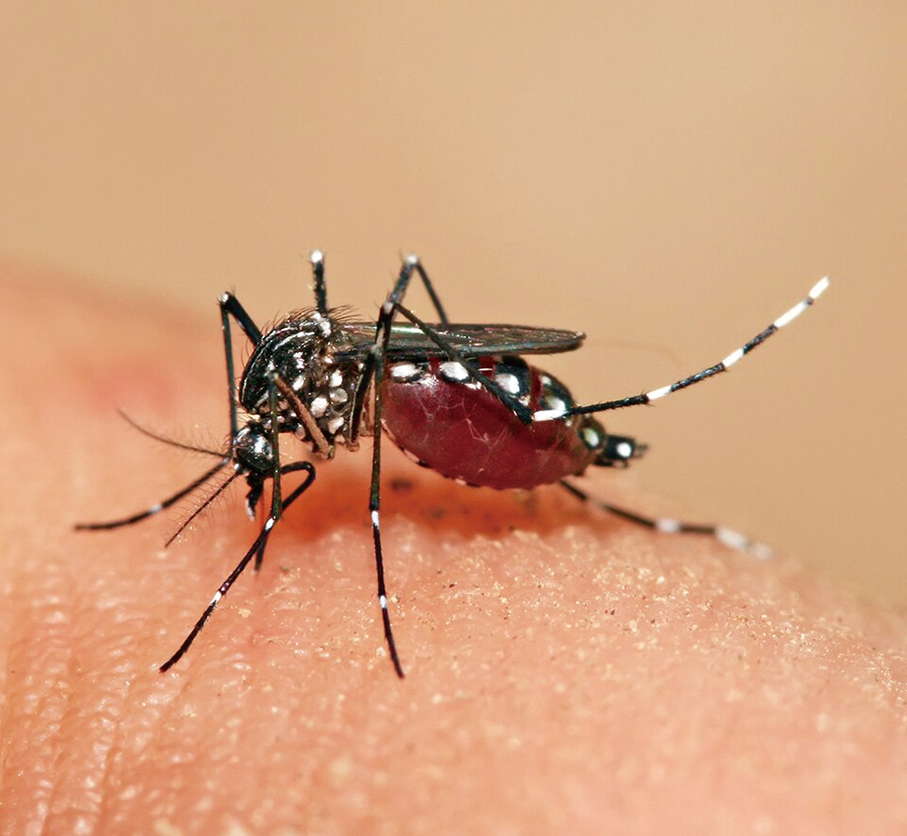
This 2009 file photo shows an Aedes aegypti mosquito feeding in Dar es Salaam, Tanzania. – Photo courtesy of Muhammad Mahdi Karim/Wikimedia Commons